In 2010, I accompanied a group of Pearl Harbor Survivors during an annual Armed Forces parade in my hometown. The reaction of the crowd to this small group of heros showed me just how much Americans value the men and women who served our country during WWII and solidified my desire to write War Bonds.
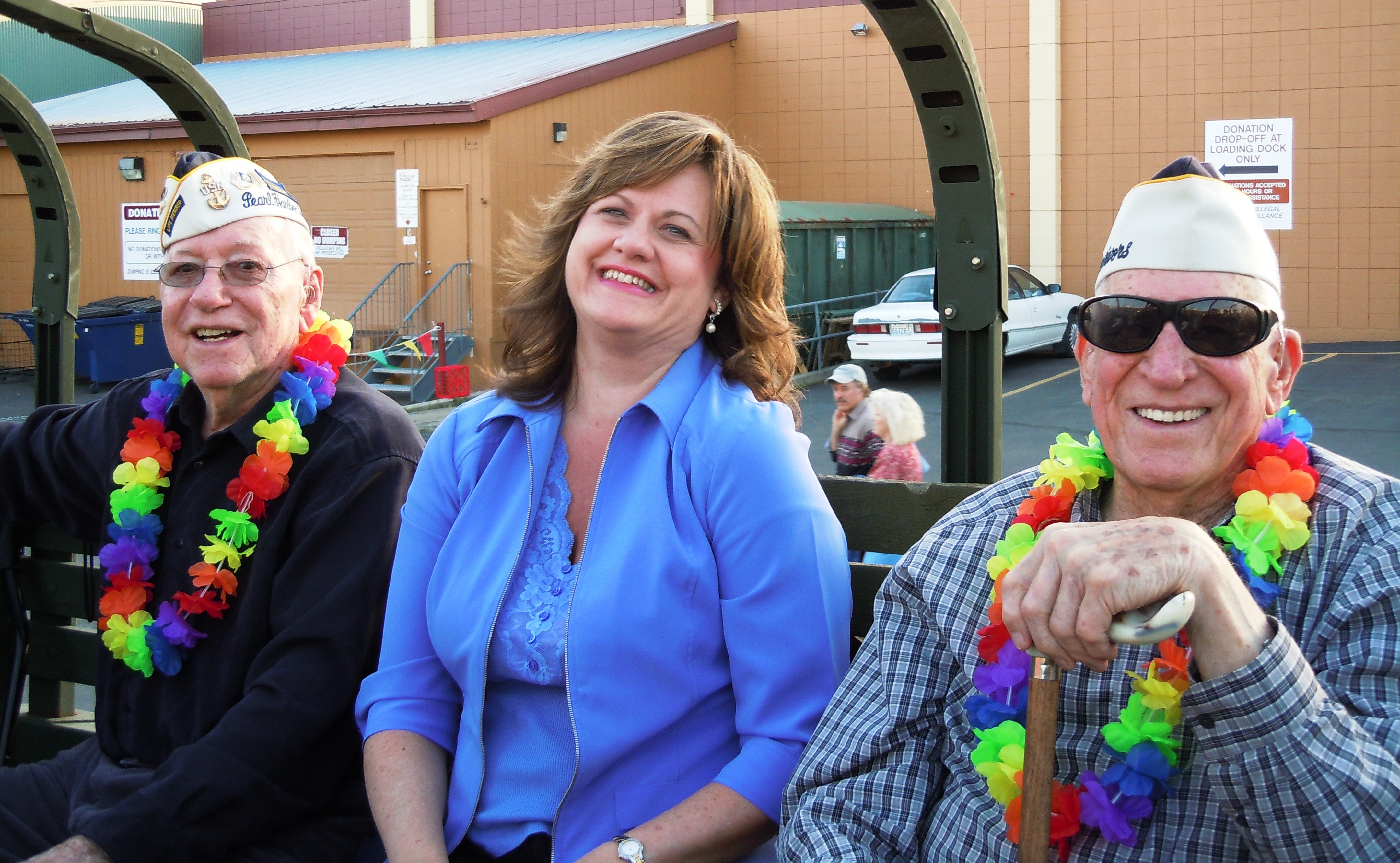
Here’s the column I wrote about that event.  Ray Daves, Cindy Hval and Denis Mikkelsen
When I received an invitation to appear in this year’s Armed Forces Torchlight Parade, I had mixed feelings. My only previous parade experience hadn’t gone well.
In seventh grade I rode on our church youth group’s float in Moses Lake. The theme? Daniel in the Lion’s Den. I had a major crush on the guy chosen to be Daniel, so I agreed to ride on the float. I pictured myself as one of the angels sent by God to shut the lions’ mouths. Instead, they made me a lion, complete with furry suit and painted-on whiskers. My mane was made of cardboard, and I kept poking my fellow feline’s eyes with every turn of my head.
Did you know Moses Lake gets very warm in the spring? I sizzled and sweated through the parade and my black whiskers ran like polluted rain down my cheeks. Then I started sneezing. The “den” was made out of hay bales, those being plentiful in Moses Lake. That’s how I found out I’m allergic to hay. By the end of the parade my eyes were swollen shut, and “Daniel” hadn’t even noticed me growling at his feet.
However, the Torchlight parade would be different. The theme was “Freedom is not Free,” and instead of a float made of hay bales I’d been ask to accompany the Pearl Harbor survivors on a military truck. I’ve written several stories about these incredible folks over the years, and they’ve kind of adopted me. I was so honored by the invitation, I would have said yes even if they wanted me to wear a lion costume.
So on parade day, I boarded the truck with five Pearl Harbor survivors ranging in age from 86 to 93. Among them: Warren and Betty Schott, who were both on Ford Island when the bombs began to fall.
Denis Mikkelsen who was sleeping aboard the USS West Virginia and woke to the sound of chaos. When the order came to abandon ship he dived into the harbor.
Sid Kennedy at the Naval Air Station Kaneohe, watched the planes swoop in. “Look at the show the Army’s putting on,” he’d said. Then he saw the red circles on the aircrafts’ wings.
And Ray Daves was on his way to breakfast when he looked up to see the first bomb hit Ford Island. He prayed, “God, don’t let it get my friend, Jim.”
The memories of Dec. 7, 1941, are seared into the minds of this small band of survivors. Each year their number dwindles, yet those who are able agree to appear in the parade, not for cheers or accolades, but to honor the thousands of Americans who did not survive the attack on Pearl Harbor.
Joining us on the truck were the survivor’s family escorts and Jean Flechel, widow of a Pearl Harbor survivor. The sun warmed us as we waited for the start of the parade and at last we began our slow trek through city streets.
Much has been said and written about the decline of patriotism in America and how younger generations don’t seem to honor the flag and our country the way our forebears did.
This may be true, but it certainly wasn’t what I observed that night. Almost without exception men, women and children leapt to their feet as our truck went by. Teenage boys took off their ball caps, men saluted or put their hands over their hearts and the applause was deafening. Amid the clapping I heard shouts of, “God bless you!” and “We love you,” but mostly what I heard were these words shouted over and over again: “Thank you! Thank you for your service.”
I heard teenage girls scream as if Justin Bieber was in town. I watched grown men weep and small children wave and clap while others stood somberly at attention as the truck passed.
Some may believe our country has lost its way and its citizens no longer value the tenets upon which our nation was built. But what I experienced in the company of American heroes that night, filled me with hope.
Maybe we haven’t forgotten what is most important, after all.

![10422185_893106567394638_6786212745801728891_n[1]](https://cindyhval.com/wp-content/uploads/2015/05/10422185_893106567394638_6786212745801728891_n1.jpg) For our family Memorial Day has always meant more than a three-day weekend. The holiday used to be called Decoration Day and that’s what we still honor. We deocrate the graves of my father and father-in-law and pause to remember those who gave their lives in service to their country.
For our family Memorial Day has always meant more than a three-day weekend. The holiday used to be called Decoration Day and that’s what we still honor. We deocrate the graves of my father and father-in-law and pause to remember those who gave their lives in service to their country.![11329851_893090864062875_1191597299310324384_n[1]](https://cindyhval.com/wp-content/uploads/2015/05/11329851_893090864062875_1191597299310324384_n1.jpg)


 Cindy Hval