Columns

Father, Faith, and Friendship

I miss him most in March.

His birthday is March 25, 1927, and he died on March 29, 1995.

My siblings and I could write volumes about our dad, Tom Burnett. Born in Mississippi and raised in Arkansas, he traveled the world courtesy of the U.S. Air Force but never lost his slow Southern drawl.

While stationed at Fairchild Air Force Base, he met my mom, Shirley Schmidt, who’d grown up in Hayden, Idaho. They both believed it was a “God thing.” He saw her singing in the choir at Glad Tidings Assembly of God and said the Lord told him, “That’s going to be your wife.”

It didn’t take Dad long to convince her.

To know my dad was to love him – and as an unabashed extrovert, he knew a lot of people. Mom and I would leave him on a bench at the mall. By the time we returned he’d say, “Hey girls, I want you to meet my friend …”

Young moms with babies in strollers, teenagers, other dudes waiting for their womenfolk – he’d befriend them all.

When people share their memories of Tom Burnett three things are invariably mentioned: his sense of humor, his devout faith, and his abiding love for my mother.

Recently, I got to see him through someone else’s eyes. While writing a story about a North Central High School reunion I was put in touch with Christine Glenn. Her parents, Chuck and Dorothy Glenn were my parents’ closest friends in the early 1950s.

In fact, if not for my dad, Christine might not even be here.

“My father would often recount his memories of how your father invited him to church and introduced him to the Lord, and also to Dorothy, my mother,” she said.

Mom, Dad, Chuck, and Dorothy

Chuck was from Montana and had enlisted in the Air Force and was sent to Fairchild. He walked into his new quarters and looked for a bunk. The place was empty except for one G.I. relaxing on a bed and reading his Bible. That G.I. was my dad.

“Tom greeted him and said, ‘The top bunk is empty. You can have that one,’ ” Christine recalled her dad saying.

The pair quickly became fast friends though initially, they didn’t seem to have much in common.

“Dad said Tom was always reading his Bible or talking about his Jesus and inviting him to church,” Christine said.

Chuck wasn’t a Christian and always had an excuse to avoid church until one day he didn’t and agreed to attend with Dad.

Two things happened quickly, Chuck became a Christian and he badgered my dad into introducing him to a cute redhead – my mom’s best friend, Dorothy Nicholl.

Mom has a scrapbook filled with photos of the four of them double dating. Picnicking at Manito Park and Tubbs Hill, posing by the falls, dressed up for church, and playing croquet at my grandparent’s Hayden home.

By this time my parents were already engaged and Chuck soon proposed to Dorothy.

“They picked out an engagement ring and Mom loved it,” Christine said.

But then my dad stepped in.

“Tom went with my dad to make a payment on the ring,” she said. “And he said, ‘Oh! I know a place where you can get one a lot cheaper!’ ”

I should mention my father’s Scottish ancestry. Tom Burnett loved a good deal and he always seemed to “know a guy” who could get him deals on everything from autos to asparagus. In this case, he introduced Chuck to the jeweler who’d made my mother’s engagement ring.

“Tom and Dad picked out Mom’s new engagement ring,” Christine said. “She never liked it. She was so disappointed.”

Dorothy died in 2014 and Christine now wears that ring. “Well, I dressed it up a little,” she said.

Another story Chuck liked to tell was how my Dad helped him find his wallet.

The four of them had been on a date at Lincoln Park. After they took the girls home, Chuck realized his wallet was missing.

“He and Tom went back to the park with flashlights and Tom found his wallet,” Christine said.

The two couples were in each other’s weddings but gradually lost touch when my dad made the military his career and was posted everywhere from Kansas to the Philippines.

Dad died in 1995, and Chuck died in July, but he never forgot my dad.

“He always said Tom was his best friend,” Christine said.

I think a lot of people felt that way.

I know I did.
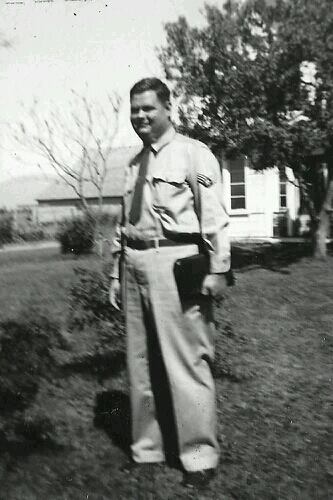
Tom Burnett

Columns

Base Life: Military BRATS reflect

He walked in the door after work and dropped his Air Force cap on my head.

I don’t remember the moment, but my Mom snapped a photo. Toddler me gazes up at the camera, sassy-like, because how can you not feel sassy when you’re wearing Daddy’s cap and shoes with bells on them?

CIndy at two.

It was 1967, and we were living at Andersen Air Force Base on Guam. My memories of island life are few.

A spill off a swing that resulted in impacted sand in my eye and a trip to the E.R.

My oldest brother holding me over his head so I could put my feet on the ceiling and “walk like a gecko.”

The smashing, crashing sounds of tropical storms that battered our lanai and tossed our metal garbage cans into the street.

Our next duty station was Vandenberg AFB (now Vandenberg Space Force Base) in Santa Barbara County, California.

Again, my memories are fleeting.

Our first family dog – a mutt we named Riley.

Getting mad at my mom and hopping on my red tricycle. “I’m going back to Guam!” I yelled. Then I got to the end of the block and had to turn around. I wasn’t allowed to cross the street without a grown-up.

My first visit to Disneyland. The Tea Cup ride made me barf. It also made Dad queasy.

My early childhood was steeped in military life and ritual and in my last column about time spent at Fairchild AFB; I invited readers to share their memories of life on a military base.

Steven Stuart (retired Army) had an interesting experience in Berlin. He was stationed there from 1979-81.

“At the time we could go over to East Berlin through Check Point Charlie and the Soviets could come over to West Berlin,” he recalled. “They would come to our PX plaza, park and just sit in their cars. There were usually four of them in small cars, smoking foul-smelling cigarettes, and watching. I always wanted to go talk to one but was informed it was a no-no. It seemed odd that the folks we were sent to protect Berlin from were in our commissary parking lot.”

Frank Schoonover grew up on military bases as an Army BRAT. He explained where we got that term.

“ ‘BRAT’ is a common reference to the children of military members. It’s a term of endearment referring to a group who often endure hardships, frequent moves, school changes, long deployments of a parent and often inadequate government housing,” he wrote.

Like many of our military traditions, the term had its genesis with the British Army.

“It’s an abbreviation for British Regiment Attached Traveler and denotes those family members who could travel with their military sponsor,” he said. “Those of us who are military brats revere the epithet as a prized acronym.”

His memories include living in Fort Meade, Maryland, where his family shared a former garage with another family – the two dwellings separated by blankets strung on a clothesline. They also shared a single bathroom.

At Fort Bliss, Texas, they lived in what once had been a stable and still had raised blocks in the bedrooms that had been used for shoeing horses. But better digs were in store.

“Our ultimate castle was also at Fort Bliss,” he recalled. “We moved into a former WAAC barracks. The bathroom had 15 sinks, showers and commodes. My mother immediately limited use to three. Woe to anyone who used a fourth!”

Paddy Inman has fond memories of Hamilton Air Force Base in Novato, California. He spent his eighth-grade year there in 1959-60.

“It was the most idyllic year of my life,” he said. “Hamilton was the Air Force Command Headquarters on the West Coast, and it was demonstrated by the amenities afforded to all the base residents.”

Every building on the base from schools to the gym to clubs was built in the Spanish style – white stucco, red tile roofs, large wood doors with brass knockers, black wrought-iron railings, expansive lawns, smooth asphalt roads with curbing and lined with palm trees.

“It exuded the aura of a posh resort more than a military installation,” Inman wrote.

One of his first jobs was pin setting in the base bowling alley.

“We sat on a raised platform in the ball pit at the end of the alley and frequently had to dodge flying pins,” he recalled. “We were paid 10 cents per line and often worked as many as six hours in the pit. If we were fast and accurate, the bowlers would sometimes leave a tip for us at the front desk.”

One of his best friends and frequent companion was the son of the base commander, who had a powerful go-kart he rode on the base roads until the MPs picked him up and delivered him home.

“His most famous escapade was roaring down a long hill toward the base headquarters in his go-kart with another of our friends standing on the back saluting during the Retreat ceremony at 5:00 and being pursued by the military police,” recalled Inman. “His dad finally decided the go-kart had to go.”

Deborah Winter’s dad was a pilot in the USAF from 1954 to 1978.

She remembers living on base at Lincoln AFB, Nebraska, in the early ‘60s, where she’d lie awake at night comforted by the sound of jet engines.

“Mom would take me and my two brothers to the flight line to welcome my dad home from several weeks of ‘alert,’ ” she recalled. “As they taxied the B-47s, they would pop the cockpit canopy and wave at us.”

She learned to drive on an unused runway at Lajes Field, Azores.

Winter said the bases all had things in common: a close-knit community, other kids ready and willing to make friends quickly, meals at the Officer’s Club, and support for the wives and families when husbands were away.

That lifestyle made a lasting impression.

“Later on I would earn my own wings as a Naval Flight Officer and serve as a navigator in my squadron,” she said.

As Father’s Day approaches, my 27th without my dad, I scroll through black-and-white photos of him in uniform. My memories of his time of service may be fleeting, but the feelings the photos evoke linger–pride, gratitude and so much love.