War Bonds

Shop Small With Me!

Mark  your calendars for Indies First, November 25 at Auntie’s Bookstore.

Check out the array of amazing authors who will serve as volunteer booksellers!  I’ll be on duty from 1 Pm- 3 PM and would love to help you find literary treasures to fill your Christmas wish lists.

Support a fabulous Indie bookstore, buy great books and chat with the people who write them.
What could be more fun?

DNkze9mVwAACyOD[1]

Columns

Keep the Orange in Halloween!

Sometimes you just have to take a stand – a produce stand.

After two back-to-back zucchini columns, I really thought I was done writing about squash.

I thought wrong.

You see, autumn is my favorite time of year. There’s nothing better than taking a stroll around the neighborhood under a crisp blue sky. Leaves crunch underfoot and trees show their best colors; a riot of russet, red and gold.

Halloween and fall decor comes out with bats, witches, spider webs and jack-o’-lanterns appearing on porches and lawns.

But the past few years I’ve noticed a rather alarming trend – ghostly white pumpkins. At first I thought folks were painting them, but then I saw the pale imitations popping up in grocery stores.

Turns out farmers are growing varieties of albino squash with names like Lumina, Cotton Candy, Full Moon, Polar Bear and miniature Baby Boos. They’re planting them mostly to keep up with decorating demands.

That’s right. Pinterest is ruining pumpkins!

An article on a travel website about the new crops, stated, “Orange is so yesterday.”

Have they even noticed who’s in the White House?

Speaking of, I don’t mean to be divisive, but unlike the Lorax, I didn’t speak for the trees, the Christmas trees, that is, and look what happened.

White flocked trees meant to simulate a dusting of snow, quickly devolved into madness when the new generation of artificial trees arrived. You can now purchase Christmas trees in most any hue; silver, pink, blue and even rainbow.

Taking the green out of holiday trees is an abomination. We might as well jettison Santa’s red velvet suit and put him a tux. While we’re at it, we could color his snowy white hair, trim that fluffy beard and give him a man bun and a soul patch.

Obviously, I’m a holiday purist.

Pumpkins have been orange since the Garden of Eden and I see no reason to adulterate them. Honestly, I find the albino variety ugly. Our landscape is soon going to be buried in white; can’t we enjoy a bright splash of tangerine before winter dulls our vistas?

As expected, when posting a potentially controversial opinion on social media, the haters came out in force. I was called “squashist,” “gourdist” and even “orange supremacist.”

I accept the charge of pumpkin profiling and am not ashamed.

This slope has already proved treacherously slippery. One Facebook friend admitted to owning a pink pumpkin. PINK! For the love of gourd!

My sister told me she’s even seen a teal squash. That’s something you can’t unsee.

It’s enough to put me off my Chocolate Chip Pumpkin bread and my Spicy Pumpkin muffins. Well, almost.

Another friend posted a meme of a field of albino squash captioned, “White pumpkins drained of their spice by illegal poachers. Please demand ethically sourced Pumpkin Spice lattes.”

Someone else replied, “#allpumpkinsmatter.”

I admit that gave me pause, and I briefly considered aborting my “Keep the Orange in Pumpkin” campaign, but I’d already gone to the trouble of creating a #pumpkinpurist hashtag, and feel it could be trending soon. It would be a shame to lose momentum.

When a friend wrote, “I judge a pumpkin by the content of its character,” I had to admire the sentiment. To be fair, if you slice into an albino pumpkin, you’ll find orange flesh, and supposedly these pale imitations have thinner skins, making them easier to carve.

Nevertheless I must persist.

And while I’m at it, pumpkins are fruit, so don’t go saying you got your vegetable servings in for the day, after three slices of pie.

As I wrapped up my research, I read this headline, “There’s no rule that pumpkins have to be orange.”

To that I can only say, well, there should be.

Contact Cindy Hval at dchval@juno.com. She is the author of “War Bonds: Love Stories From the Greatest Generation.” You can listen to her podcast “Life, Love and Raising Sons” at SpokaneTalksOnline.com. Her previous columns are available online at spokesman.com/ columnists. Follow her on Twitter at @CindyHval


All Write

Preview my new book “Tiaras & Testosterone”

On Friday night, October 27 at Auntie’s Bookstore in Spokane I’ll be reading a sneak peek of Tiaras & Testosterone as part of author Kay Dixon’s launch of her newly released book Tales of Family Travel: Bathrooms of the World.

Kay has four daughters and I have four sons– we’ve got the family bases covered, and we covered it (and survived) with a huge amount of humor.

My first book War Bonds: Love Stories From the Greatest Generation (Casemate 2015) has been well-received and is still garnering great reviews. This time I’m tackling a more personal topic. For 10 years I’ve written a popular column for The Spokesman Review, chronicling my experience of life in a “man’s world” with poignancy, affection and a whopping dose of humor.

“Your columns read like what would happen if Anne Lamott and Erma Bombeck had a love child,” said one longtime subscriber.

Now, I’m collecting those columns in Tiaras & Testosterone.

Sections include Boy Crazy, Working from Home and Other Technical Difficulties, It’s a Woman’s World and Terrible Teens: Boys to Men.

Join Kay and I Friday night at 7 PM.  I would offer a money back guarantee of a good time, but the event is free.
And I’m an author 🙂

32009_1491258322354_6841218_n[1]

Kay Dixon

10995923_10153087961739556_3470153634427158925_n[1]

Cindy Hval at Auntie’s.


Columns

Squirrels Gone Bad

In the annals of feuding you may recall the Hatfields and McCoys or the Capulets and Montagues. Soon historic records may include the tale of the Hvals and the Squirrels.

The long-simmering conflict between Norwegians and rodents shows signs of heating up again.

“Gosh-dang, flippin’ dangin’ squirrels!” my husband recently hollered from the Delightful Deck. “Leave my garden alone!”

I’m not censoring his language. That’s an exact quote.

It seems the squirrels that run along our fence line, taunting our indoor kitties, have gotten bolder and are tiptoeing through the garden, leaving a trail of holes in their wake. They don’t even have the courtesy to take a zucchini or two with them when they scamper off.

When a freshly picked cucumber tasted bitter, Derek blamed the squirrels.

“I bet they’re peeing on my plants,” he said.

He’s not the only Hval engaged in rodent warfare. Several years ago his brother bought a lake cabin. His wife thought the squirrels that skittered and chattered among the pines near the deck were adorable.

“We fed them,” she recalled. “Then they started eating our beach towels.”

Well, that wasn’t cute.

They stopped feeding them, but the squirrels called squatter’s rights to their deck. And their roof. And their beach towels.

So, my brother-in-law got some humane traps, and they launched the Hval Catch and Release Rodent Relocation program.

It turned out to be a full-time job, which wasn’t ideal since they are part-time lake dwellers.

“The squirrels came back with their cousins and their friends and screamed at us for trapping them,” my sister-in-law said.

Things escalated the year they returned to open the cabin for the summer and found squirrels had gnawed their way through the bathroom ceiling.

The pesky varmints had chewed up the drywall – and the bath towels.

“They destroyed the bathroom,” my sister-in-law said. “Thank God we’d shut the door, and they couldn’t get into the rest of the house!”

That was the last straw.

Armed with BB guns, my brother-in-law and his sons declared war on squirrel. I won’t go into the gory details, but let’s just say squirrel hunting became something of a family hobby.

You’d think the message would have been clear, yet each year the squirrels spend several days berating and taunting my in-laws when they return to the cabin.

Property damage is one thing, but personal damage is quite another.

Recently, a Facebook friend related a terrifying tale of a squirrel gone bad at Manito Park.

Heather Rose Clarke was taking an early morning Sunday stroll through the park on a paved path when she saw a squirrel off to the side. She stopped to take a picture and the squirrel approached her.

“I thought it was really cute! It went behind me and grabbed my ankle, so I turned with my upper body to take a pic,” she wrote. “That’s when it locked its claws and started biting me! I was so surprised. I tried to shake it off, but it was really attached. I reached to grab it off and that’s when it clamped onto my right arm and wouldn’t let go.”

In a few terrifying minutes the squirrel left her a bitten, bloody and scratched-up mess. A friend took her to minor emergency, where the doctor allayed her fears about rabies, cleaned up her wounds and gave her a prescription for an antibiotic. He told her he sees this a couple times a year.

“The one thing I want to stress is that I did not antagonize the squirrel to make it attack me. It literally came up to me, and at no time did I move toward it or threaten it,” Clarke said. “It totally took me off guard. I have walked in Manito hundreds of times and never had an incident.”

According to Fianna Dickson, a spokeswoman for the parks department, Clarke is not alone.

“We’ve received reports of two squirrel attacks recently, and have called out a wildlife management contractor to provide advice,” Dickson wrote in an email. “As I’m sure you’ve read, some wildlife experts speculate the squirrel who attacks may have been hand-fed by someone, and then seeks food again from humans and is frantic when it doesn’t receive food. We continue to ask the public to please refrain from feeding wildlife in parks.”

So, no matter how photogenic you think those furry, brown-eyed rodents are – don’t be lured into offering them a snack, unless you don’t mind being an appetizer on their menu, or having your beach towels served up as the main course.

I, for one, agree with Carrie Bradshaw, a character in the television show “Sex and the City,” who said: “A squirrel is just a rat with a cuter outfit.”

Contact Cindy Hval at dchval@juno.com. She is the author of “War Bonds: Love Stories From the Greatest Generation.” You can listen to her podcast “Life, Love and Raising Sons” at SpokaneTalksOnline.com. Her previous columns are available online at spokesman.com/ columnists. Follow her on Twitter at @CindyHval.

Columns

The Unhappy Camper

You think you know someone.

You think you can really trust them.

You think they’d never do anything to harm you.

And then they drive you out into the wilderness and dump you. They peel out of the gravel parking lot, leaving you and your small blue suitcase behind – abandoned like a box of unwanted kittens.

At the tender age of 9, I had to confront the harsh reality that my parents no longer loved me. Frantically, I wracked my brain, trying to remember what I’d said or done that resulted in my banishment to the godforsaken wilderness of Silver Lake Bible Camp.

It didn’t matter. It was too late.

“Bye! Have fun!” Mom yelled out the window of the rapidly disappearing car.

Fun? FUN? Who was that woman and what had she done with my real mom?

I’d been dropped off somewhere near Medical Lake with no trail of breadcrumbs to follow to find my way home. Since we lived in Ritzville at the time, it would have taken a lot of bread. But still.

“You’ll love it,” my mother said. “It’s on Silver Lake, just like your favorite book!”

I was a passionate Laura Ingalls Wilder devotee, but this was nothing like “By the Shores of Silver Lake.”

There was no Ma. No Pa. And no one was calling me Half-Pint. Instead, the camp director swept me along with a group of similarly abandoned children and began calling out cabin numbers.

I trudged to the small, wood-framed cabin without air conditioning, my suitcase bumping the gravel as I dragged it along behind me.

Rows of bunk beds lined the walls. This was it. The Big House. The Hoosegow. The Home for Unwanted Children.

The other kids didn’t seem to grasp the desperateness of our situation. Giddy, giggling girls vied for bunks. Most of them seemed to know each other. I didn’t know a soul. Finally, just two of us loners remained.

“Hey, girls! Here’s your bunk!” camp counselor Candy said, encircling our drooping shoulders in her tanned, toned arms. “Who wants the top?”

I shrugged. My bunkmate stared at the floor and then threw herself onto the bottom bunk, sobbing.

“Okay!” said perpetually perky Candy. “Cindy gets top bunk!”

It was all downhill from there.

I hated camp. I loathed it with every fiber of my small-for-my-age 9-year-old body.

Recently, I wrote an article about two friends who met at Camp Sweyolakan 60 years ago. They loved camp so much, they are still volunteering there. I enjoyed meeting them and sharing their story, but, honestly, it was like interviewing people from an alien planet. Everything I despised about camp life – these gals adored!

When I shared the story on social media and confessed I was an unhappy camper, I was relieved to find out I wasn’t alone. Response was fairly evenly split between those who thrived at camp and those who wilted.

I definitely languished.

Things I hated most in no particular order: arts and crafts, group activities, lake swimming and pig-kissing. Things I liked: the Snack Shack and chapel.

Let me break it down for you. I am not and never have been an artsy-craftsy person. I rarely colored between the lines. I was incapable of deciphering the correct amount of glue for any given project, and really, who the heck needs a macrame wallet?

Though I loved the water and could swim like a fish, my comfort zone included chlorine and concrete, not murky water through which tonight’s dinner might swim.

And softball, volleyball and obstacle courses? Listen. I was a reader. Not a doer.

Which brings me to the pig. The messiest cabin in camp was designated the Pig Pen, and the inhabitants thereof had to kiss a pig at evening chapel.

Did you know “cleanliness is next to godliness” is not actually anywhere in the Bible? Well, apparently the camp directors did not know this, and one day our cabin wasn’t up to snuff. Each resident had to kiss a pinkish, snorting, whiskery, slobbery pig.

Eventually, I kissed a lot of pigs before finding my Pork, er, Prince Charming, so I guess this was good practice.

I did, however, enjoy the singing at chapel.

“It only takes a spark to get a fire going. And soon all those around can warm up to its glowing.”

It was beautiful. The harmonies were lovely. But then the warm glow of communal worship was traded for the clammy confines of my mom’s sleeping bag on the top bunk, where I cried myself to sleep every single night.

My bunkmate’s parents loved her. She was reclaimed on Day Two of the five-day journey to Hades, leaving me to weep alone, while Candy patted my shoulder, her Close-Up, whiter-than-white teeth gleaming in the dark while she whispered, “Cindy, sweetie, your parents didn’t move while you were here. Of course they’ll come to get you Friday.”

Shows how much Candy knew. My parents did, in fact, take advantage of my absence to move to a new house.

The one remaining joy of Silver Lake Bible Camp was the Snack Shack. Well, it was until Day Two, when the three whole dollars my Depression-era parents gave me ran out.

Giddy with sugar lust and seduced by the name, I sunk my final 25 cents into a Big Hunk – the worst confection known to man.

Which meant when “free time” finally occurred, I had no money for the pay phone and couldn’t call home. I finally resorted to begging for a quarter, but my parents were moving and the phone had been disconnected.

So for every “Camp was the best experience of my life and shaped me into the confident, successful woman I am today,” there’s a tale like mine.

One full of grief, pig-kissing, macrame wallets and a lifelong loathing of Big Hunks.

Contact Cindy Hval at dchval@juno.com. She is the author of “War Bonds: Love Stories From the Greatest Generation.” You can listen to her podcast “Life, Love and Raising Sons” at SpokaneTalksOnline.com. Her previous columns are available online at spokesman.com/ columnists.


War Bonds

Death Diminishes War Bonds Roster

Sometimes I run out of words. A dire problem for a writer, but gut-wrenching loss will do that to you.

Within the span of a few weeks, two precious people featured  in War Bonds: Love Stories From the Greatest Generation have passed away.

First my beloved Marine, Myrt Powers, died. The story of her marriage to sailor, Walt Powers, is featured in chapter 30– and is unusual because both she and her husband served in World War ll. This couple were also featured on the television show Northwest Profiles and shared their story at a local veterans support group, following the book’s publication.

I last saw Myrt in March 2016 when my husband and I ran into her waiting in line for coffee in Hawaii! She and her husband wintered on Oahu for many years.

Feisty, upbeat and absolutely adorable, Myrt is everything I want to be when I grow up. My heart aches for Walt and for all of us who knew and loved her. Though she was tiny, her absence leaves a huge hole.

14090_890795544292407_8952799764996575077_n[1]Cindy Hval with Myrt and Walt Powers, 2015.

And then last week, Jack Rogers died. A lifelong, prolific artist, Rogers taught all four of my sons during his tenure as art teacher at Northwest Christian School.

The story of his courtship and enduring marriage to his wife, Fran, is featured in chapter 20 of War Bonds.

He was still painting up until the last week of his life as he decorated wooden tailgates for Personal Energy Transporters for the PET Project.

In November, I was privileged to cover one of his last art shows.

“I was given a gift and I want to share it,” he said.

And here’s where words fail.

How can I possibly convey the depth of my admiration and love for these people? How do I sum up the gratitude I feel for having been a small part of their lives and for being entrusted to share their stories with the world?

I can’t.

But I can say I will miss them and treasure the memories of the hours spent with Myrt Powers and Jack Rogers.

I hope that I’ve given readers of War Bonds a snapshot of how they made the post World War ll world, a place of hope.

Rest in peace, beloveds, for you have surely earned it.


20160720_142938
Jack and Fran Rogers, with Cindy Hval, 2016.


War Bonds

70 Years of Adventure

20708109_1498992003472755_632359020316113008_n[1]John and Amy Roberson

Amy and John Roberson grew up in the same small community of Woodland, Washington, on farms about 2 miles apart. They attended the same school grades K-12, yet it took a world war to bring the couple together.

That’s not to say Amy went unnoticed by John.

“I had my eye on her,” he said. “She was very attractive.”

In their Greenacres home, Amy shushed him.

“Now, now,” she said, smiling.

But neither of them can recall a single conversation between them until they met again in 1945 in Washington, D.C., where both were serving in the Navy.

John had been accepted to the V-12 Navy College Training Program in 1943. The program was designed to supplement the force of commissioned officers in the Navy during World War II.

He thought the Navy would be a great fit for him.

“I loved the water,” he said. “I built my own boat on the Columbia River.”

It came as quite a surprise when the first place the Navy sent him was to the University of Kansas.

He shrugged.

“I studied engineering at the University of Kansas.”

Amy had to wait until she was 20 to enlist.

“My uncle was in the Navy in World War I,” she said. “I wanted to join the Navy, too.”

After basic training, she was sent to the U.S. capital to study decoding. Meanwhile, John was stationed nearby, in Norfolk, Virginia.

A mail carrier in Woodland kept track of the local youths in the service. He discovered there were eight Woodland youths in the Washington, D.C., area where his daughter was stationed, and he connected them.

They all got together and had a great time talking about home, and that’s when Amy truly noticed John.

“John asked me for a date,” she recalled. “We were supposed to meet at the movie theater. It was pouring rain, and I showed up with drippy hair.”

Wet hair didn’t deter him from asking for another date.

Soon John left for what would be the only cruise of his Navy stint.

“My sea duty consisted of taking a ship from San Diego to Charleston (South Carolina),” he said.

They stayed in touch and both returned to Woodland when they were discharged in 1946.

“We both qualified for the GI Bill, and I told him I was going to WSU,” Amy recalled. “John said, ‘I think I will, too.’ ”

They got engaged in April 1947 and returned home in August for their wedding.

Amy made her wedding gown and bridesmaid dresses from parachute silk.

“I got a whole bolt for $10, so we all wore white,” she said.

On Aug. 17, 1947, they were married at the Presbyterian church in Woodland. They honeymooned in British Columbia and then returned to WSU where John received a Bachelor of Science in civil engineering in 1948.

Amy, too, would eventually earn a degree in home economics, but first busy years ensued.

Son, Roger, arrived in 1950, followed by twins David and Janice in 1951.

The young family moved numerous times as John pursued a master’s degree, followed by a doctorate.

“It was hectic,” Amy said.

She recalled many late nights and early mornings when John would place Janice across his knees and jiggle her to sleep while he studied.

He taught at WSU, and their children were active in Camp Fire and Boy Scouts.

In 1963, they moved to Thailand when John accepted a teaching position with the SEATO Graduate School of Engineering.

Two years later the family set out to visit the famous Bridge over the River Kwai and the POW Memorial. As they crossed the bridge used by pedestrians, carts and bicycles, a train approached.

Roger and David took refuge on a pedestrian platform on one side of the bridge while Amy, Janice and John perched on the other side. As the train drew near, John reached out to help a Thai man on bicycle with a large metal ice cream box balanced on the back. As the train passed it hit the metal box which knocked the bicycle into the three of them. Amy, Janice and John were thrown against the bridge railing which broke, sending them plunging into the dry riverbed beneath.

“We hit hard,” John recalled.

Their sons scrambled to help.

“The first aid training they received in Scouts really paid off,” Amy said.

The boys cautioned the locals not to move them, checked for bleeding and signs of concussion and summoned an ambulance.

“I do think they saved our lives or at least made our injuries less severe,” said Amy.

As it was their injuries were substantial. All three suffered numerous broken bones. Janice recovered first, but her parents were in for a long hospital stay.

“We shared a tiny hospital room for 90 days and 90 nights,” Amy recalled. Then she grinned. “And we came out as friends.”

The severity of John’s injuries curtailed their stay in Thailand and the family returned to Pullman, where more surgery awaited. He was bedridden for months as his battered body healed. Amy took care of him and their three teenagers while her own broken bones mended.

Eventually, he resumed his teaching career at WSU and authored two textbooks: “Engineering Fluid Mechanics,” with Clayton Crowe and “Hydraulic Engineering.” Both books are still in print and used in universities here and abroad.

“Without Amy’s typing, editing and encouraging, the books may never have been completed,” he said.

For several years Amy taught ESL classes in Pullman for wives of foreign students.

Their adventures continued when John retired in 1980. They enjoyed more than 50 Elderhostel trips and visited 45 countries and all 50 states.

As they celebrate their 70th anniversary Thursday, the Robersons, both 92, marvel at the way the years have flown.

“She’s been a tremendous partner – we’re good friends,” said John. “I could not have been luckier.”

Amy smiled at him.

“I learn new things about him every day.”


Columns

Zucchini: The Sequel

“We went on vacation – the squash did not,” Cindy Hval said in an email about Tuesday’s harvest, shown. “It’s like the zucchini are mocking me.” (Cindy Hval / The Spokesman-Review) “We went on vacation – the squash did not,” Cindy Hval said about Tuesday’s harvest, shown. “It’s like the zucchini are mocking me.”

Every great adventure deserves and sometimes demands a sequel. Such is the case with my previous column about surplus squash.

When I wrote about the Great Zucchini Invasion of 2017, readers responded with recipes, suggestions of where to donate the surplus, and offers to take some zucchini off my hands – or countertops.

It turned out that reader response to the column was as prolific as, well, zucchini.

The irony was in the few days after the column ran: My harvest trickled down to near nothing. In fact, I almost put away the grater and the freezer bags, but then I blinked. Yep. More zucchini and the giveaway began anew.

A Facebook friend stopped by to take a few. My monthly writers group met at my home – each writer took home helpful critiques, encouraging words. And zucchini.

I hosted my annual Great Gazebo Girlfriend Gathering and sent the ladies home with a squash or two, except for one friend who sneaked out without taking her fair share. That’s OK. I know where she lives.

And, of course, we celebrated National Sneak Some Zucchini onto Your Neighbor’s Porch day on Aug. 8. We may have celebrated a bit too much as most of our neighbors are still avoiding us.

Yet the zucchini just kept on coming. An online commenter offered this solution: “Cindy, if you put your surplus crop in a box at curbside with a FREE label, no one will take them. But if you label the zucchini $1 each, someone will steal them after dark. Problem solved.”

Others requested some of the recipes I mentioned in the column, so I’ve included a few of those here.

Speaking of recipes, a reader offered to send me a recipe for zucchini relish and pickles. Both sound wonderful, but the recipe requires canning and I’m not quite that desperate. Yet.

One reader offered to trade farm fresh eggs for zucchini, and I just may take her up on that.

Others suggested nonprofit organizations that might welcome fresh produce.

Mary Ellen Gaffney-Brown said Meals on Wheels gives out fresh produce every Wednesday. I called the organization to confirm and discovered that they often welcome veggie donations, but cautioned readers to call first.

Barbara Hill notified me of a wonderful program run by Refugee Connections. These folks actually come to your garden, glean it, and then donate the produce to the East Central Community Center.

Another fun way to share garden goodness is to take it to your local library for a produce swap. The summer bounty program sponsored by Spokane County Library District invites folks to bring their extra fresh produce to select branches, and take home something different from another garden. Leftovers are taken to a local food bank and the produce swaps continue in September.

So if you find yourself swimming in surplus squash, don’t despair. It turns out there are plenty of ways to share the wealth. That said, sequels are fine, but I’m really hoping the Great Zucchini Invasion won’t become a trilogy.

War Bonds

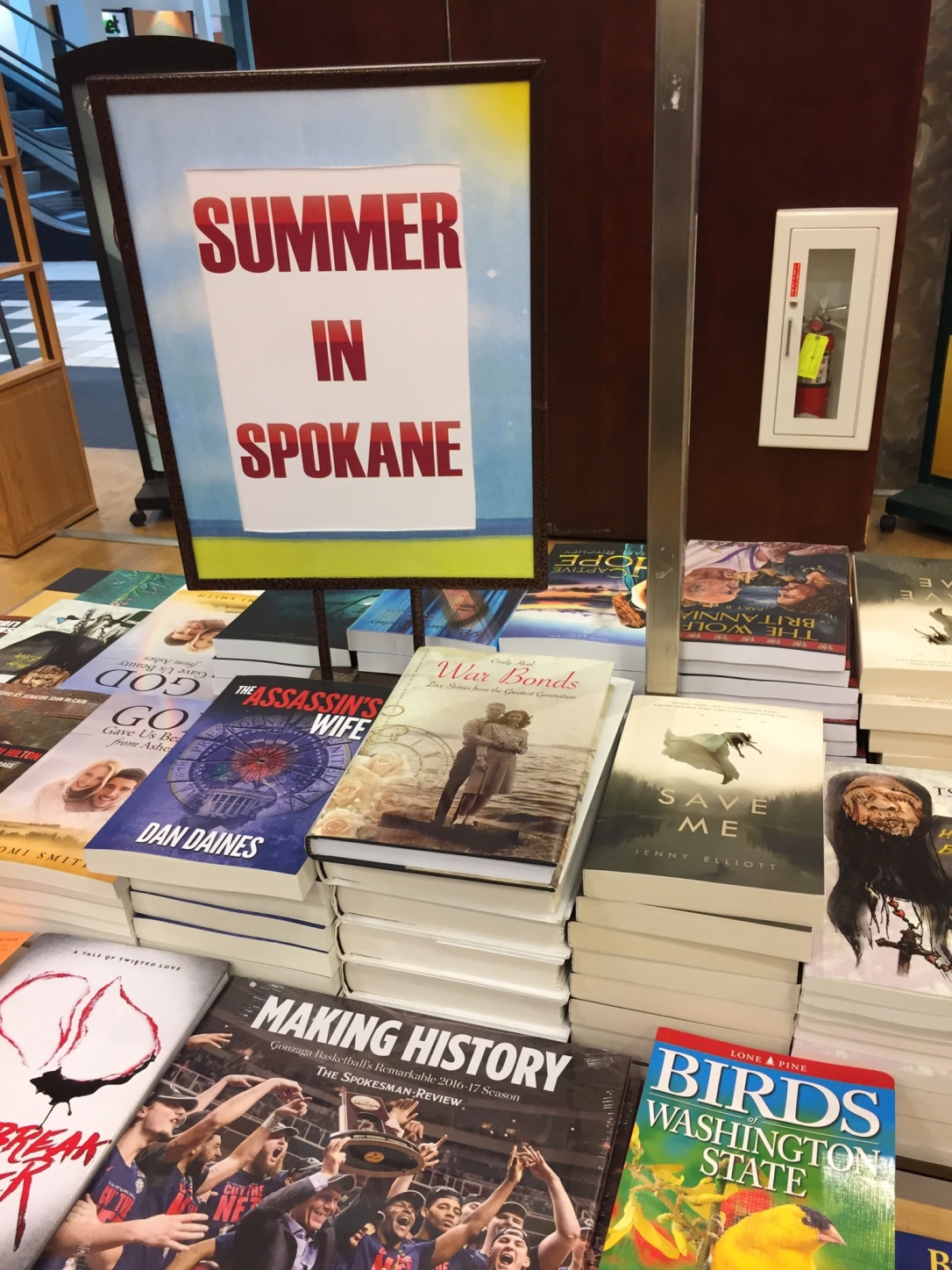
War Bonds as seen in the wild

image

My oldest son sent this photo of War Bonds as part of a Summer Reading display at Barnes & Noble Northtown in Spokane.

Makes me happy to think someone may pick up a copy for a summer read!

I’d love to see more photos of War Bonds in the wild. Feel free to email me photos at dchval@juno.com

Meanwhile enjoy your summer reads!


Columns

The Great Zucchini

20228745_1479340748771214_8152867723725408811_n[1]

Unfortunately, the most valuable life lessons are often learned the hard way. This summer I’ve been schooled in the veracity of the adage “be careful what you wish for.”

Last year my husband experimented in the Glorious Garden. He tried growing zucchini, vertically, in pallets. The experiment failed, and I was disappointed.

“Next year, I want zucchini. LOTS of zucchini,” I told my hardworking spouse.

He heard me. Boy, did he hear me.

Two weeks into this summer’s zucchini season had me yelling for mercy – praying for drought, pestilence or plague. No such luck. Our bumper squash crops shows no sign of slowing down.

It’s come to this – last week, I went to a party. I took zucchini as a hostess gift.

I returned my sister-in-law’s baking dish – with a squash tucked inside. Our relatives are starting to avoid me.

Our teenager used to eagerly ask, “What’s for dinner?”

Now, he hesitates.

In the last few weeks I’ve made zucchini cornbread casserole, cheesy zucchini, zucchini and rice, zucchini fritters, zucchini chips, zucchini stuffing casserole – and that’s just for dinner.

I’ve also baked dozens of zucchini chocolate chip muffins and many loaves of chocolate zucchini bread.

I have bags of shredded frozen zucchini in the freezer, and Derek recently bought a spiralizer. He wants to try zucchini spaghetti, but I’m not sure I’m ready to make the vegetable-in-place-of-pasta leap. Ask me next week.

And yes, I should know better, because many years ago, I used to write for a now defunct section of this newspaper, called HOME, and one of my assignments was to cover ‘The Great Zucchini War’ between two Spokane Valley neighbors.

It was actually more of a story of the gift that kept on giving. In the 2006 article, I chronicled the tale of a super-sized squash that made its way from bench, to birdbath, to treetop, as two neighbors escalated the art of re-gifting.

The Pedens and the Fairhursts took the squash war to unheard of heights. The much maligned vegetable was camouflaged in orange, black and silver and set afloat in a koi pond. It was transformed into a replica of a Flying Tiger fighter plane. Sporting wings, tail fins and the snarling teeth of a tiger, it perched in the upper branches of a walnut tree where it remained until a ladder tall enough to reach it could be found.

When last seen, it was Halloween and the re-gifted gourd was growing soft in the middle. It had been painted white, covered in ghostly draperies and encased in concrete – on a neighbor’s porch.

That was 11 years ago, and one can only hope the extra-large zuch was given a decent burial somewhere, or at least turned into enough bread to feed the ’hood.

Which brings me back to my squash stash. I’ve been trying to make eye contact with my next-door neighbors, but surprisingly they always seem to be in a hurry to peel out of their driveways or slam shut the sliding doors on their decks.

I’ve pondered placing the surplus squash in a box in our front yard with a “free to good home,” sign, but I worry they will rot in the hot summer sun before they are adopted.

There’s always Craigslist, but I don’t relish getting caught in some kind of undercover sting operation. I can just picture a jaded cop in a deserted parking lot mocking me. “You thought you’d get cash – for squash!?”

Last week I interviewed a longtime greengrocer who told me, “If you have to buy zucchini at a store, you must not have any friends.”

Well, at the rate my freezer is filling, I won’t have any need for zucchini or friends until roughly, 2020.

Listen to me dear readers; be careful what you wish for – especially if it involves produce.

Contact Cindy Hval at dchval@juno.com. previous columns are available online at spokesman.com/ columnists. Follow her on Twitter at @CindyHval.