Columns, War Bonds

Of Boys Lost and Boys Found

Spoiler alert: This week’s column has a happy ending. I wish all stories about lost children could end the same.

Stepping lively, I dodged traffic cones dotting the street, thankful the end of roadwork season is almost here.

I savored the glorious October sun, knowing my regular treks around the neighborhood will soon be replaced by boring indoor workouts at the gym.

Adjusting my headphones, I cranked up my walking music and my pace. A tug on my arm startled me. I’d been so focused on boosting my heart rate, I had failed to notice the approach of two small boys.

“Do you know where Standard Street is?” one of them asked. “We’re lost.”

If this scenario sounds familiar to readers, I’m not surprised. I seem to collect lost boys the way other folks collect license plates or trading cards. From a tiny autistic boy who’d escaped from his house to play on a busy street one Sunday morning, to Ricky who got confused when he got off the school bus one afternoon, I seem to be a lost-boy magnet. This time there were two of them looking at me with anxious eyes.

I’m embarrassed to admit my route is so familiar I don’t pay attention to street names.

“I think we’re on Standard,” I replied. “But there’s a sign on the corner – let’s check.”

We approached the sign and verified we were on Standard, but the boys weren’t reassured.

“Actually, we need to know where Lyons Street is,” the spokesboy said.

“What’s your address?” I asked.

Two pairs of eyes stared at me blankly.

“I don’t know it,” the smaller boy said.

“Me either,” his friend admitted. “But it’s apartments.”

Taking a deep breath, I asked them their names and ages.

“I’m Marc with a ‘c,’ and I’m 9,” the taller boy said.

“I’m Luis, and I’m 8,” his friend replied.

I asked them how they got lost.

“Well, we got off the bus at a friend’s house after school,” Marc said. “But he couldn’t play, so we decided to walk home, but we don’t really know where we are now.”

“What school do you go to?” I asked.

“Linwood Elementary,” he replied.

Linwood is about 2 miles away from my Shiloh Hills neighborhood and across bustling Division Street. They couldn’t remember where they’d gotten off the bus.

As we chatted, we kept walking because I assured them that Lyons was north of Standard, and if we kept walking north hopefully they would be able to spot their apartment building.

“How about I call your parents?” I offered as we walked. “Maybe one of them can come pick you up.”

It was 4:20 and the boys said the bus usually had them home by 3:30.

“We’ve probably been walking for HOURS,” opined Luis, who didn’t know his phone number.

Marc said his mom was home and gave me her number. I called repeatedly from my cellphone as we walked, but no one answered.

“She has MS and sometimes she doesn’t answer the phone,” he said. “Especially if she doesn’t know who’s calling.”

By this time we were almost to my house, and I estimated they still had at least a half-mile to walk.

“If I give you guys a ride do you think you could show me your apartment building?” I asked.

“Yes!” said Marc.

“My legs are really tired,” Luis admitted.

I offered them some water, but they declined.

“I’d like some crackers if you have some,” said Luis.

I dashed inside to grab my purse and discovered we were out of crackers.

“What are you doing?” my son, Sam, asked.

“Taking some lost boys home,” I replied.

“What? Again!?” he said, shaking his head.

The boys buckled up and Marc opined that my car was similar to his mom’s. He knew the make and model of her car. It would have been more helpful if he knew her address.

However, as we approached the neighborhood park, they got excited.

“Hey! I know where we are now!” Marc yelled. “We’re almost home!”

Sure enough, he spotted their apartment building and I dropped them off.

When I wrote about my afternoon adventure on Facebook, a friend said, “I hope you gave them a lecture about getting in cars with strangers once you safely delivered them home!”

Honestly, I was just so relieved I’d been able to get them home; I never thought to scold them. I did lecture them about learning their addresses.

“You need to know the name of the apartment complex and the street address,” I’d chided.

They’d both just shrugged and nodded.

My relief at the happy outcome gave way to dismay. I wished I’d scolded them about getting off the school bus at someone else’s house without first making sure they had permission. I was horrified that they seemed to think it was acceptable to go to a stranger’s house and then get into her car.

They were so trusting and sweet and had absolute confidence in my ability to get them home. And that’s what really made me sad.

Because I’d like to think we live in a world where grown-ups are trustworthy. Where parents have confidence that when their children are out of their sight, other adults are watching out for them.

And mostly, I want to believe that all lost boys return home safe and sound.

Contact Cindy Hval at dchval@juno.com. She is the author of “War Bonds: Love Stories From the Greatest Generation.” You can listen to her podcast “Life, Love and Raising Sons” at SpokaneTalksOnline.com. Her previous columns are available online at spokesman.com/ columnists. Follow her on Twitter at @CindyHval.

War Bonds

Seizing serendipity: WWII vet publishes novel

14021667_1144536465584979_1889335700444087371_n[1]

I was privileged to interview Stan Parks, 92, for this Saturday feature in the Spokesman Review.

Stan Parks, 92, has been many things: sailor, dentist, world traveler, husband, father, grandfather, photographer, sculptor, civic leader. Recently, he added a new title to his resume: author.

In March he published his first novel, “Jakob’s Ladies,” through Gray Dog Press.

Tackling new projects is second nature to Parks, who also serves as president of the Spokane Downtown Kiwanis Club.

“I retired in 1982,” he said. Then he grinned. “But I didn’t really retire.”

 “Serendipity” is a word he uses often to describe the many opportunities he’s been able to embrace during his lifetime.

Born and raised in Chicago, Parks left his studies at Loyola University to join the Navy in 1942.

“Well, they let me finish my year at Loyola because I was part of the V-12 program,” he said.

The V-12 program was designed to supplement the force of commissioned officers in the U.S. Navy during WWII.

The newly commissioned lieutenant junior grade was assigned to the USS LST-53, a tank landing ship, recently returned from the invasion of Normandy. Parks and his crew and were sent to the Pacific theater.

“When the war ended we were given the job of returning occupied troops to Japan,” he recalled. “I saw quite a bit of Japan. We picked up Japanese from outlying islands and brought them home so they could rebuild the country.”

After the war, he resumed his studies at Loyola. One evening a friend invited Parks to join him and his wife for dinner. Unbeknownst to Parks, he wasn’t the only guest.

“Serendipity,” he said, smiling. “I chatted with my friend for awhile and then his wife called us into dinner. I walked into the dining room and saw this beautiful young lady. Her name was Eleanor, but I called her Norie.”

More than six decades have passed since that fateful meeting, but his eyes still light up at the mention of her name.

“We married on Dec. 28, 1947,” he said.

They settled in Aurora where Parks established a thriving dental practice and where they raised their four children.

In 1978, he visited Guatemala, volunteering his time to provide dental services at a medical mission run by the Benedictines. The trip proved eye-opening for Parks, who mostly cared for the students at the mission school.

“They had absolutely nothing,” he said. “No dental care at all.”

He knew he’d have to return, which he did almost every year until 2004. With other dentists, he established a modern dental clinic, complete with everything they’d need to care for patients.

“The office is still there,” said Parks. “And dentists still go.”

When asked why he returned to Guatemala so many times he replied, “The satisfaction of helping those people. You can’t believe how little they had.”

After 32 years, Parks retired and he and Norie moved to Fort Meyers, Florida. His retirement from dentistry allowed him to pursue other passions.

“I did a lot of acting,” he said. “My wife and I joined the Peninsula Players. I really enjoyed it. My wife was a great actress.”

And there were the boats. The Norie 1, 2 and 3.

“They got bigger each time,” Parks said, laughing. “We spent a lot of time in the Bahamas, living on the boat.”

When their son moved to Spokane, Parks and his wife enjoyed visiting the area so much, they purchased a condo so they could spend more time here.

He’s always had an artist’s eye; framed photographs he’s taken throughout the years line the walls of his South Hill home. But he also likes to work with his hands, so when an opportunity to take a sculpting class from Sister Paula Turnbull came, he seized it.

“Talk about serendipity,” he said, pointing to several busts that he created under her tutelage.

One of those pieces is a bas relief featuring the face of his beloved Norie, who died five years ago.

Tears fill his eyes when he says her name.

“We were married 63 years. She was fabulous. As gorgeous as she was physically, she was that way on the inside, too. It’s hard without her.”

After her death, he moved to Spokane permanently to be near his son.

He went to see Turnbull upon his return to find out if she was offering more classes.

“She said she was too busy to teach, but she said I could work in her studio,” said Parks. “I loved it.”

When he heard about a writing class at the Sinto Senior Activity Center he decided to take it. He’d already penned his memoir.

“Well, it’s not really finished,” he said.

But he wanted to try his hand at fiction.

“If you don’t know how to do something, you can learn! It sharpens your mind.”

With encouragement from his writing group, he wrote “Jakob’s Ladies,” a historical novel set in 1895, about a dentist who goes out west to Sheridan, Wyoming, to launch his practice.

Parks did quite a bit of research, even traveling to Sheridan.

“I was in love with my characters. When one of them died – that was the hardest part to write.”

The book is dedicated to Norie, “My lady, my first mate, my only mate.”

He’s pondering a sequel, but he has plenty to keep him busy. He’s always been part of civic groups, so his leadership of the Downtown Kiwanis is a good fit.

“I can’t become a philanthropist and give away a fortune, but I can join a club like Kiwanis and give away pretty big chunks of money.”

At 92, he’s not resting on any laurels.

“There’s so much to be done and so many opportunities to do it,” said Parks. “I need 100 more years to do all the things I want to do.”

War Bonds

Things no one tells you before you write a book: hazards of grocery shopping

I was hot, sweaty and tired after a long afternoon of writing followed by a brisk three-mile walk, but someone has to buy the groceries for my family and that someone is me.

Wearing my favorite emoticon-covered work-out tank and some scruffy shorts, I hopped into the car. I thought about running a brush through my hair, but it was  windy day. Why bother?
I thought about slapping some make-up on, but why would I do that when I just needed a few things from the store?

You know where this is going don’t you?

While I was selecting some Walla Walla sweet onions, a woman near me said, “I like your shirt.” I smiled and thanked her.

That’s when she said, “Oh my gosh! Are you Cindy Hval? Did you write that book of love stories from World War II?”

When I nodded. She grabbed the guy stocking produce and gushed, “Do you know who this is?” And said some very lovely and kind things about War Bonds.

Of course, the produce guy wanted to know more. And then he said, “Hey! I DO know who you are, I read your column in the Spokesman Review!”

There’s a moral here. There’s a lesson to be learned.

For me it’s this: I can’t go grocery shopping anymore, ever again.
The end.

20160802_185840


War Bonds

WWII veteran uses art talent to help disabled people around world

20160720_140851

Jack Rogers, 93, is featured in War Bonds: Love Stories from the Greatest Generation with his wife Fran. The couple celebrated 70 years of marriage in April.

In this article for the Spokesman Review, I share how Rogers hasn’t let a series of strokes slow his desire or ability to help those indeed.

Greatest Generation indeed!

Rolling his wheelchair to his desk beneath a window, Jack Rogers picked up his pen and added deft strokes to a picture of a lone cross-country skier traversing a snowy landscape.

Rogers, 93, has always said he won’t retire. And despite suffering a series of strokes in October, he’s kept his word, though these days his desk is in a North Side care and rehabilitation facility.

Looking up from his work he smiled and said, “Old age creeps up on you.”

He has spent a lot of time in and out of hospitals and rehab facilities following the strokes, but he still participated via wheelchair in his 40th Bloomsday race. He hasn’t missed one since the race began in 1977.

A founding member of the Spokane Watercolor Society, Rogers started the art department at Spokane Falls Community College in 1963 and taught there for 26 years.

Though he retired from the college, his schedule was still packed. In October, he was teaching a private student in his home when he suffered a stroke.

The past few months have been difficult, as the always-active man chafed at the limitations forced on him by his health.

“I need to make a contribution in this world by helping others,” he said.

Thankfully, his longtime friend Joe Kramarz found a way for Rogers to do just that.

Kramarz volunteers with Inland Northwest PET Project. Since 2005, the organization has been creating and distributing Personal Energy Transporters from a hillside shop in Colbert.

A PET is a hand-pedaled vehicle made of lumber and steel. The sturdy parts and solid-core rubber wheels provide transportation in terrain that would prove difficult for traditional wheelchairs to navigate.

The PETs are sent throughout the world to those who have lost use of their legs due to injury, birth defects, land mines, polio and other causes.

The organization has grown from a half-dozen volunteers to 100, scattered across the region from British Columbia to Alaska. Now Jack Rogers is one of them.

Kramarz came up with the idea to have Rogers paint customized tailgates for the PETs.

“We used to have Northwest-themed stencils on the tailgates,” he said. “Now we have Jack’s art.”

Kramarz knows how important it is for his friend to be useful. He takes the tailgates to Rogers and picks them up when he’s done.

“Jack’s told me many times, ‘If you’re not producing and helping other people, you’re not living,’ ” he said.

From a fly fisherman casting his line in a river, to snow-capped mountains, each scene Rogers creates has the unique flavor of the Inland Northwest.

“We just shipped 140 to Guatemala,” Kramarz said. “Jack’s done about 18, now.”

Dick Carpenter, founder of Inland Northwest PET Project, is happy to count Rogers as one of the many volunteers who make up the nonprofit.

“Absolutely incredible men and women come together as a team to make this happen,” he said. “It’s astonishing to me how committed these people are.”

The motto of the organization is, “Lifting people out of the dirt into a life of dignity and hope.”

Carpenter said the PETs have the ability to instantly change lives.

“In shame-based countries people with disabilities are hidden away,” he said. “Mobility makes all the difference – it erases the shame.”

As Rogers worked on a tailgate he said, “It takes me about two to three hours to finish one. My part is small; all the other volunteers make this happen.”

In addition to working with the PET Project, Rogers is still teaching private students and is illustrating a book for an author in Los Angeles.

The book is set in the Philippines – a place Rogers knows something about. During World War II his Army unit was the first one back into Manila, after Gen. Douglas MacArthur’s famous landing.

“I’m very fortunate God gave me a talent,” he said. “I have a duty to share it.”

Rogers still has no plans to retire.

“My point is not what I’ve done,” he said, “but what I’ve done for someone else.”

To help

Inland Northwest PET Project accepts donations.

Tax-deductible donations may be mailed to WCPC PET Project, 15123 Little Spokane Drive, Spokane, WA 99208. Donation form and more information available online at petspokane.org.

In addition to funding, current needs include donation of hard board, 11 feet by 5 feet or 10 feet by 4 feet, 1/4-inch thickness preferred.

For more information call, (509) 466-3425.

War Bonds

Stroke slows but doesn’t stop Jack Rogers

While out on assignment a few weeks ago, I found out the folks I was interviewing were good friends of Jack and Fran Rogers, whose story is told in a chapter titled “Can’t Take My Eyes Off of You” in War Bonds: Love Stories From the Greatest Generation.

I knew Jack, 93, had a stroke in October and his recovery process has been slow.

Imagine my delight when I heard that Jack, an art instructor for many years, was still painting! He paints Personal Energy Transporters (PETs). PETs are shipped to countries all over the world to provide personal mobility to amputees who are often victims of land mines and IEDs.  I wrote  about this great program here :http://www.spokesman.com/stories/2012/sep/27/pet-project-spreads-mobility/

Sadly, his health has had another setback, but I’m hoping to catch up with him soon.

Even a stroke can’t stop this WWll vet from wanting to do work that makes the world a better place.

20160617_164905
An example of Jack’s work on a PET
20160617_164942
Jack Rogers sits on a PET
War Bonds

Spokane Authors and Self Publishers

Happy to be speaking at the meeting of Spokane Authors and Self Publishers tomorrow, July 7 at 2:30 at The Golden Corral, 7117 N Division St.

I wrote about the group several years ago in a feature for the Spokesman Review. Who knew someday I’d be returning as an author?

Copies of War Bonds: Love Stories from the Greatest Generation will be available for purchase.

Guests are welcome, so I home to see many local writers tomorrow afternoon!

War Bonds

Rotary embraces War Bonds

War Bonds at Rotary

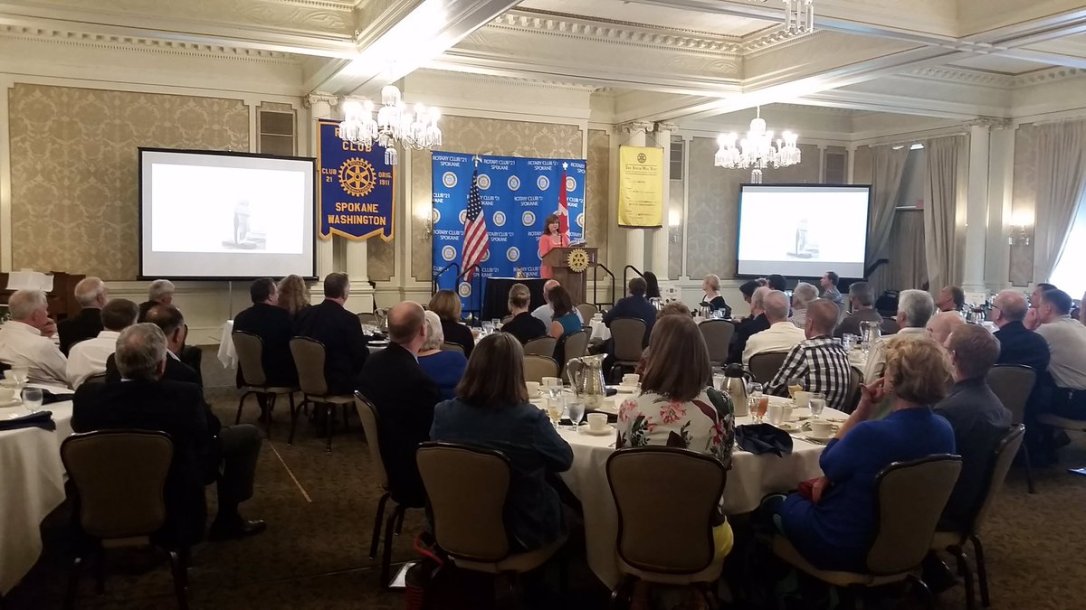
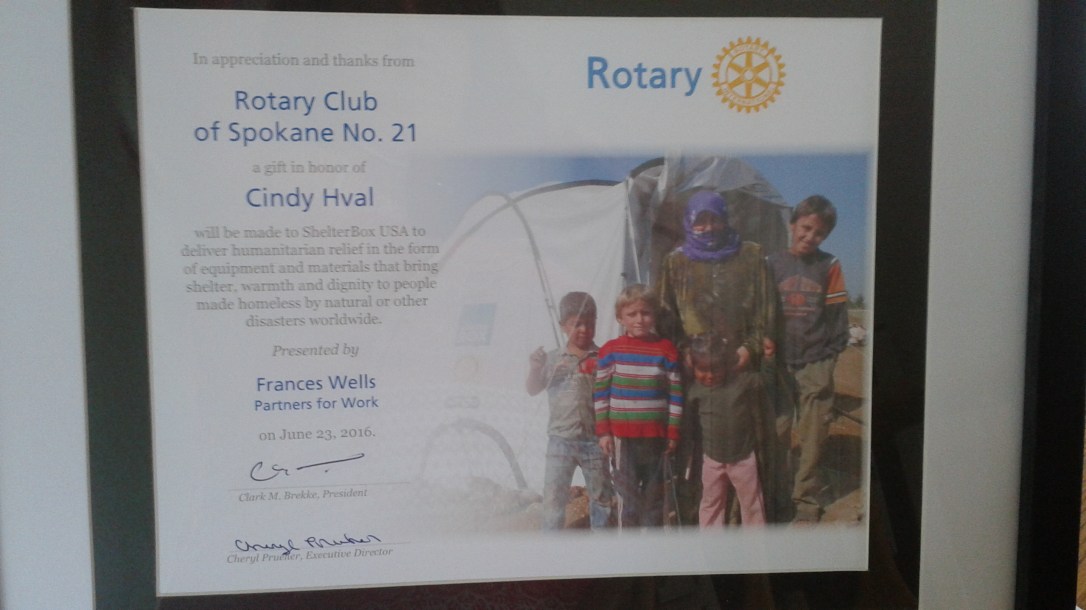
I had the privilege of speaking to Spokane Rotary Club 21 on Thursday. Several folks from the Greatest Generation are members of this Rotary club and were among the more than 100 members present.

Rotary has long appreciated and honored the U.S. Armed Forces, so this was a perfect venue to share the stories of love, devotion and courage featured in War Bonds: Love Stories From the Greatest Generation.

Auntie’s Bookstore was on hand to sell copies of War Bonds after the luncheon and sold all 30 copies they had in stock!

While signing books, I was tickled to find that many of the purchasers were husbands buying copies for their wives. The husbands of Rotary excel at romance 😉

Such an honor to present to a group that gives back to our community and to the world in myriad ways.

20160623_141338

War Bonds

Inland Northwest Writer’s Guild

Happy to speak about writing, publishing and marketing books at the Inland Northwest Writers’ Guild at 7 PM on Wednesday, 6/15 at Auntie’s Bookstore.

All writers are welcome to attend– especially lightly published and beginning authors!

There’s a punctuation and grammar skills class at 6, for those that want to brush up on their skills and then I’ll be speaking at 7 with plenty of time for Q &A.

Hope to see many fellow scribes!


War Bonds

The thrill ain’t gone

13254332_1088081834563776_7878354948230130632_n[2]

Even a year after publication, it’s still a thrill to be asked to sign a stack of books! So grateful readers and booksellers are valuing War Bonds and the stories shared within.

13266071_1088081817897111_2872651087086270262_n[1]

A recent reading at a local Barnes & Noble prompted a slew of interest and phone calls, so I was delighted to stop in and sign more copies.

As we head into Memorial Day weekend I’m even more conscious of the privilege I’ve had in being allowed to share these stories before they were lost.

I feel like “thankful” should be part of my signature.

War Bonds

Reading in the Hundred Acre Wood

13267776_1082785828426710_8004627206616391344_n[1]

Spent a delightful evening at Barnes & Noble last night. I was joined by fabulous poet Zan Agzigian and amazing blues/jazz songstress Heather Villa for an evening of poetry, prose and song.

The reading was held in the children’s area of the store because that’s where they have the stage, so it was fun to read from Pooh’s Hundred Acre Wood!

In addition to reading from War Bonds, I shared a portion of my work-in-progress, and the reception was warm and enthusiastic. A much-needed boost in the slow-going labor of writing my next book.

Even more fun was having my youngest son, 16-year-old Sam, in the audience.
“I love to hear you read,” he said. And he snapped the above photo.

At the signing afterward, a woman approached and asked me to sign a copy of War Bonds .

“It’s not my copy,” she explained. “It’s my 17-year-old daughter’s. She’s already read it several times and she often reads the stories aloud to me. She wants she and her fiance to be like the couples in your book, growing old together.”

How cool is that? A teenager who values the stories of the Greatest Generation! Nothing, makes me happier or more hopeful then know these stories are appreciated by the next generation.