Blog

Columns

Kindness is the best gift

A few days before Thanksgiving, I had one of those too-much-too-little days.

Too much traffic, too many crowded stores and too little time between appointments. I pulled into my bank’s parking lot and noticed the drive-thru line was several cars deep. I decided to park and go inside. Both tellers were helping people, but I was next in line.

While I tapped my foot and glanced at my watch, the teller nearest me engaged in a long conversation with an older gentleman named Jimmy. Honestly, I was annoyed that they were still chatting when his business concluded, and the line grew behind me.

Then I tuned into their conversation. It sounded like Jimmy’s wife was dying and might not make it to Christmas.

“I’m so sorry, Jimmy,” the teller said, patting his hand.

The urgency of my errands and appointments paled as I thought of a friend facing her first Christmas without her husband. Another just lost her dad. Yet another is grieving his mom.

And Jimmy?

Maybe this was the first time he’d been able to tell someone what his holidays looked like. Maybe this was the first time someone slowed down enough to listen.

Blinking back tears, I finished my banking and left, but not before noting the teller’s name.

I’m thankful for kind people like Rayna at Chase Bank. And I’m grateful for humbling encounters like this to remind me that while I’m rushing from one appointment to the next, hurting people are all around me, and there’s no greater calling than kindness.

As soon as I had a break that day, I phoned and asked to speak to the branch manager. Too often, we’re quick to call to complain instead of compliment. I wanted to let them know about their stellar employee.

The manager was gone for the week, so I sent an email. But Rayna answered the phone, and I got to tell her how much witnessing her kindness inspired me.

During the holidays, many of us feel the pinch of those too-much-too-little days, but kindness is one thing we can never have too much of.

Columns

Recipe for easing worry

Many years ago, on a bitterly cold January afternoon, I sat down to write a column about soup because January is National Soup Month.

Like many columns, this one had a mind of its own and turned into an essay about worry.

I wrote, “Making homemade soup is great therapy. In fact, it’s become my surefire stress reliever. Nobody does worry like a mom, and mothers of teenagers are in a league of their own. If worry were an Olympic sport, moms would own the medals stand.”

Now, with our four sons safely past their teenage years and on their own, I assumed our pleasantly empty nest would become a fret-free zone.

Wrong.

Not only do I still occasionally worry about my kids, I now worry about my aging mother. How’s that for the circle of life?

August is too hot for soup, but recently, after an extremely stressful day, I stood in my kitchen surrounded by bowls, pans, veggies, chicken breasts, lemons and spices. I needed some cooking therapy.

Some people stress-eat. I stress-cook, and the recipe for the day was lemon-herb chicken, broccoli and potato sheet pan dinner.

Place a sheet pan in the oven. Preheat to 425 (leave pan in the oven). Cut Yukon gold potatoes into chunks and toss with olive oil, salt and pepper in a large bowl. Remove the pan from hot oven and coat it with cooking spray. Spread potatoes on the pan and roast for 15 minutes.

Mom is losing her teeth and for various reasons isn’t a candidate for dentures. With one lone upper tooth, she’s distressed about her appearance and afraid she won’t be able to eat. At least once during every visit, she asks, “What about my teeth? I don’t know where they went. Everyone asks me what we’re going to do about it.”

And I explain again the importance of caring for her remaining teeth and remind her of all the good things she still can eat – like potatoes.

In a large bowl, combine chicken breasts with olive oil, salt, pepper, parsley, rosemary and garlic powder. Grate the zest and squeeze the juice from one lemon and toss with chicken. Thinly slice the second lemon.

The tangy smell of lemon makes me think of my oldest son and his love for sour things. Ethan and his friends planned to float the Spokane River later in the week. They don’t have tubes or floaties; they just wade in and float. I’m pretty sure he’ll forget sunscreen, but he’s 33. At some point, you have to stop sending “don’t forget the sunscreen” texts. At least I know he’s a good swimmer. Those years of lessons paid off. But the river is unpredictable.

In the bowl used for potatoes, combine broccoli florets with the remaining oil, salt and pepper. After the potatoes have roasted, carefully remove the pan from the oven. Add the broccoli and stir to combine with the potatoes.

Our youngest son Sam doesn’t care for broccoli much – or roasted potatoes. As I cook, he’s driving to Dallas from his home in Odessa, Texas, for a getaway. Tollways. Traffic. Unfamiliar city. Did he top up the coolant in his car? Are Google Maps up to date?

Clear four spots on the pan for the chicken and add to the pan. Scatter lemon slices over. Roast for 15 minutes.

Zach is working on his new album. Our third-born would love to quit his day job to make music full-time. He’d also like a steady girlfriend. It occurs to me that most of my worries are about my three single sons. I wonder if when they are partnered like Alex, I’ll worry less.

Remove pan from oven and brush chicken with soy sauce; roast until the chicken is cooked through and the veggies are tender, about five minutes more.

As I set the table and cleaned the kitchen, my heart felt lighter and my mind clearer. I often pray while I cook, and that plus the absorption of the tasks helps me chop, measure and mix my concerns into bite-size pieces.

Cindy Hval can be reached at dchval@juno.com. Hval is the author of “War Bonds: Love Stories from the Greatest Generation” (Casemate Publishers, 2015) available at Auntie’s Bookstore and bookstores nationwide.

Columns

The Sounds of Summer

A faint rumbling caught my attention as I carried a load of laundry through the living room.

It sounded almost like a motorcycle but not as loud. The noise tickled a memory as it ebbed and faded.

A breeze drifted through the open windows and rattled the blinds. I set the basket down to raise them and discovered the source of the rumbling.

“It’s a Harley! I got a Harley!” a neighbor kid yelled.

He’d affixed a sports card to his bike spokes, and he pedaled back and forth in front of our house, delighted with the souped-up bike that sounded just like a motorcycle to him.

All four of our sons had done the same thing at one time or another – a simple summertime joy discovered by thousands of kids.

Later that evening, a less pleasant sound floated through the windows. There couldn’t possibly be a more irritating song than “Pop Goes the Weasel.” Why ice cream trucks choose that tune is a mystery.

All around the Mulberry Bush,

The monkey chased the weasel.

The monkey stopped to pull up his sock,

Pop! goes the weasel.

What does this even mean, and what does it have to do with ice cream treats?

While I pondered popping weasels, I looked out the window to see a tragic sight. A kid wearing flip-flops with cash clenched in his upraised fist was huffing and puffing after the disappearing truck.

It reminded me of the “Crabgrass” comic running in our newspaper. Friends Miles and Kevin are consistently thwarted in their efforts to catch the ice cream truck.

Our neighbor kid experienced a similar fate. I watched him trudge back by our house – empty-handed, except for his cash.

My Facebook memories show the last time one of our kids got a treat from the ice cream truck. Eleven years ago, I snapped a photo of 12-year-old Sam running down the street, a frozen Sponge Bob treat held aloft.

Another sound seems uniquely summerish – the thump, thump, thump of a bouncing basketball. Many homes in our neighborhood have curbside hoops. Now that school’s out, I pass several pickup games in progress when I’m on my walk.

Once, a ball bounced off the backboard and into my path.

I picked it up, pivoted and shot.

Let’s just say my high school basketball skills have severely rusted. The ball hit the rim and bounced back to me.

I shrugged and tossed the ball to the nearest kid.

“Try again!” he said, tossing it back.

My second effort didn’t exactly swish, but it went in.

“Sweet!” said the kid.

I grinned and resumed my walk.

A few weeks ago, we added a new sound to our summer. We bought an outdoor Bluetooth speaker/lantern for The Great Gazebo.

This means I had to add a music app to my phone. I’m notoriously app-averse, but the results are lovely.

In the afternoon, I can listen to tunes while I deadhead flowers or work on a crossword puzzle. In the evening, we have lovely soft light to go with our music. The lantern has several settings, from a steady golden glow to a flickering firelight.

Whether the soundtrack of your summer features kids on bikes, ice cream trucks, bouncing basketballs, or the rich sound of Ella Fitzgerald crooning “Summertime,” I hope you’ll find moments to relax and soak it in.

Columns

Blue Light Specials and Zebra Print

The zebra-striped short spring jacket shamed me from the closet.

I hadn’t worn it once in the last two years, so as per my policy, it was time to send it off to Goodwill.

But first I shrugged it on. I’m not going to lie. It’s a cute coat. It’s also one of the last things my mom bought for me while she still enjoyed shopping.

How long have I had it? Well, she purchased it at Kmart in Spokane Valley, a few years before it closed in 2019. She bought herself one, too. One of us was never a fan of “dressing your age.”

Mom had three hobbies, reading, sewing and shopping. I inherited her love of the first, but prolonged exposure to the others only led me to develop a strong antipathy to both.

No matter. Mom loved nothing more than shopping for others. One of her favorite haunts was Kmart. It’s no coincidence that when we moved to North Spokane when I was 16, the store was within easy walking distance of our house.

Even prior to moving nearby, Kmart was a family fixture.

Who can forget the excitement of the blue light special!? Even better if that blue light flashed from the deli.

Long before there was a Subway on every corner, the Kmart deli introduced us to submarine sandwiches. The plastic-wrapped subs featured ham, bologna, salami and American cheese. Topped with thinly sliced tomatoes, a couple of pickle slices and tons of shredded lettuce, these were a real treat because our family didn’t frequent fast food restaurants.

Actually, I preferred the ham sandwiches. Cooked ham, mayo and shredded lettuce on a fluffy white hamburger bun. Yum!

Of course, Mom was there for the bargains. Any kid growing up in the ‘70s likely had a pair of moon boots from Kmart and, probably a pair of knock-off Keds. The white canvas shoes were worn by generations of women and children. Mom still has several pairs of those slip-on shoes in her closet.

By the time I was a teen, I rebelled against any item of clothing purchased at the store. The final straw was when Mom bought me a puffy navy blue parka with a hood. I was 14. I knew a puffy parka with a hood in a BOY color was social suicide.

“It’s Kmart Fall Apart!” I wailed. “I will never leave this house in that coat!”

Sadly, I did leave the house in that coat, but I took it off as soon as I reached the end of the driveway.

Flash forward a few years. I’m an at-home mom with three boys under 5. My now-retired dad would pick Ethan, 4, and Alex, 2, up on Tuesday mornings while baby Zach and I stayed home.

He’d drop Mom off at Bible study, deliver Ethan to preschool, and then he and Alex would head to Kmart. Alex got a spin (or two) on the merry-go-round at the entrance, and then they’d head to the deli, where Dad sipped coffee and Alex munched a big chocolate chip cookie.

Dad died weeks before Alex’s third birthday, but I hope somehow he still remembers his special dates with Papa Tom.

Mom took over dates with her grandsons. She didn’t drive, but she’d pack whichever boy was visiting in an umbrella stroller and set off in search of a blue light special. When they outgrew the stroller, they walked with her, confident they’d get a treat or a new toy when they got to the store.

She doesn’t shop anymore. Alzheimer’s-induced anxiety makes outings stressful, but at 92, she knows all my sons by name and often tells stories about their Kmart adventures.

Who knew so many memories could be triggered by a lightweight zebra-striped jacket with a Jaclyn Smith label?

I pulled it from the donate bag and hung it back in my closet.

There’s no shame in holding onto memories. Especially, when you can touch them and feel once again, the warmth of your mother’s love.

Columns

Don’t Take Me Out to the Ballgame

When I picked up my friend Sarah on a recent Sunday afternoon, she said my timing was perfect because the Seattle Mariners game had just ended.

“Oh, do they usually play on Sundays?” I asked.

She stared at me.

“They play five times a week,” she said. “Next week they’ll play six.”

Speechless, it was my turn to stare.

You may think conversations about politics and religion are divisive, but try telling a good friend that you hate the sport she adores. Actually, we have this same discussion every spring because Sarah knows I don’t like it – she just has difficulty accepting my antipathy.

To wit, the following day, she texted me a link to Mariners tickets and asked me to attend a game with her.

I declined due to a lack of interest. And time.

In 2021, the average nine-inning Major League Baseball game was 3 hours and 10 minutes. That’s bad enough, but each team plays 162 regular-season games. Let’s say we round a game to 3 hours, and you (and Sarah) watch every one of your team’s regular-season games. That’s 486 hours or a little over 20 days of your life! And we aren’t counting postseason games because doing that much math isn’t good for me.

This year, MLB added a pitch clock, and that’s supposed to speed up the games. They may go faster, but there are still way too many of them.

In addition to the time aspect, there’s the danger. I love football, which Sarah loathes, but I pointed out to her that no spectator has been concussed by a stray football in the stands, while hundreds of people each year get popped in the noggin by fly balls at baseball games.

She said that’s why they bring mitts. She said that like it’s actually possible for me to catch a ball with or without a mitt.

Undeterred, Sarah posted a link on my Facebook so that I could read about “the most literary sport in the history of sports.”

I skimmed it. Apparently, there are a lot of novels about baseball. I did know this because my friend, Beth Bollinger, penned one of them, “Until the End of the Ninth,” a lovely book about the 1946 Spokane Indians team.

Additionally, the article listed some baseball lingo that has leaked into our language.

For example, you can strike out on a date, or make it to second base. You can touch base with clients, or knock a column out of the park, and maybe you can even make it to the big leagues.

The article didn’t mention movies, but I’ve enjoyed several films featuring the sport – “The Sandlot,” “Moneyball” and “Field of Dreams” come to mind. Plus, I can watch a movie about it in half the time it takes to watch an actual game.

Having failed to convert me through literary persuasion, Sarah resorted to texting me photos of herself and her husband at a baseball game, her son in a Little League uniform, and finally pictures of Mariners games on her TV.

I countered with an adorable photo of our son Zachary during his lone season in Little League. Turns out the kid only wanted to play for the unlimited sunflower seeds and didn’t realize he would be playing two games a week. In his first at-bat, he got nailed in the leg by an errant pitch. We told him he still had to honor his commitment to the team.

“You guys are trying to get me killed!” he said.

Just because I don’t care for Major League Baseball doesn’t mean I don’t enjoy a Spokane Indians game once every few years – especially on fireworks night.

So, even though Sarah thinks I’m an awful person for not sharing her passion for the Mariners, I still believe football fans and baseball lovers can get along. After all, diversity is what makes America great, and having dissimilar friends is educational. For example, while writing this column, I finally understood why baseball is called America’s national pastime.

It’s because so much time passes while you’re watching it.

Columns

Flying the friendlier skies

Sometimes a cookie isn’t a cookie, it’s a quinoa crisp.

And the pretzels? Well, they’re “bioengineered,” at least if you fly United Airlines. Which we do. A lot.

Since our only grandchildren live across the country in Ohio, we’ve racked up our frequent flier miles these past three years. It’s no secret that air travel no longer resembles what it once was, but if you do some research before you go and familiarize yourself with the rules of the air, you can make the friendly skies friendlier. Here are some tips.

No. 1: If you fly more than once a year, TSA Precheck is your best friend. For $85 and some paperwork, you won’t have to remove your shoes, coat, or belt. Additionally, you don’t need to remove your liquids or snacks from your bags and the lines are much shorter at every airport we’ve been to (nine at last count). Plus, it’s good for five years!

That doesn’t mean you won’t be selected for additional screening. Just ask my husband, Random Check. Last month, he got picked for random screening at each stage of our trip, so I temporarily renamed him.

Unlike me, Random Check, aka Derek, is a plane-sleeper. He usually nods off just after takeoff and prefers the window seat, so he can rest his head against the window. On the off chance that I doze off, I prefer to rest my head on Derek. This means I get stuck in the middle seat.

This brings me to tip No. 2: The passenger in the middle seat owns both armrests. This is our only compensation for flying shoulder-to-shoulder with strangers. If you’re an aisle-seater, don’t even think about placing your elbow on mine.

It’s not lost on me that I’m the introverted half of a couple, yet the one compelled to make small talk with a seatmate. So, tip No. 3: If your Serbian seatmate, who now lives in Boise by way of Denmark, wants to lean across you and snap a photo of a really long empty Ohio runway, you let her. It’s one picture (or five) and your husband has the window seat.

Tip No. 4: Reclining your seat. Honestly, those 2 inches don’t make much difference to my 5-foot-8 frame, but for my 6-2 husband with osteoarthritis, that little bit of space can mean a lot. He rarely reclines, but when he does we check to make sure the person behind him is small enough to not be too inconvenienced.

If you haven’t flown in a while, you might be unaware of the continually narrowing times for connecting flights. Usually, we have between 20 and 45 minutes to make it to the next gate.

Tip No. 5: Jumping out of your seat into the aisle the minute your flight lands will not get you off the airplane any quicker. Remember in kindergarten when you learned to line up? That’s exactly what you do as you wait to deplane–one row at a time from the front row to the back row. It’s not complicated, unless you make it so – like the woman seated near the back when we landed in Spokane. She attempted to vault over 25 rows of folks patiently waiting their turn. She may have left the plane a minute or two earlier, but it looked like a couple of travelers bodychecked her with their carry-ons. Ouch!

Speaking of ouch, my last suggestion is simple but important.

Tip No. 6: Obey the rules. Listen to the flight attendants’ instructions and follow them. Last week my friend, Ryan Oelrich, was on a flight and the woman seated in front of him had difficulty comprehending carry-on placement.

He live-posted his experience on Facebook.

“I’m now attempting to calmly explain to the nervous woman seated in front of me that the area under her seat is mine and the area under the seat in front of her is where she needs to move her oversized bag,” he wrote. “She informs me as if I’m 5 years old that this doesn’t make sense and I’m wrong. After all, if this were true where would the people in the front rows put their bags?”

For the record, people seated in the front row place their bags in the overhead bins.

Ryan enlisted the help of a flight attendant who asked the passenger to place her bag under the seat in front of her.

The result?

“The woman speaks louder attempting to enlighten all passengers around her to what she sees as her superior baggage storage method,” Ryan wrote. “Other passengers eye her nervously but entirely ignore her. Her baggage rebellion fails.”

After much effort and some swearing, she wrested her bag from beneath her seat and placed it where it was supposed to be.

Ryan tried to place his bag in front of him, only to find the woman had tucked her feet under her seat, blocking it.

Sounds like she needed the reminder I frequently gave my toddlers, “The happy way is to obey!”

This is true of most things in life, including following the rules of air travel.

As for those quinoa crisps? I tried pawning them off on my grandsons as chocolate cookies. They weren’t fooled either.

All Write

Note from a War Bonds Reader

Sometimes writing feels like slogging away in solitary confinement.
Since “War Bonds” was published in 2015, I’ve completed an as-yet unsold manuscript and pitched another full-length book that garnered some interest from agents, but not enough for me to commit to writing it.

And there’s my children’s picture book still looking for a home…

That’s why this note I received a couple of days ago was so encouraging. It reminded me (as do my tiny twice-yearly royalty checks) that people are reading and enjoying a book I wrote!

Maybe I can write and sell another one:-)

Dear Cindy,

I am halfway through your book.  It is so enjoyable.  I really enjoy biographies and autobiographies.   

It came at a perfect time.  Our married Grandson/ Wife are moving out to their own apartment shortly.  As a Grandmother,  I want to jump into action and provide for them.  Your book has reminded me that the best time is to “let go”.    Couples starting out need to have that struggle at the beginning. 

The book is delightful.  I was born in 1944 and my uncles went to war.  I can recall their visits. 

The title of your book is super appropriate.

Thank you, Cindy.

All the Best ,

Pam

Columns

Fit to be Fried

How often we must replace household appliances might reveal more about us than we think.

Take my iron, for example. My parents bought me my first iron when I married 36 years ago. It lasted 20 years until I dropped it and cracked the water reservoir. No, that’s not a testament about how things used to last longer; it’s more an indictment of how little it was used.

I thought about that while doing my biannual ironing atop the same ironing board I received with the original iron all those years ago.

We still have our wedding gift blender, though I haven’t dug it out of the pantry in years. Our coffee makers, however, need replacing on an alarmingly regular basis. We’ve lost count of how many we’ve been through. Of course, we’ve burned up several coffee grinders, as well. And just in case we cannot wait for a pot to brew, we’re on our second Keurig machine.

While raising our four sons, we also wore out several vacuums. Our most notable vacuum-cleaner catastrophe occurred one year just before guests were due to arrive over the Christmas holidays.

My ever-helpful spouse was cleaning up the pine needles beneath the tree and sucked up the tree lights cord. It killed our vacuum and sadly destroyed lights that we’ve never been able to replace. They had three color settings AND played Christmas carols!

Speaking of cleaning, one year for my birthday my mother gave me a steam mop. I didn’t exactly jump up and down when I opened it, but after one use I became a convert and have never looked back. I’m on my second steam mop.

Electric can openers had to be replaced regularly until Derek pointed out that manual openers were easier to operate, didn’t break and didn’t take up coveted counter space.

Some things seem to last forever, no matter how often we use them. The only reason we bought our current slow cooker is because we wanted a newer model. We kept our 20-year-old one as a backup.

Of course, there’s always some new gadget that marketers promise will make our lives easier. Remember the bread machine fad of the early 2000s?

Instant pots have dominated the kitchen scene for a few years, but seem to be losing steam. I didn’t buy into the hoopla. I don’t care that it can cook a pot roast super fast – pot roasts are meant to be cooked slowly – ditto soup.

That’s what Crock-Pots are for. I can dump the ingredients in before I leave for work and come home to a dinner that’s ready to serve.

That’s not to say I’m opposed to change. We recently added two new appliances we didn’t know we needed.

When my sister-in-law started renting out her downstairs as an Airbnb, she said she furnished it with a microwave and an egg cooker.

“An egg cooker?” I said. “That’s what Derek’s for.”

I only eat breakfast on weekends and that’s because he makes it.

She assured me it made perfect poached eggs and soft-boiled them just the way Norwegians love them. I found an inexpensive one and gave it to my husband.

He tried it the same weekend as our other new addition – an air fryer. Our sons all have air fryers, but I couldn’t imagine why we’d need one.

“We don’t eat fried foods,” I’d explained.

But on a trip to Costco, we succumbed to an impulse buy and came home with a 7-quart air fryer.

The next morning, Derek made poached eggs in the egg cooker and bacon in the fryer. Both were fabulous!

I begin looking for other things for him to air fry. Why Derek? Well, I’m terrified of new technology and I also don’t follow printed instructions well. I’m also sexist enough to believe air fryers like grills and smokers are best handled by the male of the species. (Not really, but I have been cooking for men for 36 years, and I’m getting kind of tired.)

Despite the claims of healthier cooking through air frying, our waistlines may be showing the adverse effects of our impulse buy. Our freezer now contains things like chicken wings and what Derek calls fish sticks.

I corrected him. “No, they are beer-battered cod fillets!”

We do plan to try air frying things like Brussels sprouts and cauliflower, but Derek’s already pondering an upgrade.

“I could cook more bacon at one time if we had a bigger basket,” he said.

I’m not sure how much bacon two people need at one time, but I think I’m about to find out.

**********

UPDATE: Dear Reader, It’s been 5 months and we have yet to air fry ANY vegetables– unless you count French fried potatoes and onion rings. Buyer beware!

All Write

Buried in a Good Book

I’m often asked what I like to read and my answer is always M&M’s– Mysteries and Memoirs.

So, I was delighted to be asked to write a profile about Edgar Award-nominated Tamara Berry. (Spoiler alert: SHE WON!)

Here’s the story I wrote for The Spokesman-Review.


PS: I loved “Buried in a Good Book” and have already received an advance copy of the third book in series “Murder Off the Books.” Can’t wait to read it!

Tamara Berry always wanted to be a writer.

“But it seemed like such a pipe dream,” she said.

Yet, next month the Spokane Valley native and East Valley grad will travel to New York City to attend the 77th Annual Edgar Allan Poe Awards, presented by the Mystery Writers of America. Berry’s mystery novel “Buried in a Good Book” has been nominated for the Lillian Jackson Braun Memorial Award.

The Edgars honor the best in mystery fiction, nonfiction and television. Past winners include heavy hitters such as Walter Mosley, Stephen King, Viet Thanh Nguyen and Patricia Cornwell. Spokane novelist Jess Walter won the best novel award for his 2005 book “Citizen Vince.”

The kid who once dreamed about life as an author has published under three pen names in a variety of genres.

Berry graduated from Eastern Washington University with a literature degree and in 2012 released her first e-book, “Love is a Battlefield,” as Tamara Morgan.

“I started writing romance when my kiddo was super young,” Berry said. “The only thing I had the mental capacity for was romances and I read a ton of them.”

Her first two contemporary romances were set in the world of the Highland Games.

“They feature burly, strong guys and romance readers go for that,” she said.

More than a dozen books followed before she retired Tamara Morgan and was reborn as Lucy Gilmore.

In 2018, her agent told her doggie romances were selling well – that is, romance novels featuring dogs.

Soon she’d written a three-book series about service dogs in training and two stand-alone romantic doggie comedies.

“I write mainly comedy,” she said.

When she pitched her next romance idea no one seemed interested except for one editor who asked “Can you put a dead body and a cat in it?”

And the Eleanor Wilde mystery series was born penned under Tamara Berry. Wilde is a pseudo-psychic/medium with a penchant for solving crimes.

“I love con artists,” Berry said. “There’s quite a few of them in my books. I’m drawn to the way they manipulate people. They’re interesting characters with a high level of insight and they tend to be more self-aware.”

While the Eleanor Wilde series sold well, the author had a new story in mind.

“I pitched a lumberjack series where a thriller author and her teenage daughter move to Winthrop, Washington.”

Her agent told her what was really selling was book-themed mysteries.

“Could you put a librarian or a bookmobile in it?”

Berry could and did.

“But I got to keep the lumberjack,” she said.

“Buried in a Good Book,” the first book in the cozy mystery series featuring thriller author Tess Harrow, is up for an Edgar award next month. This is the first year the Lillian Jackson Braun Memorial Award will be granted and it’s the only Edgar award that comes with a cash prize.

Braun, who died in 2011, wrote more than two dozen novels in her “The Cat Who…” mystery series. The award named after her will be awarded for the best full-length, contemporary cozy mystery.

Having read lots of Nancy Drew books as a kid, Berry said crafting cozy mysteries is well within her wheelhouse, but the formula is quite different from romance novels.

“There are no steamy sex scenes, no swearing and no gore,” she said. “The violence is hinted at, but not on the page. And of course, you have to have a murder and solve it.”

For Berry, that’s the fun part.

“I often don’t know who the culprit is going to be,” she said. “I get to be as surprised as the reader.”

Cozy mysteries are generally more gentle than hard-boiled detective fiction or grisly suspense thrillers. Think Agatha Christie’s Miss Marple series, or TV’s Jessica Fletcher of “Murder, She Wrote,” as examples of the genre.

Berry said there are two types of writers – plotters and pantsers.

“Plotters sit down and write an outline. Pantsers fly by the seat of their pants. I’m a pantser.”

The prolific author usually writes in bed or on her couch with her two dogs and two cats cuddled up next to her. She writes seven days a week and has a strict 1,000 words per day, daily word count.

“Once I hit 1,000 words I can free myself to do other things,” Berry said.

That includes promoting her latest Lucy Gilmore book, “The Lonely Hearts Book Club.” Due March 28, the lighthearted novel tells the story of the community created by a book club full of misfits including a young librarian and an old curmudgeon who forge an unlikely friendship.

And of course, she’ll be in New York City for the Edgars.

“I’ve been working at this so long,” she said. “It’s not glamorous, but it’s pretty great. If 16-year-old me could see me now, she’d be freaking out!”

Columns

Father, Faith, and Friendship

I miss him most in March.

His birthday is March 25, 1927, and he died on March 29, 1995.

My siblings and I could write volumes about our dad, Tom Burnett. Born in Mississippi and raised in Arkansas, he traveled the world courtesy of the U.S. Air Force but never lost his slow Southern drawl.

While stationed at Fairchild Air Force Base, he met my mom, Shirley Schmidt, who’d grown up in Hayden, Idaho. They both believed it was a “God thing.” He saw her singing in the choir at Glad Tidings Assembly of God and said the Lord told him, “That’s going to be your wife.”

It didn’t take Dad long to convince her.

To know my dad was to love him – and as an unabashed extrovert, he knew a lot of people. Mom and I would leave him on a bench at the mall. By the time we returned he’d say, “Hey girls, I want you to meet my friend …”

Young moms with babies in strollers, teenagers, other dudes waiting for their womenfolk – he’d befriend them all.

When people share their memories of Tom Burnett three things are invariably mentioned: his sense of humor, his devout faith, and his abiding love for my mother.

Recently, I got to see him through someone else’s eyes. While writing a story about a North Central High School reunion I was put in touch with Christine Glenn. Her parents, Chuck and Dorothy Glenn were my parents’ closest friends in the early 1950s.

In fact, if not for my dad, Christine might not even be here.

“My father would often recount his memories of how your father invited him to church and introduced him to the Lord, and also to Dorothy, my mother,” she said.

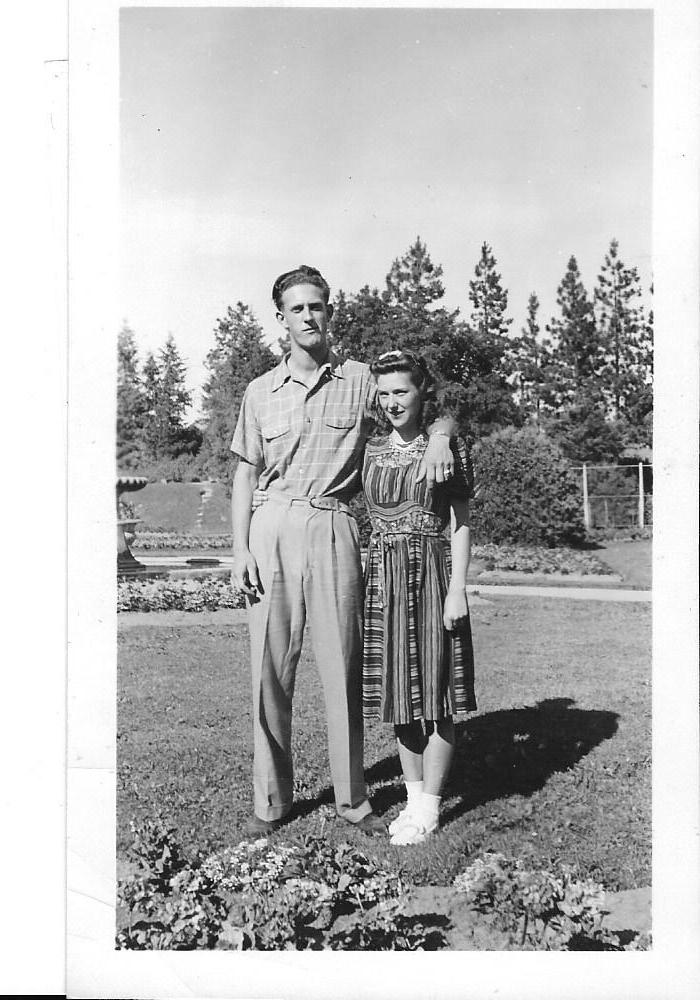
Mom, Dad, Chuck, and Dorothy

Chuck was from Montana and had enlisted in the Air Force and was sent to Fairchild. He walked into his new quarters and looked for a bunk. The place was empty except for one G.I. relaxing on a bed and reading his Bible. That G.I. was my dad.

“Tom greeted him and said, ‘The top bunk is empty. You can have that one,’ ” Christine recalled her dad saying.

The pair quickly became fast friends though initially, they didn’t seem to have much in common.

“Dad said Tom was always reading his Bible or talking about his Jesus and inviting him to church,” Christine said.

Chuck wasn’t a Christian and always had an excuse to avoid church until one day he didn’t and agreed to attend with Dad.

Two things happened quickly, Chuck became a Christian and he badgered my dad into introducing him to a cute redhead – my mom’s best friend, Dorothy Nicholl.

Mom has a scrapbook filled with photos of the four of them double dating. Picnicking at Manito Park and Tubbs Hill, posing by the falls, dressed up for church, and playing croquet at my grandparent’s Hayden home.

By this time my parents were already engaged and Chuck soon proposed to Dorothy.

“They picked out an engagement ring and Mom loved it,” Christine said.

But then my dad stepped in.

“Tom went with my dad to make a payment on the ring,” she said. “And he said, ‘Oh! I know a place where you can get one a lot cheaper!’ ”

I should mention my father’s Scottish ancestry. Tom Burnett loved a good deal and he always seemed to “know a guy” who could get him deals on everything from autos to asparagus. In this case, he introduced Chuck to the jeweler who’d made my mother’s engagement ring.

“Tom and Dad picked out Mom’s new engagement ring,” Christine said. “She never liked it. She was so disappointed.”

Dorothy died in 2014 and Christine now wears that ring. “Well, I dressed it up a little,” she said.

Another story Chuck liked to tell was how my Dad helped him find his wallet.

The four of them had been on a date at Lincoln Park. After they took the girls home, Chuck realized his wallet was missing.

“He and Tom went back to the park with flashlights and Tom found his wallet,” Christine said.

The two couples were in each other’s weddings but gradually lost touch when my dad made the military his career and was posted everywhere from Kansas to the Philippines.

Dad died in 1995, and Chuck died in July, but he never forgot my dad.

“He always said Tom was his best friend,” Christine said.

I think a lot of people felt that way.

I know I did.

Tom Burnett