Columns

Adventures in Austin

We sat squished together, our suitcases gripped between our knees.

A wall of humanity teetered in the aisle and blocked every window view. Each seat was crammed, forcing latecomers to stand and grasp for handholds as the bus shuddered and lurched down the highway.

I raised my eyebrows at my husband, and he grinned.

“It’s an adventure!” he said.

When Derek found out his annual business conference was in Austin, Texas, this year, he suggested that we go a couple of days early and have our youngest son meet us there for the weekend.

Sam lives in Odessa, Texas, which is about a five-hour drive from Austin. Plus, we’d be there just two days after his 26th birthday!

The trip costs quickly added up, so when Derek learned our hotel didn’t offer a shuttle from the airport, he proposed public transport.

“Look!” he said. “We can catch the bus outside the terminal under the giant blue guitar and the tickets are just $1 a piece!”

The transit website showed a sleek bus with room to stow our luggage.

What we boarded looked like an STA leftover circa 1990. Even more concerning, when I told the driver where we wanted to get off, he shrugged and shook his head.

Nevertheless, trusting our Google Maps, we settled in for what we thought would be a 15-minute ride.

It’s been a while since I traveled by bus, but in my experience, when the bus is full, the driver doesn’t stop for additional passengers. This logic escaped our driver, who pulled up at EVERY STOP, even when there weren’t any seats left or any straps to hang onto.

Thirty-five minutes later, we got off at what we hoped was our stop. Google said it was a four-minute walk to our hotel. So, we set off, dragging our roller bags behind us.

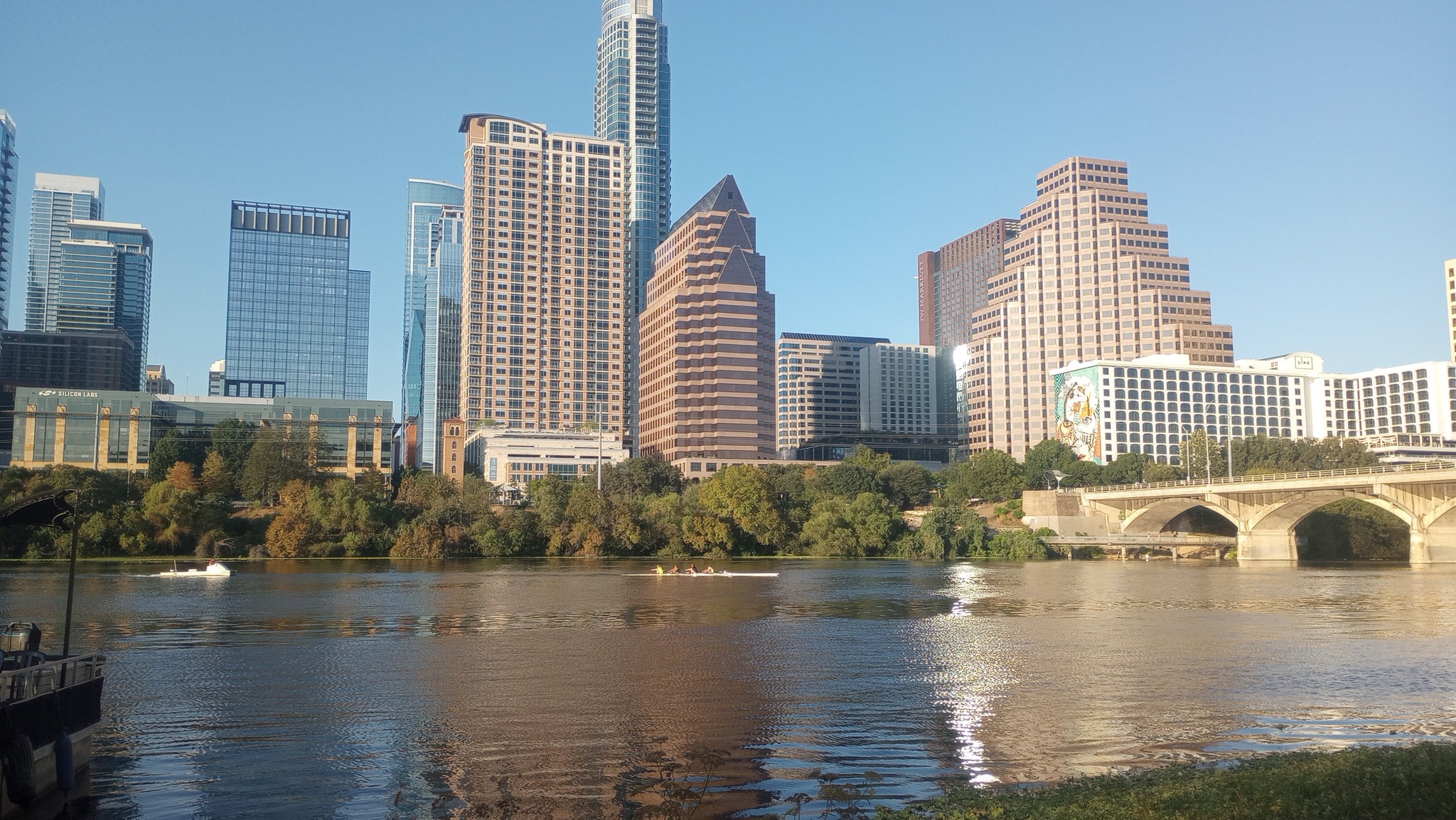
Surrounded by the towering skyscrapers of downtown Austin, my trusty navigator tried to orient us. We didn’t realize our hotel was BEHIND us. After walking for several minutes with no Hyatt Regency in sight, I spotted it while crossing the Congress Avenue Bridge.

We trudged down a set of concrete steps and found the Ann and Roy Butler Hike-and-Bike Trail, which winds around Lady Bird Lake in the heart of the city. I’d read about the trail and was eager to explore it, but didn’t realize it was unpaved and that I’d be lugging my suitcase along it.

Minutes later, we were outside the back of our hotel, looking at the beautiful pool.

“Let’s use the pool entrance,” I said.

But Derek declined, opting for the front door. He quickly regretted that choice when we discovered construction meant we’d added another quarter-mile to our “adventure.”

Eventually, we dragged our sweaty selves (it was 92 degrees) and our dusty luggage into the lobby.

Sam arrived an hour later. By then, we’d recovered enough to add another mile to our walking total, and we hoofed it to the Rainey Street Historic District.

The lively area is known for its quaint early 20th century bungalows now transformed into hip bars with live music. Strings of lights around dining patios sparkled, a street magician dealt a deck of cards on the corner, and restaurant hosts beckoned guests from the sidewalks.

You’d think my BBQ-loving spouse would have his heart set on brisket, but instead, he led us to Bangers Sausage House and Beer Garden. Men in lederhosen twirled dirndl-clad gals to polka tunes. Not quite how I’d pictured our first meal in Austin, but the food was delicious, and as we left, a country group replaced the polka band.

Saturday morning, Sam drove us to the state capitol. We explored the extensive grounds populated by moving memorials (the Texas African American History Memorial is breathtaking) before taking a self-guided tour of the building. It’s the sixth-tallest state capitol, and as we peered down from the legislative level, we saw a bridal portrait shoot in the works.

Ready for some brisket, we hit Terry Black’s Barbecue. The line wound from the sidewalk, through the expansive patio, and into the building. The eatery is run with military precision. We followed instructions and soon took loaded plates to a picnic table.

That evening, we got a little batty. The Congress Avenue Bridge is home to the largest urban bat colony in the world, with an estimated population of 1.5 million. Female Mexican free-tailed bats raise an estimated 750,000 pups each year at the bridge. Every night from around mid-March to early November, the bats emerge from under the bridge and blanket the sky as they head out to forage for food.

Our hotel was just steps away from the prime viewing point. Not long after sunset, the bats emerged, swirling and swarming high above our heads. It’s quite a spectacle, and while I’m not fond of bats, I’m even less fond of mosquitoes, so I appreciated their efforts.

Sam returned to Odessa on Sunday, and that evening Derek’s conference began. For the next two days, he attended meetings, received industry updates, and met with fellow business owners from across the nation.

Meanwhile, I basked under the brilliant blue skies and balmy 90-degree temps beside the pool, treated myself to a spa day, and read to my heart’s content.

When it was time to check out, I asked if he planned another airport bus ride.

“Nope,” Derek said. “Sam downloaded the Uber app on my phone.”

It seems my husband’s appetite for adventure had been amply sated.

Columns

Beware Banana-Toting Bandits

75278254_2607814332590511_5970967958439067648_n

When our train pulled into the tiny whistle-stop station at Dalkena, Washington, I spotted some unsavory types milling around the tracks.

A pint-size pirate, wearing a bandana over her face, clutched her grandpa’s hand and boarded the car in front of us.

Then the door to our carriage slid open, and a mean-looking hombre swaggered down the aisle. Her black cowboy hat was a dead giveaway. Everyone knows only outlaws wear them. Sure enough, within minutes the desperado barked, “All right, hand it over – gimme yer money!”

She flourished her weapon wildly at men, women and even small children.

I’d never been “robbed” at banana-point before, but I hastily stuffed some cash into her bag, and tried not to make eye contact.

Thankfully, we’d been warned in advance that train robberies frequently occur on the Scenic Pend Oreille River Train. Even better, the cash collected goes to support the many community projects of the Newport/Priest River Rotary Club, which operates the ride.

The little girl in front of us wasn’t feeling quite as generous.

When she realized the robbery wasn’t real, she turned to her mom.

“I want my money back!”

But when the whistle blew and the train lurched forward, she pressed her nose to the window, captivated like the rest of us by the autumn beauty that shone brightly despite the rain.

73236405_2607814502590494_3597753241816793088_n

“I’m so glad we did this,” my husband said, as we settled back into our seats, watching the deep green of the forest, give way to golden fields surrounded by russet maples and amber birches.

We’d been so disappointed when in 2016, the North Pend Oreille Valley Lions Club had to end the excursion train ride between Ione and Metaline Falls that they’d operated for 35 years. The ride was an item on our bucket list that we’d never got around to.

In 2017, the Newport/Priest River Rotary Club partnered with the Pend Oreille Valley Railroad to operate a new excursion ride. This time we weren’t going to miss out.

Starting in Newport, Washington, the 9-mile, 90-minute ride, follows the Pend Oreille River to Dalkena (where train “robberies” occur) and back to Newport.

The train features three classic railroad coaches and three open-air cars. The excursion operates rain or shine, and there was plenty of rain Saturday. The drizzle didn’t daunt the 300-some hearty travelers who waited to board the 1 p.m. ride.

Seating is first come, first served, so Derek and I were glad we snagged seats in “The Logger,” an enclosed coach on loan from the Spokane Railroad Historical Society.

Many came prepared with blankets and quilts, and chose the chilly seats because they offer better views than peering at the scenery through rain-streaked windows.

But no matter where you sit, the views are still spectacular.

The train runs on a historic railroad that’s one of the last short lines still operating. The track was built between 1907 and 1910 by Frederick Blackwell to transport people, logs, lumber and cement.

As we chugged along the Pend Oreille River, we saw hundreds of pilings from the long-defunct Dalkena Mill sprouting from the water. The pilings once held acres of logs. Now they provide perches for ospreys and eagles.

We traveled away from the river and across Highway 20 through forests and pastures. Sharp eyes can spot a variety of wildlife including coyotes, moose, bears, deer and turkeys.

The beautiful scenery and fresh air made us hungry, so after the ride we drove to Priest River, Idaho, and enjoyed a delicious meal at The Settlement Kitchen and Craft Tavern.

Who knew I’d have to travel to Idaho to sample my first watermelon radish? The colorful and tasty veggie was part of an appetizer featuring pumpkin hummus.

There’s still time for you to catch the train. The Scenic Pend Oreille River Train’s final excursions of the season are this weekend.

Bundle up and enjoy the ride, but beware of black-hatted, banana-toting bandits.

For more information about SPORT (Scenic Pend Oreille River Train Rides), visit sporttrainrides.com, or call (877) 525-5226.

All Write

Overcoming Obstacles to Enjoy the View

Like a prehistoric behemoth reaching mud-stained claws to snatch errant hikers and shove them into its gaping maw, the uprooted tree made a menacing obstacle.

Who knew when it had toppled? Its exposed roots jutted toward the branch-strewn trail, and drying mud made the ground soft beneath our feet.

60736272_2337547806283833_6512734287047950336_n

“I think we can get around it, just watch your step,” my husband said.

Edging forward, I said, “I’m sure glad I took that selfie before we started this hike.”

Derek paused and dropped the branch he’d been holding out of my way.

60828401_2337548272950453_2642197549024280576_n

“You took a selfie? But I took a photo of you next to the sign at the trailhead.”

He’d told me to smile, but feeling contrary and eager to start the hike, I’d squinched my eyes shut and bared my teeth at him.

I shuddered.

“Just think if we don’t make it out, that would have been the last photo our kids would have of their mom!”

I was teasing. Mostly. Our situation wasn’t dire, just a bit more challenging than we’d anticipated.

After 24 hours of luxuriating in the pools at Quinn’s Hot Springs and eating sumptuous food at the resort’s restaurant, Harwood House, we were ready to burn some calories and take in some Montana scenery that didn’t involve questionable choices in swimwear.

The sprawling Lolo National Forest offers plenty of hiking opportunities, including Iron Mountain Trail No. 242, just a few miles from Quinn’s.

It’s deemed a moderate trail, and we’re moderate hikers. The initial grade proved a bit steep, and there wasn’t much of a view at first – just lots of greenery and pretty wildflowers neither of us could identify.

“Uh oh!” Derek muttered.

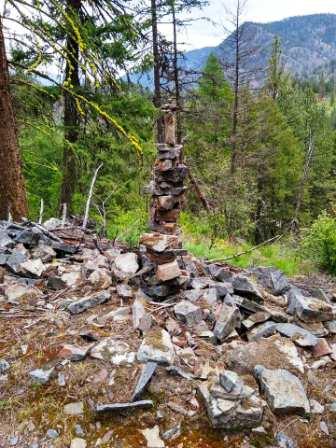
We’d turned a bend and found the trail littered with rocks. Carefully, we picked our way across the shifting stones.

Little rocks are more treacherous to footing than giant boulders. No one wants a romantic getaway to end with a sprained ankle or a trip to the emergency room.

60771254_2337547879617159_8333665867816501248_n

Some enterprising individual had taken creative license with nature and stacked a small cairn near the overlook.

Onward and upward we pressed, and now the fallen tree and its detritus offered another possible roadblock.

“We could go back,” I said, doubtfully.

Derek surveyed the carnage.

“Nah, let’s at least try to get to the first viewpoint.”

So I carefully picked a path and he followed.

Minutes later, we reached the viewpoint and gazed down at the churning brownish waters of the Clark Fork River. Surrounded by mountains and pines, we wondered how our intrepid forebears had traversed the “road” with loaded wagons drawn by teams of horses or mules, hauling silver ore from the mine to the river far below.

60630576_2337547949617152_1850539332960518144_n

Iron Mountain Road was in use until 1910, and must have originally been much wider than the trail we’d just traversed.

We could hear the distant hum of traffic on the highway hidden somewhere below us as we watched the river, swollen by recent rains, rolling in the distance. Pine branches danced in the slight breeze. A hawk wheeled silently in the sky above.

It felt good to take a break from watching our feet and watch Mother Nature instead.

The hike reminded me that it’s not always big obstacles that cause the most harm. Sometimes it’s the pesky little annoyances that trip me up and rob me of my equilibrium.

Because I work in a deadline-driven industry, I’m often guilty of keeping my head down, eyes on the project in front of me, only occasionally peering up to see what new task is around the bend.

That’s why it’s so important to sometimes simply stop. To rest. To take a deep breath, look up and enjoy the marvelous view.