Columns

Smells Like Teen Spirit

The nurse in the delivery room smiled as I pressed my nose to the downy head of my newborn son.

“He smells like angel kisses,” I murmured, besotted.

I had a nonmedicated birth, so I couldn’t blame that statement on a drug-induced haze. Nope, this was a love-induced haze.

“Enjoy it while it lasts,” said the nurse. “In about 13 years you’re going to walk into his room and gag. It’s gonna reek like ripe goat pen meets Old Spice.”

I stared blankly at her. It was like she was speaking Swahili.

That was many years ago, and of course, now I know that nurse had pretty much called it. However, I can’t attest to the goat pen analogy. In my experience (and I’ve had a lot of experience) the scent of a teenage male’s room is best described as sweaty gym socks meet crushed corn ships, mingled with soccer jersey left to mildew in the bottom of an athletic bag, topped with a cloying cloud of Axe body spray.

The odor could be marketed as a teen-pregnancy-prevention aid.

Baby boys should come with a disclaimer. The heady scent of Baby Magic lotion wears off long before they reach kindergarten and is initially replaced by the smell of dirt. Plain old dirt. Which isn’t bad, it’s a reminder of all their adventures.

Adventure-reminders also include; worms, gravel, sticks and clumps of mud left in pockets. Mud? You may ask. It was for the worms, of course. But that earthy aroma is better than what comes next.

Around age 12, the smell of dirt gives way Eau de Gag. It’s so unfair that by the time they really start smelling good again, they move out.

At one time I had three teenage boys living in my house. Trust me when I say there are not enough Yankee candles in the world to compensate.

Change in body odor is one thing, but the universal shift in attitude as boys transition from teens to young men – well, that’s something impossible to mask.

Eye-rolling “whatevers” often replace heart-to-heart conversations. The chattiest of teens suddenly embraces sullen silence, and sometimes the silence is shattered by angry words and accusations that fly through the home polluting the atmosphere more than gym socks and body spray ever could.

And the things we find in pockets are far more sobering than worms.

Even when you know this necessary bid for healthy separation and independence is coming – when you know this is the natural order of things – it’s still painful.

As they grow, we lovingly support their independence by giving them safe places to explore. But when they can drive and spend long hours away from our watchful eyes, they sometimes explore places we’d rather protect them from.

Now, with just one teen left at home, these pitfalls don’t dismay me and instead of clutching him more tightly, I hold him more loosely than I did his older brothers.

Because I know what comes next. If you can weather those turbulent teen years, a really nice young man may come home to visit you. And he’ll actually choose to spend time with you.

Last weekend, one of those young men came home for dinner. As I reached up and wrapped my arms around my oldest son, he pressed his whiskery cheek against my forehead.

I hugged him, and somewhere beneath the cigarette smoke and shampoo, I caught the faintest whiff of my baby boy. Time blurred, melted and stopped momentarily, as I closed my eyes, breathed deeply and held him tight.

This I know. If someday my eyesight fails, if my hearing declines, if I lose my sense of touch, I will always recognize this man I call my son. His infant scent is embedded in our mutual DNA. To me he still smells like angel kisses.

Contact Cindy Hval at dchval@juno.com. She is the author of “War Bonds: Love Stories From the Greatest Generation.” You can listen to her podcast “Life, Love and Raising Sons” at SpokaneTalksOnline.com. Her previous columns are available online at spokesman.com/ columnists. Follow her on Twitter at @CindyHval.
Columns

For Summer’s Sake

My new business cards arrived in the mail recently. They read “Spokane County Court Services, Cindy Hval CASA/Guardian Ad Litem.”

I’d heard about the CASA program many years ago. When a petition has been filed alleging a child has been abused or neglected, the Juvenile Court appoints an individual to serve as a court appointed special advocate.The role of a CASA is to represent the best interest of the child by making independent observations of the child’s situation and submitting a written report to the court.

After 30 hours of training, plus my first in-service, I’ve already been assigned my first case.

But it was another child I thought of as I held the business cards in my hand – she’s the reason I wanted to be a CASA in the first place.

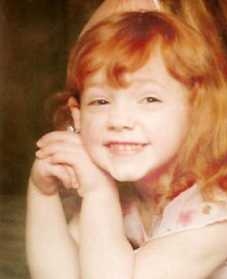
Her name was Summer Phelps and she died on March 10, 2007, at age 4 – her body a broken, bruised and bloody roadmap of the abuse she’d suffered at the hands of her father and stepmother.

My brother-in-law was the ER physician on duty the night Summer was brought into Deaconess Hospital. She arrived with no pulse and no breath sounds, but he and the medical staff fought desperately to bring her back.

“After 20 minutes, I had to call it,” said my brother-in-law, recalling that night.

It was the worst case of abuse he’d ever seen. He doesn’t talk about Summer, or what he saw on her battered little body that night – but she still haunts his nightmares.

Eventually, Summer’s father and stepmother were convicted of homicide by abuse. I struggled to read the newspaper accounts of the trial. Reading it again while writing this column hasn’t diminished the horror. I walked away from my desk many times – my stomach knotted, my eyes blurred with tears.

Ten years ago, I vowed to do something to help the children in our community, but at the time my hands were full with my own family.

In January when a friend mentioned she was taking the CASA training, I remembered that promise, and at her urging, signed up.

I’m glad I did because the need is great.

“We average 52 kids a month coming into the system,” said Patrick Donahue, CASA/GAL program coordinator and Juvenile Court volunteer coordinator. “We have six staff GALs (guardian ad litem) who advocate for an average of 65-75 kids each.”

The roles of a CASA and a GAL are identical; CASA just means they are volunteers. Currently, 142 active volunteers represent about 370 children.

“CASA volunteers are vital to the dependency process in that they advocate for fewer children and can be more involved in the overall advocacy for the children’s best interest,” Donahue said. “Children with a CASA volunteer may spend less time in the dependency process in that their cases may resolve sooner. They typically have fewer disruptions in placements and their overall time in foster care can be more positive with a CASA volunteer.”

CASA volunteers meet regularly with the child/children they’re assigned to. The kids typically range in age from newborn to 12 years. CASAs ask questions and observe the child’s living conditions. They talk with the parents, the foster parents, teachers, doctors and day care providers to assess how the child is doing.

The ultimate goal is to reunite the parents with their child if the parents can provide a safe and stable environment. A CASA’s recommendation to the court offers an important independent insight and can be a significant factor in deciding what’s ultimately best for the child.

“Spokane takes great pride in hearing foster children say, ‘My CASA was the one person in my life at that time that was always there for me.’ ” Donahue said.

That isn’t to say every dependency case ends in happily ever after. The scars of emotional trauma and abuse can linger long after physical scars heal. The pain of being separated from parents can have lasting consequences. Not every child gets a healthy, intact family and a house with a white picket fence, but at the bare minimum they can have a safe home, free from violence and neglect.

The kind of home Summer Phelps deserved.

SUMMER PHELPS

Summer Phelps

Contact Cindy Hval at dchval@juno.com. She is the author of “War Bonds: Love Stories From the Greatest Generation.” You can listen to her podcast, “Life, Love and Raising Sons,” at SpokaneTalksOnline.com. Follow her on Twitter at @CindyHval.

To volunteer

The next CASA training begins April 11 and runs 5:30-8:30 p.m. Tuesdays and Thursdays until May 9, plus one Saturday morning, April 15 from 8:30-12:30. For more information about the training email Patrick Donahue pdonahue@spokanecounty.org or call (509) 477-2469.

For more information about CASA, visit www.spokanecounty.org.


Columns, War Bonds

Keeping my promise: A personal Pearl Harbor reflection

This week The Spokesman Review published a special keepsake section commemorating the 75th anniversary of the attack on Pearl Harbor. For the past nine years, I’ve been interviewing Pearl Harbor survivors for newspaper and was pleased to have many of those stories included.

In addition I wrote the following piece describing what it meant for me to visit the place I’d written about so often.

Never forget.

Cindy Hval, who wrote “War Bonds: Love Stories From the Greatest Generation,” visited Pearl Harbor in March. She explored places she had learned about in nine years of interviewing Pearl Harbor survivors.

Stretching out, I pressed my cheek into the hot sand, its gritty heat almost too much to bear. Closing my eyes, I imagined the shriek of airplane engines and the spitting sound of machine gun fire hitting the beach, while the air around me burned.

I covered my head with my arms, and could almost hear the whistling sound of bullets whizzing past my ear.

A shadow loomed. “Are you okay?” my husband asked.

Slowly, I sat up and scooted back onto my brightly-colored beach towel.

“Just thinking about Nick,” I said, while I slipped on my sunglasses.

The beauty of being married 30 years is I didn’t have to explain what I meant.

Derek and I visited Oahu in March to celebrate our anniversary, but the trip was part pilgrimage for me. After nine years of interviewing Pearl Harbor survivors, I was at last visiting the place I’d written about so often.

Here on Waikiki, I was just 12 miles away from Hickham Field where Nick Gaynos almost lost his life on Dec. 7, 1941.

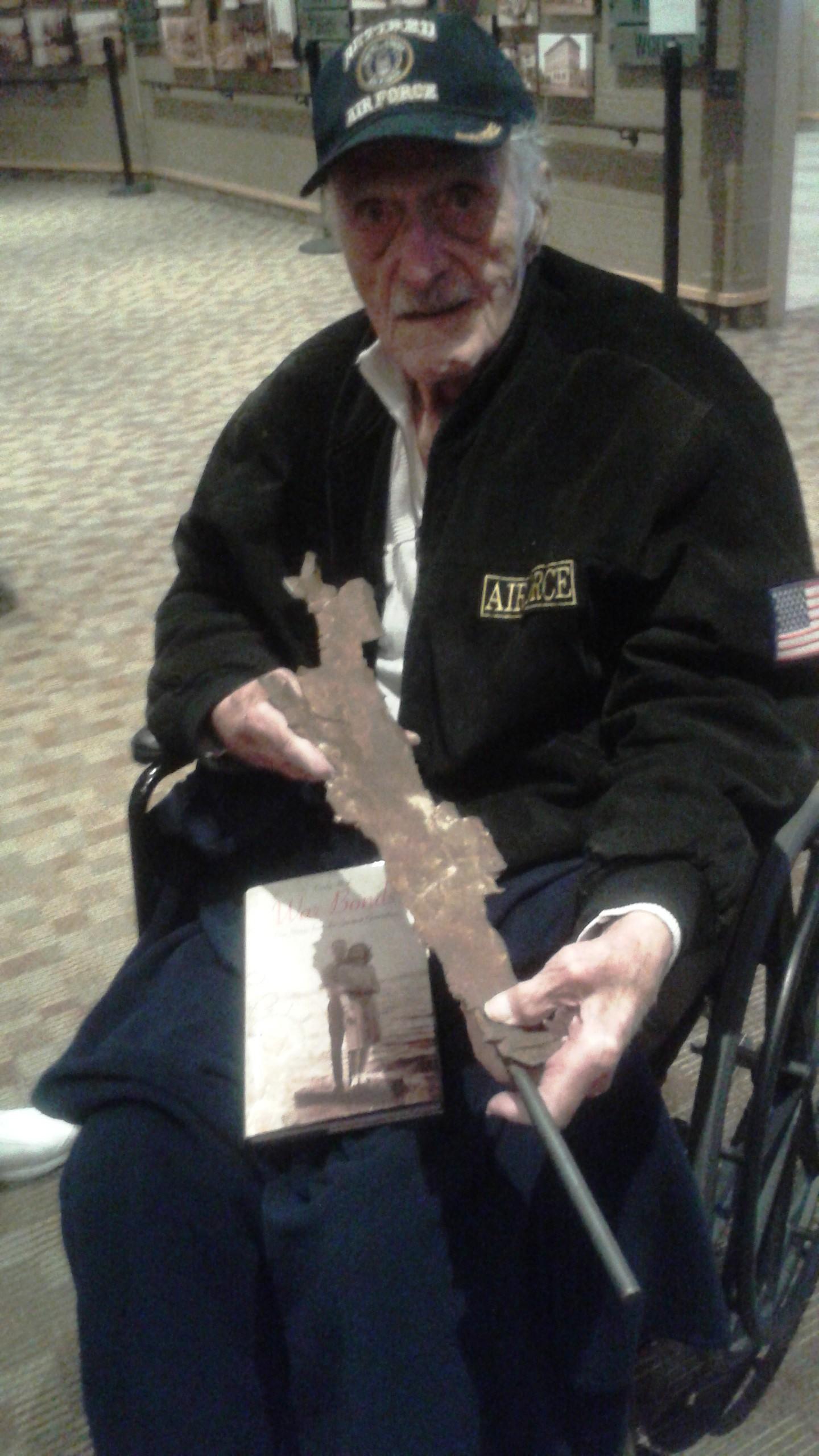
Nick Gaynos holding the piece of shrapnel that landed near him while under fire during the attack on Pearl Harbor 75 years ago. Gaynos died 20 days after this March 11, 2015, photograph. (Courtesy Cindy Hval)

During the attack on Pearl Harbor, Nick had been running toward his duty station when a Japanese pilot targeted him. He’d told me of looking up as he ran and seeing the grin on the pilot’s face as he fired at him.

Nick hit the beach and covered his head with his arms as the bullets flew. When he got up he discovered a large piece of shrapnel next to him.

“I grabbed it,” he said. “It was still hot from the explosion.”

When my book “War Bonds: Love Stories From the Greatest Generation” was released, Nick attended a reading at the Coeur d’Alene Public Library in March 2015. He brought that piece of shrapnel with him. It was jagged and more than 2 feet long. He died a few weeks later.

Now, on the island that had been so devastated by the horrific attack, I carried his memories with me as well as those of Warren and Betty Schott. The Schotts had quarters on Ford Island and were eyewitnesses to the attack.

When Derek and I walked through the entrance of the Pearl Harbor Visitor Center, I wanted nothing more than to talk to Betty, to tell her I was here. But Betty passed away in July 2015.

At the center, we watched a short film featuring actual footage of the attack. A scene of sailors and soldiers pulling the wounded and dead from the harbor made me gasp. That’s what Warren had done in the aftermath – it was the one thing he didn’t want to discuss with me over the course of many interviews. It was the only thing he refused to speak of with his wife of 76 years. Now, watching the footage through tear-filled eyes, I finally understood why he was loath to speak of it.

That horror was also all too real for my friend Ray Daves. During the attack, he hustled to a rooftop and handed ammo to two sailors who were manning a .30-caliber machine gun. He had his own brush with death when a Japanese plane exploded 20 feet from that rooftop before crashing into the sea below. His left hand was lacerated by shrapnel.

Like Warren Schott, Ray spent time pulling wounded men from the harbor, his blood mingling with the red splashes in the water around him. In his biography, “Radioman,” he described the bodies and body parts floating in the harbor. “We had to push them aside to get to the wounded,” he said.

Despite those gruesome memories, what really choked him up was recalling the bombing of the USS Arizona.

“My friend George Maybee was on the Arizona,” Ray said. “We’d gone through radio school together. Sat beside each other every day and were bunkmates at night.”

Ray Daves

“My friend George Maybee was on the Arizona,” Ray said. “We’d gone through radio school together. Sat beside each other every day and were bunkmates at night.”

He watched as the Arizona burst into a huge fireball. He knew his friend was gone.

Over the years, Ray and I grew close. He reminded me so much of my dad. They were both from Arkansas and had joined the military seeking a way out of the poverty of the rural south. Both had tender hearts and shared a wickedly funny sense of humor.

The last time I spoke to Ray before his June 2011 death, I told him I longed to visit Pearl Harbor.

“George is there,” he said, his eyes filling.

“I’ll look for his name,” I said. “I’ll say a prayer.”

Ray took my hand. “You do that, sweetheart.”

Five years later, I boarded the boat that took us to the USS Arizona. As we stepped from the boat onto the memorial, the throng of tourists quieted. The only sound was the snapping of the flag in the wind and the clicking of cameras.

We were somber with the knowledge that we were standing on the final resting place of 1,102 of the 1,177 sailors and Marines killed on the Arizona.

1913753_1047614618610498_5611130893995793483_n[1]A rainbow of undulating color in the water below caught my eye. Some 500,000 gallons of oil are still slowly seeping out of the ship’s submerged wreckage, and it continues to spill up to nine quarts into the harbor each day.
Slowly, I entered the shrine. A marble wall bearing the names of those entombed beneath us stretched out behind a velvet rope.

So. Many. Names.

Overwhelmed, I looked at Derek. “I’ll never find him,” I whispered.

The day had been overcast, but suddenly a shaft of sunlight illuminated the marble.

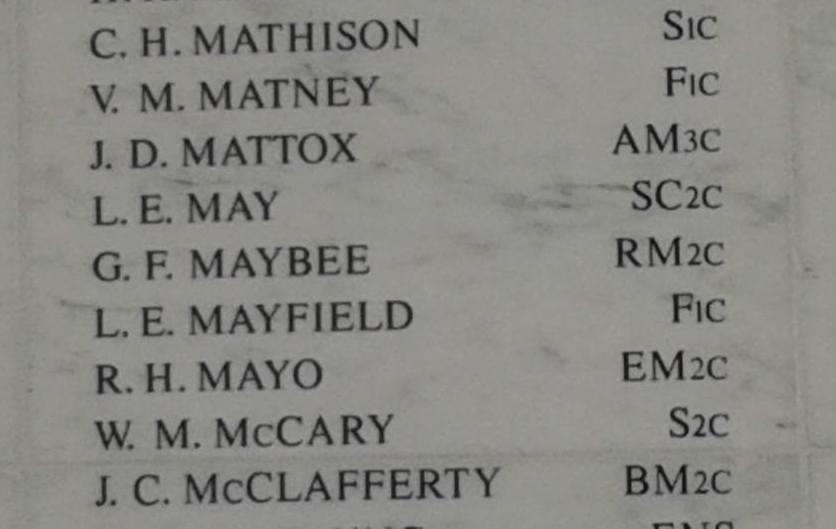
“There,” Derek said. “There he is – G.F. Maybee.”

George Frederick Maybee was a radioman, second class, aboard the USS Arizona when the battleship was bombed on Dec. 7, 1941, at Pearl Habor. Maybee, whose name is etched in a marble wall at the Arizona memorial, had been a friend of Ray Daves, a Pearl Harbor survivor from Deer Park who died in 2011. (Courtesy Cindy Hval)

Bowing my head, I wept for the sailor I’d never met and for my friend who knew and loved him.

I hope that somehow Ray knows I kept my promise.

George Maybee hasn’t been forgotten. Neither has Ray Daves.


Columns

Family, friends, foes and Facebook: Election 2016

There’s a reason I keep my Facebook page politics-free, and it has little to do with being a journalist.

I don’t like conflict. I don’t like name-calling, and I really, really don’t like intolerance and ignorance.

Sadly, there’s nothing like a contentious election season to bring out all of the above. But I purposely keep my political views to myself. In fact, for someone who’s written a column about her underwear, I’m actually an intensely private person. Imagine my surprise when I found myself unfriended by a family member following the election.

My apparent offense? I “liked” a comment another family member had left that repudiated a label often used during passionate political posts. The label? “Privileged white male.” The PWM in question explained why he was tired of his opinions being dismissed with this label and I liked his explanation.

Bam. Apparently, hitting the like button on that comment exceeded her tolerance level. Keep in mind I’d never disagreed or argued with anything this person had posted.

I’m not alone in my experience. A friend was banished from Facebook friendship by a family member because he admitted he’d left the presidential spot blank on his ballot. He couldn’t stomach either option, so he did what he felt was honorable.

He was accused of being a sexist, racist jerk and told that he should … well, I can’t print the rest of the rant in a family newspaper.

When imagined incorrect interpretations are applied to Facebook likes, when rage and rhetoric rule the day, how then can our country and our community move forward? Is it possible to stand and fight for causes and people we’re passionate about without dipping buckets into wells of hatred and splattering others with venom and vitriol?

I’d like to think it is. Perhaps part of the solution is getting to know the “other” among us.

In the weeks preceding the election I had coffee with a friend who said she honestly didn’t know anyone who would vote for Donald Trump. She was joyfully planning a small voting victory party for election night.

That same week I had lunch with a friend who said she didn’t know anyone who would actually vote for Hillary Clinton. “Of course, that doesn’t mean she won’t win,” my friend said. “It’s just that I can’t imagine anyone I know choosing her.”

My reticence renders me like Switzerland, so both of these friends felt comfortable tossing around labels about people who would vote for the candidates they opposed.

“Underclass, undereducated, sexist bigots,” my liberal friend opined.

“Sensitive snowflakes, elitists and whiny millennials,” my conservative friend asserted.

And therein lays the problem. The minute we apply a blanket label to anyone who may vote differently from us, we’ve ensured our bubble is intact. We have become so comfortable in our social and political isolation that we have lost touch with the wider world.

This past week I’ve seen an outpouring of grieving and gloating on social media, and while the hateful rhetoric of some shocked and saddened me, I was relieved that my closest circle of friends had more measured thoughtful reactions.

Whether frightened or hopeful about the next few years, I hope the path forward will include listening and learning from those who differ from us. Hatred can never be part of the solution.

Violence won’t beget tolerance or peace. Rage doesn’t lead to enlightenment.

Our children are watching. They’re listening to our words. They’re reading our posts on social media. If we truly want to create a safe world for them to thrive in, we owe it to them to forge ahead with courage and to take every opportunity to choose love.

The words of Martin Luther King Jr. have never been more apt, “I have decided to stick with love. Hate is too great a burden to bear.”

Contact Cindy Hval at dchval@juno.com. She is the author of “War Bonds: Love Stories From the Greatest Generation.” You can listen to her podcast “Life, Love and Raising Sons” at SpokaneTalksOnline.com. Her previous columns are available online at spokesman.com/ columnists. Follow her on Twitter at @CindyHval.

Columns, War Bonds

Of Boys Lost and Boys Found

Spoiler alert: This week’s column has a happy ending. I wish all stories about lost children could end the same.

Stepping lively, I dodged traffic cones dotting the street, thankful the end of roadwork season is almost here.

I savored the glorious October sun, knowing my regular treks around the neighborhood will soon be replaced by boring indoor workouts at the gym.

Adjusting my headphones, I cranked up my walking music and my pace. A tug on my arm startled me. I’d been so focused on boosting my heart rate, I had failed to notice the approach of two small boys.

“Do you know where Standard Street is?” one of them asked. “We’re lost.”

If this scenario sounds familiar to readers, I’m not surprised. I seem to collect lost boys the way other folks collect license plates or trading cards. From a tiny autistic boy who’d escaped from his house to play on a busy street one Sunday morning, to Ricky who got confused when he got off the school bus one afternoon, I seem to be a lost-boy magnet. This time there were two of them looking at me with anxious eyes.

I’m embarrassed to admit my route is so familiar I don’t pay attention to street names.

“I think we’re on Standard,” I replied. “But there’s a sign on the corner – let’s check.”

We approached the sign and verified we were on Standard, but the boys weren’t reassured.

“Actually, we need to know where Lyons Street is,” the spokesboy said.

“What’s your address?” I asked.

Two pairs of eyes stared at me blankly.

“I don’t know it,” the smaller boy said.

“Me either,” his friend admitted. “But it’s apartments.”

Taking a deep breath, I asked them their names and ages.

“I’m Marc with a ‘c,’ and I’m 9,” the taller boy said.

“I’m Luis, and I’m 8,” his friend replied.

I asked them how they got lost.

“Well, we got off the bus at a friend’s house after school,” Marc said. “But he couldn’t play, so we decided to walk home, but we don’t really know where we are now.”

“What school do you go to?” I asked.

“Linwood Elementary,” he replied.

Linwood is about 2 miles away from my Shiloh Hills neighborhood and across bustling Division Street. They couldn’t remember where they’d gotten off the bus.

As we chatted, we kept walking because I assured them that Lyons was north of Standard, and if we kept walking north hopefully they would be able to spot their apartment building.

“How about I call your parents?” I offered as we walked. “Maybe one of them can come pick you up.”

It was 4:20 and the boys said the bus usually had them home by 3:30.

“We’ve probably been walking for HOURS,” opined Luis, who didn’t know his phone number.

Marc said his mom was home and gave me her number. I called repeatedly from my cellphone as we walked, but no one answered.

“She has MS and sometimes she doesn’t answer the phone,” he said. “Especially if she doesn’t know who’s calling.”

By this time we were almost to my house, and I estimated they still had at least a half-mile to walk.

“If I give you guys a ride do you think you could show me your apartment building?” I asked.

“Yes!” said Marc.

“My legs are really tired,” Luis admitted.

I offered them some water, but they declined.

“I’d like some crackers if you have some,” said Luis.

I dashed inside to grab my purse and discovered we were out of crackers.

“What are you doing?” my son, Sam, asked.

“Taking some lost boys home,” I replied.

“What? Again!?” he said, shaking his head.

The boys buckled up and Marc opined that my car was similar to his mom’s. He knew the make and model of her car. It would have been more helpful if he knew her address.

However, as we approached the neighborhood park, they got excited.

“Hey! I know where we are now!” Marc yelled. “We’re almost home!”

Sure enough, he spotted their apartment building and I dropped them off.

When I wrote about my afternoon adventure on Facebook, a friend said, “I hope you gave them a lecture about getting in cars with strangers once you safely delivered them home!”

Honestly, I was just so relieved I’d been able to get them home; I never thought to scold them. I did lecture them about learning their addresses.

“You need to know the name of the apartment complex and the street address,” I’d chided.

They’d both just shrugged and nodded.

My relief at the happy outcome gave way to dismay. I wished I’d scolded them about getting off the school bus at someone else’s house without first making sure they had permission. I was horrified that they seemed to think it was acceptable to go to a stranger’s house and then get into her car.

They were so trusting and sweet and had absolute confidence in my ability to get them home. And that’s what really made me sad.

Because I’d like to think we live in a world where grown-ups are trustworthy. Where parents have confidence that when their children are out of their sight, other adults are watching out for them.

And mostly, I want to believe that all lost boys return home safe and sound.

Contact Cindy Hval at dchval@juno.com. She is the author of “War Bonds: Love Stories From the Greatest Generation.” You can listen to her podcast “Life, Love and Raising Sons” at SpokaneTalksOnline.com. Her previous columns are available online at spokesman.com/ columnists. Follow her on Twitter at @CindyHval.

Columns

In which I enjoy being a girl

Today’s Spokesman Review column finds me attempting to update an old song.

If there’s one remark guaranteed to rain down the wrath of Mom upon my sons, it’s when one of them says to the other, “Don’t be such a girl!”

Using gender as an insult is a nonstarter in my house.

Besides, as Doris Day famously sang, “I enjoy being a girl” – at least most of the time.

The 1958 Rodgers and Hammerstein show tune is fun to sing, but the lyrics are definitely not contemporary.

I’m a girl, and by me that’s only great!

I am proud that my silhouette is curvy,

That I walk with a sweet and girlish gait

With my hips kind of swivelly and swervy.

Let’s be honest here. After birthing four sons and reaching my fifth decade my silhouette’s curves are decidedly more pronounced. Are spheres curves? I’m not sure. I didn’t do well in geometry.

Also, my gait is no longer girlish. In fact, many mornings I limp to the kitchen to get my first cup of coffee due to a strained Achilles.

I still take the stairs two at a time, if by two at a time you mean carefully placing one foot and then the other on each stair before descending.

I adore being dressed in something frilly

When my date comes to get me at my place.

Out I go with my Joe or John or Billy,

Like a filly who is ready for the race!

We’ve already established that I’m not racing anywhere. I also no longer wear something frilly due to the aforementioned dangerous curves.

Fifty may be the new 30, but 30-year-olds are dressing like teenagers, so shopping is complicated. I recently bought some trendy jeans, artistically ripped in strategic places.

My husband said, “I could take a razor to your old jeans and save you a lot of money.”

“But, I’ve got bling! On my butt!” I replied, twirling around to show him my jewel-encrusted back pockets.

He started humming “Rhinestone Cowboy.”

I hummed “Sleeping Single in a Double Bed.”

Game. Set. Match.

When I have a brand new hairdo

With my eyelashes all in curl,

I float as the clouds on air do,

I enjoy being a girl!

My sons used to pluck out a stray gray hair whenever they’d appear. A few years ago, my youngest announced, “I don’t think we should be pulling out your grays – you’re gonna get bald.”

So, now my new hairdo involves regular appointments for highlights – not to cover the gray, but to camouflage it. It doesn’t cause me to float on air, but it does lighten my wallet considerably.

When men say I’m cute and funny

And my teeth aren’t teeth, but pearl,

I just lap it up like honey

I enjoy being a girl!

Men do say I’m cute and funny and I love that. Of course, the men who tell me that now are generally over 70 or under 20.

Also, my teeth aren’t pearls, but there’s definitely some silver and a few crowns involved.

I flip when a fellow sends me flowers,

I drool over dresses made of lace,

I talk on the telephone for hours

With a pound and a half of cream upon my face!

OK, here’s the deal. I learned long ago, that while flowers from a guy are sweet, I can buy my own roses any time I want – no need to wait around for Valentine’s Day. And I like lace as much as the next gal, but not necessarily where it can be seen by the public, if you know what I mean.

I’ve come to terms with moisturizers, eye cream, toners and “miracle” repair, but I draw the line at a pound and a half of cold cream. Actually, the only cold cream I have is in the refrigerator and I pour it in my morning coffee.

Who talks on the phone for hours anymore? Texting and instant messaging are much more efficient. However, I rarely use emoticons. Especially after I sent what I thought was a chocolate cupcake to a friend on her birthday. Apparently, there are poop emojis. Lesson learned.

And one lesson I hope my sons have learned is that “being a girl” is not an insult. After all, without this girl, they wouldn’t even be here.

Contact Cindy Hval at dchval@juno.com. She is the author of “War Bonds: Love Stories From the Greatest Generation.” You can listen to her podcast, “Life, Love and Raising Sons,” at SpokaneTalksOnline.com. Her previous columns are available online at spokesman.com/ columnists. Follow her on Twitter at @CindyHval.

Columns, War Bonds

Magic, Make-Believe and Me

In this column for the Spokesman Review, I address the importance of keeping magic and make=believe alive for our children– especially now.

I was smiling as we walked out of the movie theater into the warm summer night.

“That was absolutely magical,” I said.

My sons, 16 and 21, nodded, but they didn’t seem as enthralled by “The BFG” as I’d been. The movie, based on the book by Roald Dahl, tells the story of an unlikely friendship between an orphan girl named Sophie and the Big Friendly Giant. The two join forces to rid the world of mean, nasty giants.

I loved the retelling. It brought back memories of curling up and reading the book with my second son, who was notoriously difficult to get to sit still and read anything at all. Dahl’s books were just scary enough and just off-kilter enough to capture his imagination and still his ever-churning legs.

 The week before, we’d seen “Finding Dory,” and both sons preferred that movie to “The BFG.”

Not me. While “Dory” was a fun film with great visual elements, humor and a compelling message, it lacked the heart of “The BFG.” It lacked magic.

For me, the best part about being a parent has been the ongoing permission to indulge in my love of make-believe. From sharing beloved childhood favorite films and books with my boys to discovering new stories and new adventures with them, parenthood has allowed me to retain a bit of the ability to believe in the impossible.

Perhaps that’s why I reacted so strongly when my youngest got in the car one day after kindergarten and announced, “There’s no such thing as Santa Claus.”

Furious, I whipped around and gave his older brothers the “look” – you know the scary glare meant to stop even the naughtiest child in their tracks. My offspring have dubbed it “Mom’s Death Ray.”

“Don’t look at us!” said Zack, then 11, “We know Santa is real!”

Taking a deep breath, I asked, “Why do you say that, Sam?”

“Tyler’s mom helped us with Christmas crafts today, and we were talking about what we wanted Santa to bring us for Christmas. She said, ‘Santa Claus is a made-up character, and he doesn’t take presents to children all over the world.’ Is she right? Is there really no such thing as Santa?”

I looked into his troubled blue eyes and tried to gauge his desire to know with his longing to believe.

So, I reminded Sam of the story of St. Nicholas and how he used his wealth to give to the poor and needy. I told him the story of Santa Claus came from St. Nicholas’ and asked him what he thought.

He scratched his head, looked at his brothers and then replied, “Oh, he’s real all right, but I think he has help getting all those presents delivered.”

Crisis averted. Magic preserved.

I know not all parents agree that a healthy dose of make-believe makes for a happy childhood. For instance, one of my sons told me of a millennial parent in his acquaintance who told him that allowing his preschoolers to believe in Santa and the Tooth Fairy is the same as lying to them, and he will never lie to his kids.

But children are not miniature adults. The brain, body and emotions of a 5-year-old boy are not equivalent to those of a 30-year-old man. Fairy tales and make-believe allow imaginations to soar. They create a sense of wonder and possibility.

These past few weeks have made it difficult for many of us to hold onto any sense of hope, wonder and enchantment. The world can be a harsh, unlovely place. Maybe that’s why we need stories of magic and mystery all the more.

In a darkened theater we can watch a blue fish with memory problems cross the ocean to find her family, or see a little girl have tea with the queen of England and help banish evil giants from the land.

Stories offer us a respite from ugly reality and fan the flames of flagging faith, encouraging us to believe in the unbelievable, at least for a little while.

Contact Cindy Hval at dchval@juno.com. She is the author of “War Bonds: Love Stories From the Greatest Generation.” Her previous columns are available online at spokesman.com/ columnists. Follow her on Twitter at @CindyHval.

Columns, War Bonds

The Scrapbook

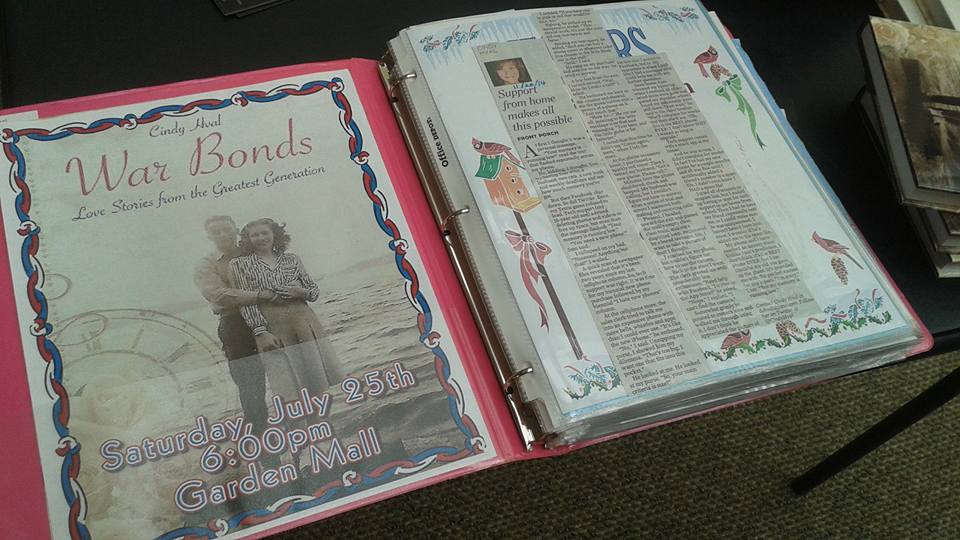
It’s been almost six months since my first book, War Bonds: Love Stories From the Greatest Generation was released. I’ve signed hundreds of copies, but at a recent reading I was asked to sign something that brought tears to my eyes.

A sweet lady approached me before the event began and said, “I’m wondering if you will sign something for me?”  And she pulled out a bulging scrapbook from her basket.

War Bonds at Fairwood

It was filled with clippings from from my Spokesman Review newspaper column, The Front Porch.

“I’ve been saving them for years,” she said.

So, I blinked back tears and happily signed her scrapbook.

Writers are nothing without readers. To think my columns mattered enough for her to save delighted me. It also made me happy that my next book will be an anthology of those columns. Who knows? Maybe in a few years I’ll be doing another reading at that venue and this time I’ll have my own “scrapbook” of sorts, to sign.

Columns

Saying goodbye to Betty

Today’s Spokeman Review column.

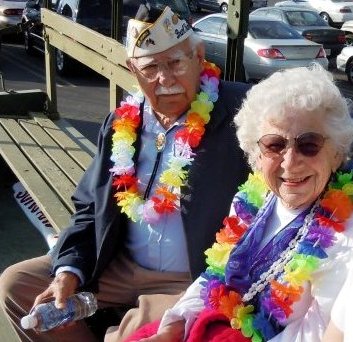
Betty Schott (seated) wears a lei at a ceremony in 2014 to commemorate the 73rd anniversary of the attack on Pearl Harbor.

I loved to listen to her talk.

Though soft-spoken, Betty Schott, 98, had a sharp mind and an even sharper sense of humor. She smiled easily, laughed often, and called me “honey.”

But when her husband of 76 years died in May 2014, her smile faded and the quips didn’t come as quickly.

Adjusting to life without her beloved wearied her.

On Sunday, Betty died, 80 years and one day from the anniversary of her first date with Warren Schott.

I met the Schotts in 2007 when I interviewed them for my Love Story series. It was the start of a friendship that spanned eight years and immeasurably enriched my life.

From the beginning, a no-nonsense Warren assured me their story was no romantic tale. In fact, all those years ago, when a friend offered to set him up on a blind date with Betty, Warren scoffed, “Don’t do me any favors.”

He was a young sailor, not in the least interested in finding true love. But on July 4, 1935, love found him in the form of a beautiful, petite North Central High School graduate named Betty Forest.

They were married April 2, 1938, at the Wee Kirk O’ the Heather chapel at Forest Lawn Cemetery in Los Angeles.

When I attended their 75th anniversary celebration, Betty quipped, “Well, we got married in a cemetery and honeymooned in Death Valley, so we got all that out of the way!”

But as Pearl Harbor survivors, the Schotts saw more than their share of death.

Warren had been sent to the Naval Air Station at Pearl Harbor shortly after their marriage. Betty was determined to join him and worked until she earned her passage. She arrived on Ford Island in 1939 and they settled into a tiny apartment near Battleship Row.

Their bedroom overlooked the island’s runway, so they were accustomed to noise, but the sounds that woke them on Dec. 7, 1941, were unlike any they’d heard before.

Betty pulled on her robe and looked out the bathroom window. “Warren!” she called, “there’s smoke and fire at the end of the runway.”

Warren went to another window and spotted a plane flying low overhead. “I saw the red balls on the wings of the plane,” he said. “I watched that plane torpedo the USS Utah. I said, ‘Betty, we’re at war!’ ”

While Betty filled fire extinguishers with other civilians in a supply warehouse, Warren had the grim job of pulling the dead and injured from the harbor. The men he pulled out of the water were covered in oil. Afterward, Betty discovered, “They got rid of every towel in my house trying to help clean them up. Finally they took down my kitchen curtains and used them.”

Over the years, they talked about everything, but on one topic Warren remained silent. “He never talked about the people he pulled out of the oily water that morning,” Betty said. “Never.”

It was often painful for them to share their memories. “Slamming a door for days after the attack would make you jump,” Betty said, recalling the terrible noise and confusion they experienced.

But the Schotts felt it was their duty to tell their story and to honor those who died that day.

Though they didn’t think their 76-year marriage was anything remarkable, they were tickled that their story was included in “War Bonds: Love Stories From the Greatest Generation.”

When I visited with Betty in December while working on a story about the 73rd anniversary of Pearl Harbor, I returned some photos she’d let me use for the book.

She reached up and patted my cheek with her soft, timeworn hand. “I’m so proud of you, honey,” she said. And it felt like I’d received a blessing from my grandmother.

What I remember most was my last visit to her home – the home Warren had built, the home they’d shared for 65 years.

The plaque I’d seen years earlier still hung in the kitchen. It read, “Happiness is being married to your best friend.”

Warren’s death had left her adrift. She missed him so much, and she swore sometimes she could still see him sitting in his chair. She’d blink or turn her head and he’d be gone, but his presence was so real to her, his voice so compelling. Her own voice quavered when she said, “Every night at 11 p.m., he’d say, ‘Honey, now it’s time to go to bed.’ ”

That’s why I would not be at all surprised if on Sunday morning, Betty heard him whisper, “Honey, now it’s time to come on home.”

And of course she went to him. How could she not? She said, “He’s been my best friend for 77 years.”

Contact Cindy Hval at dchval@juno.com. She is the author of “War Bonds: Love Stories From the Greatest Generation.” Her previous columns are available online at spokesman.com/ columnists. Follow her on Twitter at @CindyHval.

War Bonds

Saying goodbye is the hardest part

When you write a book about WWll veterans who are in their 80’s and 90’s you know your time with them is limited, but it doesn’t make saying goodbye any easier.

Betty Schott died on July 5. She and her husband, Warren, survived Pearl Harbor together and their marriage spanned 76 years.

Betty 2Warren and Betty Schott appearing in the Armed Forces Lilac Parade in Spokane, May 2010.

In this week’s Spokesman Review column I say goodbye to Betty, one of the sweetest, wisest, kindest women I’ve ever known.

Her last words to me were, “I’m so proud of you, honey.”

You can read the column here.  Or here.