War Bonds

Shop Small With Me!

Mark  your calendars for Indies First, November 25 at Auntie’s Bookstore.

Check out the array of amazing authors who will serve as volunteer booksellers!  I’ll be on duty from 1 Pm- 3 PM and would love to help you find literary treasures to fill your Christmas wish lists.

Support a fabulous Indie bookstore, buy great books and chat with the people who write them.
What could be more fun?

DNkze9mVwAACyOD[1]

All Write

Preview my new book “Tiaras & Testosterone”

On Friday night, October 27 at Auntie’s Bookstore in Spokane I’ll be reading a sneak peek of Tiaras & Testosterone as part of author Kay Dixon’s launch of her newly released book Tales of Family Travel: Bathrooms of the World.

Kay has four daughters and I have four sons– we’ve got the family bases covered, and we covered it (and survived) with a huge amount of humor.

My first book War Bonds: Love Stories From the Greatest Generation (Casemate 2015) has been well-received and is still garnering great reviews. This time I’m tackling a more personal topic. For 10 years I’ve written a popular column for The Spokesman Review, chronicling my experience of life in a “man’s world” with poignancy, affection and a whopping dose of humor.

“Your columns read like what would happen if Anne Lamott and Erma Bombeck had a love child,” said one longtime subscriber.

Now, I’m collecting those columns in Tiaras & Testosterone.

Sections include Boy Crazy, Working from Home and Other Technical Difficulties, It’s a Woman’s World and Terrible Teens: Boys to Men.

Join Kay and I Friday night at 7 PM.  I would offer a money back guarantee of a good time, but the event is free.
And I’m an author 🙂

32009_1491258322354_6841218_n[1]

Kay Dixon

10995923_10153087961739556_3470153634427158925_n[1]

Cindy Hval at Auntie’s.


War Bonds

Death Diminishes War Bonds Roster

Sometimes I run out of words. A dire problem for a writer, but gut-wrenching loss will do that to you.

Within the span of a few weeks, two precious people featured  in War Bonds: Love Stories From the Greatest Generation have passed away.

First my beloved Marine, Myrt Powers, died. The story of her marriage to sailor, Walt Powers, is featured in chapter 30– and is unusual because both she and her husband served in World War ll. This couple were also featured on the television show Northwest Profiles and shared their story at a local veterans support group, following the book’s publication.

I last saw Myrt in March 2016 when my husband and I ran into her waiting in line for coffee in Hawaii! She and her husband wintered on Oahu for many years.

Feisty, upbeat and absolutely adorable, Myrt is everything I want to be when I grow up. My heart aches for Walt and for all of us who knew and loved her. Though she was tiny, her absence leaves a huge hole.

14090_890795544292407_8952799764996575077_n[1]Cindy Hval with Myrt and Walt Powers, 2015.

And then last week, Jack Rogers died. A lifelong, prolific artist, Rogers taught all four of my sons during his tenure as art teacher at Northwest Christian School.

The story of his courtship and enduring marriage to his wife, Fran, is featured in chapter 20 of War Bonds.

He was still painting up until the last week of his life as he decorated wooden tailgates for Personal Energy Transporters for the PET Project.

In November, I was privileged to cover one of his last art shows.

“I was given a gift and I want to share it,” he said.

And here’s where words fail.

How can I possibly convey the depth of my admiration and love for these people? How do I sum up the gratitude I feel for having been a small part of their lives and for being entrusted to share their stories with the world?

I can’t.

But I can say I will miss them and treasure the memories of the hours spent with Myrt Powers and Jack Rogers.

I hope that I’ve given readers of War Bonds a snapshot of how they made the post World War ll world, a place of hope.

Rest in peace, beloveds, for you have surely earned it.


20160720_142938
Jack and Fran Rogers, with Cindy Hval, 2016.


War Bonds

70 Years of Adventure

20708109_1498992003472755_632359020316113008_n[1]John and Amy Roberson

Amy and John Roberson grew up in the same small community of Woodland, Washington, on farms about 2 miles apart. They attended the same school grades K-12, yet it took a world war to bring the couple together.

That’s not to say Amy went unnoticed by John.

“I had my eye on her,” he said. “She was very attractive.”

In their Greenacres home, Amy shushed him.

“Now, now,” she said, smiling.

But neither of them can recall a single conversation between them until they met again in 1945 in Washington, D.C., where both were serving in the Navy.

John had been accepted to the V-12 Navy College Training Program in 1943. The program was designed to supplement the force of commissioned officers in the Navy during World War II.

He thought the Navy would be a great fit for him.

“I loved the water,” he said. “I built my own boat on the Columbia River.”

It came as quite a surprise when the first place the Navy sent him was to the University of Kansas.

He shrugged.

“I studied engineering at the University of Kansas.”

Amy had to wait until she was 20 to enlist.

“My uncle was in the Navy in World War I,” she said. “I wanted to join the Navy, too.”

After basic training, she was sent to the U.S. capital to study decoding. Meanwhile, John was stationed nearby, in Norfolk, Virginia.

A mail carrier in Woodland kept track of the local youths in the service. He discovered there were eight Woodland youths in the Washington, D.C., area where his daughter was stationed, and he connected them.

They all got together and had a great time talking about home, and that’s when Amy truly noticed John.

“John asked me for a date,” she recalled. “We were supposed to meet at the movie theater. It was pouring rain, and I showed up with drippy hair.”

Wet hair didn’t deter him from asking for another date.

Soon John left for what would be the only cruise of his Navy stint.

“My sea duty consisted of taking a ship from San Diego to Charleston (South Carolina),” he said.

They stayed in touch and both returned to Woodland when they were discharged in 1946.

“We both qualified for the GI Bill, and I told him I was going to WSU,” Amy recalled. “John said, ‘I think I will, too.’ ”

They got engaged in April 1947 and returned home in August for their wedding.

Amy made her wedding gown and bridesmaid dresses from parachute silk.

“I got a whole bolt for $10, so we all wore white,” she said.

On Aug. 17, 1947, they were married at the Presbyterian church in Woodland. They honeymooned in British Columbia and then returned to WSU where John received a Bachelor of Science in civil engineering in 1948.

Amy, too, would eventually earn a degree in home economics, but first busy years ensued.

Son, Roger, arrived in 1950, followed by twins David and Janice in 1951.

The young family moved numerous times as John pursued a master’s degree, followed by a doctorate.

“It was hectic,” Amy said.

She recalled many late nights and early mornings when John would place Janice across his knees and jiggle her to sleep while he studied.

He taught at WSU, and their children were active in Camp Fire and Boy Scouts.

In 1963, they moved to Thailand when John accepted a teaching position with the SEATO Graduate School of Engineering.

Two years later the family set out to visit the famous Bridge over the River Kwai and the POW Memorial. As they crossed the bridge used by pedestrians, carts and bicycles, a train approached.

Roger and David took refuge on a pedestrian platform on one side of the bridge while Amy, Janice and John perched on the other side. As the train drew near, John reached out to help a Thai man on bicycle with a large metal ice cream box balanced on the back. As the train passed it hit the metal box which knocked the bicycle into the three of them. Amy, Janice and John were thrown against the bridge railing which broke, sending them plunging into the dry riverbed beneath.

“We hit hard,” John recalled.

Their sons scrambled to help.

“The first aid training they received in Scouts really paid off,” Amy said.

The boys cautioned the locals not to move them, checked for bleeding and signs of concussion and summoned an ambulance.

“I do think they saved our lives or at least made our injuries less severe,” said Amy.

As it was their injuries were substantial. All three suffered numerous broken bones. Janice recovered first, but her parents were in for a long hospital stay.

“We shared a tiny hospital room for 90 days and 90 nights,” Amy recalled. Then she grinned. “And we came out as friends.”

The severity of John’s injuries curtailed their stay in Thailand and the family returned to Pullman, where more surgery awaited. He was bedridden for months as his battered body healed. Amy took care of him and their three teenagers while her own broken bones mended.

Eventually, he resumed his teaching career at WSU and authored two textbooks: “Engineering Fluid Mechanics,” with Clayton Crowe and “Hydraulic Engineering.” Both books are still in print and used in universities here and abroad.

“Without Amy’s typing, editing and encouraging, the books may never have been completed,” he said.

For several years Amy taught ESL classes in Pullman for wives of foreign students.

Their adventures continued when John retired in 1980. They enjoyed more than 50 Elderhostel trips and visited 45 countries and all 50 states.

As they celebrate their 70th anniversary Thursday, the Robersons, both 92, marvel at the way the years have flown.

“She’s been a tremendous partner – we’re good friends,” said John. “I could not have been luckier.”

Amy smiled at him.

“I learn new things about him every day.”


War Bonds

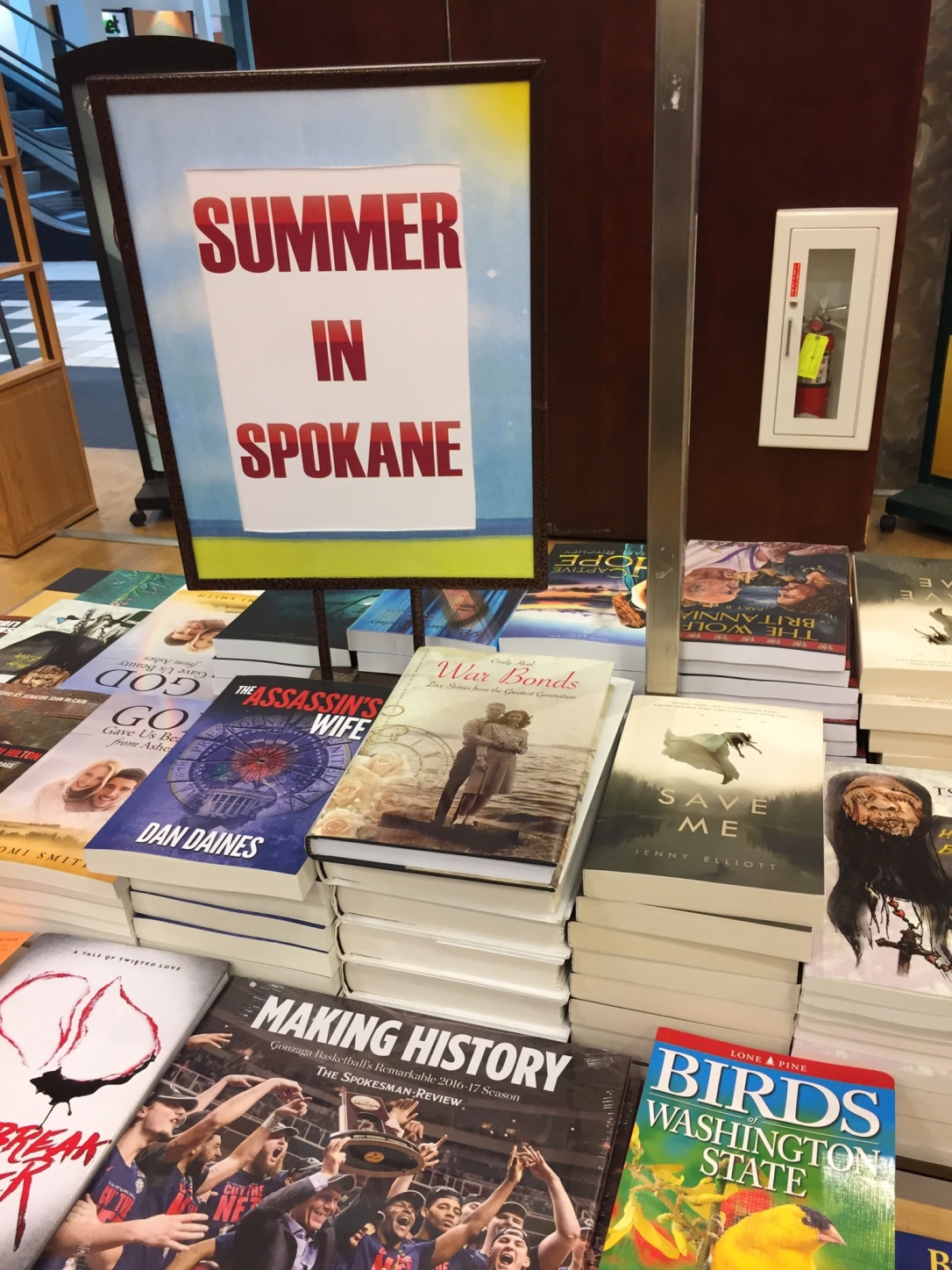
War Bonds as seen in the wild

image

My oldest son sent this photo of War Bonds as part of a Summer Reading display at Barnes & Noble Northtown in Spokane.

Makes me happy to think someone may pick up a copy for a summer read!

I’d love to see more photos of War Bonds in the wild. Feel free to email me photos at dchval@juno.com

Meanwhile enjoy your summer reads!


Columns

The Great Zucchini

20228745_1479340748771214_8152867723725408811_n[1]

Unfortunately, the most valuable life lessons are often learned the hard way. This summer I’ve been schooled in the veracity of the adage “be careful what you wish for.”

Last year my husband experimented in the Glorious Garden. He tried growing zucchini, vertically, in pallets. The experiment failed, and I was disappointed.

“Next year, I want zucchini. LOTS of zucchini,” I told my hardworking spouse.

He heard me. Boy, did he hear me.

Two weeks into this summer’s zucchini season had me yelling for mercy – praying for drought, pestilence or plague. No such luck. Our bumper squash crops shows no sign of slowing down.

It’s come to this – last week, I went to a party. I took zucchini as a hostess gift.

I returned my sister-in-law’s baking dish – with a squash tucked inside. Our relatives are starting to avoid me.

Our teenager used to eagerly ask, “What’s for dinner?”

Now, he hesitates.

In the last few weeks I’ve made zucchini cornbread casserole, cheesy zucchini, zucchini and rice, zucchini fritters, zucchini chips, zucchini stuffing casserole – and that’s just for dinner.

I’ve also baked dozens of zucchini chocolate chip muffins and many loaves of chocolate zucchini bread.

I have bags of shredded frozen zucchini in the freezer, and Derek recently bought a spiralizer. He wants to try zucchini spaghetti, but I’m not sure I’m ready to make the vegetable-in-place-of-pasta leap. Ask me next week.

And yes, I should know better, because many years ago, I used to write for a now defunct section of this newspaper, called HOME, and one of my assignments was to cover ‘The Great Zucchini War’ between two Spokane Valley neighbors.

It was actually more of a story of the gift that kept on giving. In the 2006 article, I chronicled the tale of a super-sized squash that made its way from bench, to birdbath, to treetop, as two neighbors escalated the art of re-gifting.

The Pedens and the Fairhursts took the squash war to unheard of heights. The much maligned vegetable was camouflaged in orange, black and silver and set afloat in a koi pond. It was transformed into a replica of a Flying Tiger fighter plane. Sporting wings, tail fins and the snarling teeth of a tiger, it perched in the upper branches of a walnut tree where it remained until a ladder tall enough to reach it could be found.

When last seen, it was Halloween and the re-gifted gourd was growing soft in the middle. It had been painted white, covered in ghostly draperies and encased in concrete – on a neighbor’s porch.

That was 11 years ago, and one can only hope the extra-large zuch was given a decent burial somewhere, or at least turned into enough bread to feed the ’hood.

Which brings me back to my squash stash. I’ve been trying to make eye contact with my next-door neighbors, but surprisingly they always seem to be in a hurry to peel out of their driveways or slam shut the sliding doors on their decks.

I’ve pondered placing the surplus squash in a box in our front yard with a “free to good home,” sign, but I worry they will rot in the hot summer sun before they are adopted.

There’s always Craigslist, but I don’t relish getting caught in some kind of undercover sting operation. I can just picture a jaded cop in a deserted parking lot mocking me. “You thought you’d get cash – for squash!?”

Last week I interviewed a longtime greengrocer who told me, “If you have to buy zucchini at a store, you must not have any friends.”

Well, at the rate my freezer is filling, I won’t have any need for zucchini or friends until roughly, 2020.

Listen to me dear readers; be careful what you wish for – especially if it involves produce.

Contact Cindy Hval at dchval@juno.com. previous columns are available online at spokesman.com/ columnists. Follow her on Twitter at @CindyHval.


War Bonds

What it’s really like to be an author

17264188_1846836355570945_187170845837808425_n[1]

My cousin, author Julie Christine Johnson, posted this graphic on her Facebook page awhile ago.

Boy, does it ever resonate with me. I’m inching my way to the finish line of my second book and have actually completed my first children’s book.

You know what that means?

Yeah. It’s time to pitch and query agents and publishers. Every writers FAVORITE thing to do. Not!

I sold War Bonds: Love Stories From the Greatest Generation directly to the publisher after my  literary agent was fired from her agency. It took me a couple months to sell a manuscript she’d had a of couple years. Not exactly “spontaneous success.”

But these new books represent new opportunities to wade out into the deep water and sink or swim, instead of treading water and hoping for rescue.

Those moments of “seemingly spontaneous success” don’t happen without a lot of work and not a little bit of angst. But I truly love both of my new projects and am hopeful that they will find a home and an audience.

Wish me luck friends, I’m jumping in without my water wings 😉

War Bonds

Happy 2nd birthday War Bonds!

1798867_10203559455453968_7245892183934310853_n[1]

Two years ago today, I was humbled and amazed by the turnout for the launch of my first book.

10409258_10152758717494576_5333093873657784944_n1

In the five years it took to write and publish War Bonds: Love Stories From the Greatest Generation, I lost so many of the couples featured. It broke my heart that some weren’t there to see their stories in print.

In the two years since publication, I’ve lost several more. Each death leaves an ache in my heart.

Yet at the front row of the book launch party many of my War Bonds couples were present as well as widows and widowers. They were in awe of the size of the crowd and watched with joy as every single copy of War Bonds sold out at Auntie’s Bookstore.

11001778_10153237444536807_18744094380434334_n1

I’ve learned a lot about publishing, publicity, book tours and public speaking over the last two years– knowledge I know will serve me well when my next book  comes out.

Today I’m still somewhat disbelieving that War Bonds is on bookshelves, in libraries and for sale in bookstores all over the world.

I’m so thankful for those who stood with me during the long journey from idea to pub party.

Thankful for readers who bought the book, read the book, reviewed the book and recommended it to others.

Thankful for bookstore owners, civic groups and organizations who invited me to share the message that true love can survive anything– even a world war.

But more than anything I’m thankful for my War Bonds family. They opened their hearts, homes and lives to me and allowed me to poke around. Then they trusted me to share their stories with the world.

What a journey.

What a blessing.

What a privilege.

10922781_10205535666138376_4139031365667251241_n[1]

Columns, War Bonds

Keeping my promise: A personal Pearl Harbor reflection

This week The Spokesman Review published a special keepsake section commemorating the 75th anniversary of the attack on Pearl Harbor. For the past nine years, I’ve been interviewing Pearl Harbor survivors for newspaper and was pleased to have many of those stories included.

In addition I wrote the following piece describing what it meant for me to visit the place I’d written about so often.

Never forget.

Cindy Hval, who wrote “War Bonds: Love Stories From the Greatest Generation,” visited Pearl Harbor in March. She explored places she had learned about in nine years of interviewing Pearl Harbor survivors.

Stretching out, I pressed my cheek into the hot sand, its gritty heat almost too much to bear. Closing my eyes, I imagined the shriek of airplane engines and the spitting sound of machine gun fire hitting the beach, while the air around me burned.

I covered my head with my arms, and could almost hear the whistling sound of bullets whizzing past my ear.

A shadow loomed. “Are you okay?” my husband asked.

Slowly, I sat up and scooted back onto my brightly-colored beach towel.

“Just thinking about Nick,” I said, while I slipped on my sunglasses.

The beauty of being married 30 years is I didn’t have to explain what I meant.

Derek and I visited Oahu in March to celebrate our anniversary, but the trip was part pilgrimage for me. After nine years of interviewing Pearl Harbor survivors, I was at last visiting the place I’d written about so often.

Here on Waikiki, I was just 12 miles away from Hickham Field where Nick Gaynos almost lost his life on Dec. 7, 1941.

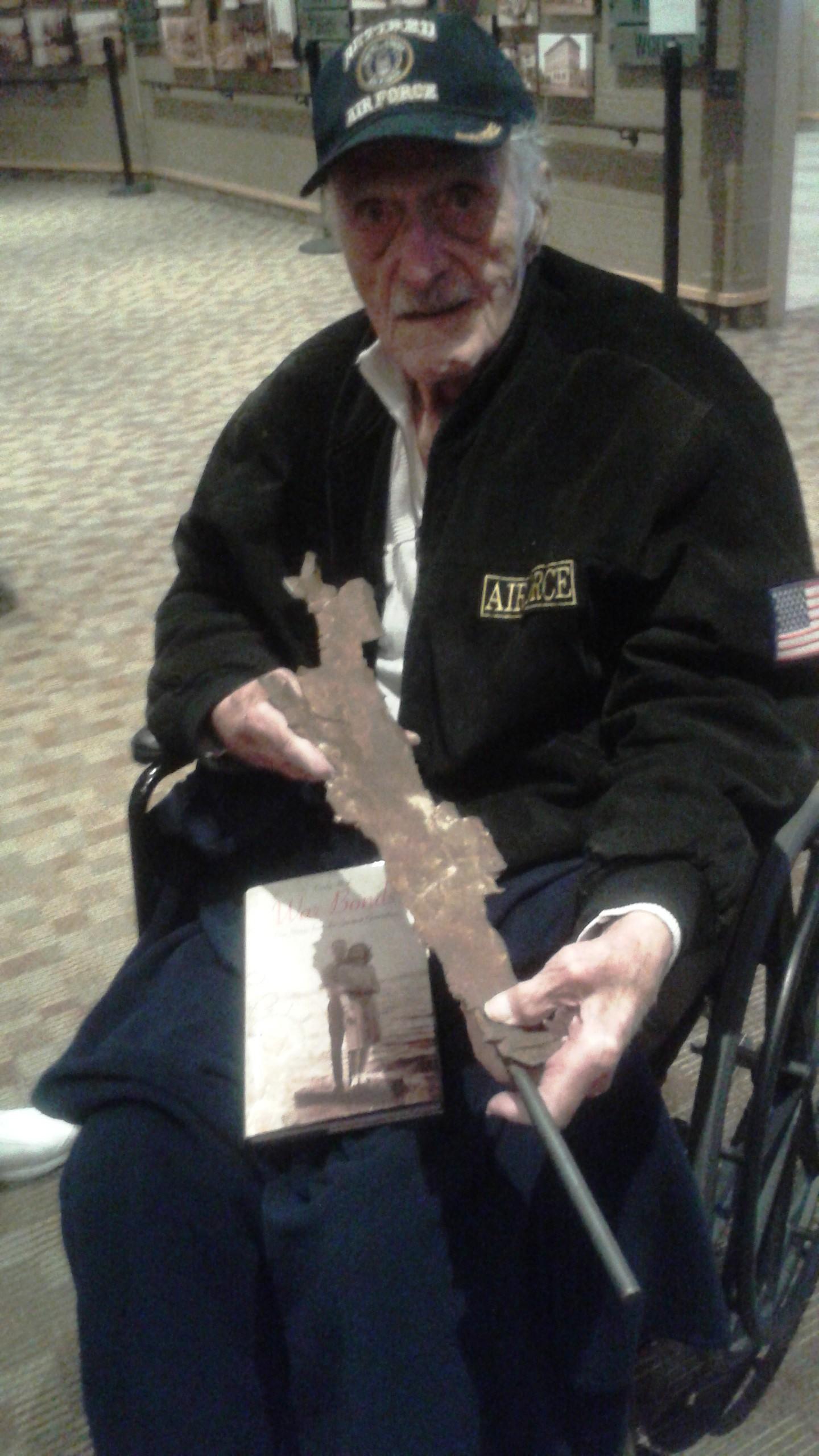
Nick Gaynos holding the piece of shrapnel that landed near him while under fire during the attack on Pearl Harbor 75 years ago. Gaynos died 20 days after this March 11, 2015, photograph. (Courtesy Cindy Hval)

During the attack on Pearl Harbor, Nick had been running toward his duty station when a Japanese pilot targeted him. He’d told me of looking up as he ran and seeing the grin on the pilot’s face as he fired at him.

Nick hit the beach and covered his head with his arms as the bullets flew. When he got up he discovered a large piece of shrapnel next to him.

“I grabbed it,” he said. “It was still hot from the explosion.”

When my book “War Bonds: Love Stories From the Greatest Generation” was released, Nick attended a reading at the Coeur d’Alene Public Library in March 2015. He brought that piece of shrapnel with him. It was jagged and more than 2 feet long. He died a few weeks later.

Now, on the island that had been so devastated by the horrific attack, I carried his memories with me as well as those of Warren and Betty Schott. The Schotts had quarters on Ford Island and were eyewitnesses to the attack.

When Derek and I walked through the entrance of the Pearl Harbor Visitor Center, I wanted nothing more than to talk to Betty, to tell her I was here. But Betty passed away in July 2015.

At the center, we watched a short film featuring actual footage of the attack. A scene of sailors and soldiers pulling the wounded and dead from the harbor made me gasp. That’s what Warren had done in the aftermath – it was the one thing he didn’t want to discuss with me over the course of many interviews. It was the only thing he refused to speak of with his wife of 76 years. Now, watching the footage through tear-filled eyes, I finally understood why he was loath to speak of it.

That horror was also all too real for my friend Ray Daves. During the attack, he hustled to a rooftop and handed ammo to two sailors who were manning a .30-caliber machine gun. He had his own brush with death when a Japanese plane exploded 20 feet from that rooftop before crashing into the sea below. His left hand was lacerated by shrapnel.

Like Warren Schott, Ray spent time pulling wounded men from the harbor, his blood mingling with the red splashes in the water around him. In his biography, “Radioman,” he described the bodies and body parts floating in the harbor. “We had to push them aside to get to the wounded,” he said.

Despite those gruesome memories, what really choked him up was recalling the bombing of the USS Arizona.

“My friend George Maybee was on the Arizona,” Ray said. “We’d gone through radio school together. Sat beside each other every day and were bunkmates at night.”

Ray Daves

“My friend George Maybee was on the Arizona,” Ray said. “We’d gone through radio school together. Sat beside each other every day and were bunkmates at night.”

He watched as the Arizona burst into a huge fireball. He knew his friend was gone.

Over the years, Ray and I grew close. He reminded me so much of my dad. They were both from Arkansas and had joined the military seeking a way out of the poverty of the rural south. Both had tender hearts and shared a wickedly funny sense of humor.

The last time I spoke to Ray before his June 2011 death, I told him I longed to visit Pearl Harbor.

“George is there,” he said, his eyes filling.

“I’ll look for his name,” I said. “I’ll say a prayer.”

Ray took my hand. “You do that, sweetheart.”

Five years later, I boarded the boat that took us to the USS Arizona. As we stepped from the boat onto the memorial, the throng of tourists quieted. The only sound was the snapping of the flag in the wind and the clicking of cameras.

We were somber with the knowledge that we were standing on the final resting place of 1,102 of the 1,177 sailors and Marines killed on the Arizona.

1913753_1047614618610498_5611130893995793483_n[1]A rainbow of undulating color in the water below caught my eye. Some 500,000 gallons of oil are still slowly seeping out of the ship’s submerged wreckage, and it continues to spill up to nine quarts into the harbor each day.
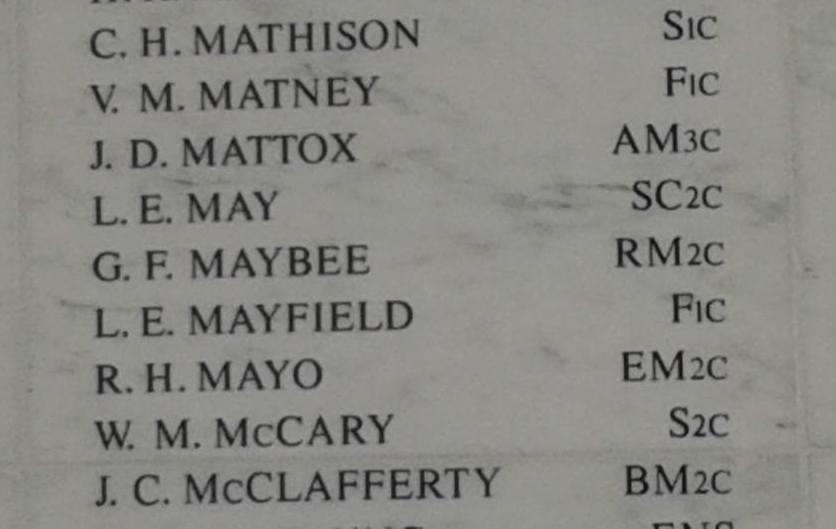
Slowly, I entered the shrine. A marble wall bearing the names of those entombed beneath us stretched out behind a velvet rope.

So. Many. Names.

Overwhelmed, I looked at Derek. “I’ll never find him,” I whispered.

The day had been overcast, but suddenly a shaft of sunlight illuminated the marble.

“There,” Derek said. “There he is – G.F. Maybee.”

George Frederick Maybee was a radioman, second class, aboard the USS Arizona when the battleship was bombed on Dec. 7, 1941, at Pearl Habor. Maybee, whose name is etched in a marble wall at the Arizona memorial, had been a friend of Ray Daves, a Pearl Harbor survivor from Deer Park who died in 2011. (Courtesy Cindy Hval)

Bowing my head, I wept for the sailor I’d never met and for my friend who knew and loved him.

I hope that somehow Ray knows I kept my promise.

George Maybee hasn’t been forgotten. Neither has Ray Daves.


War Bonds

Indies First a boon to authors and booksellers


This weekend during Small Business Saturday, I got to spend a few hours as an honorary bookseller at Auntie’s Bookstore in Spokane. Saturday was a designated Indies First event.

cxvb-souoaawwly1


Indies First is a collaboration between authors, publishers, retailers, and readers, and it celebrates independent bookstores and local communities. Speaking of local, this national movement was launched by author Sherman Alexie, who was born and raised on the Spokane Indian Reservation.

Authors/honorary booksellers signed copies of their books, visited with shoppers and offered book recommendations. I was thrilled to see scores of shoppers buying stacks of books!

15181562_1237250082980283_256605854000626170_n2

Plus I got to hang out with brilliant authors like Jess Walter.

My shift also overlapped with Bruce Holbert and Shawn Vestal.

15241802_10154706250234720_4392236594074648283_n1

Bottom line? When you support your local bookstores, everyone wins.