Columns

In Which I Attempt Nordic Skiing

When my husband Derek bought me a pair of long underwear, I knew it meant one of two things. Either the thrill was gone from our marriage, or he wanted me to do something I probably didn’t want to do.

The fact that the long johns were black and trimmed with lace offered a glimmer of a hope. Then Derek told me what he had in mind. Snow Queen

“You know honey, Mount Spokane is a very romantic place,” he began. “There’s a rustic lodge with a wood-burning fireplace that’s perfect for a picnic.”

Derek is an avid cross-country skier. No downhill racing with those sissy ski lifts for him. He skis the way his Nordic ancestors have for centuries, climbing steep slopes, then gliding downward on skinny, well-waxed skis.

Every weekend he hits the trails at Mount Spokane. Our sons or his sister and her Norwegian husband usually accompany him.

My spouse is an extroverted, gregarious sort of guy, and if he loves something, he wants everybody to love it – especially me. However, he knows I’m not an outdoors person. I prefer to view snow from the comfort of my sofa with a mug of cocoa in hand.

So he made me an offer I couldn’t refuse.

“I bought cheese,” he said, and wiggled his eyebrows seductively. “Smoked black-pepper white cheddar cheese,” he continued. “And I’ve got salami and gourmet crackers. I’ll make a big thermos of your special fireside coffee. Would you please try cross-country skiing – just once?”

It’s so unfair. I’m a sucker for any meal I don’t have to cook, and Derek is well acquainted with my passion for cheese.

“OK, I’ll try it.”

“Great!” he said. “You’ll love it. It’s just like walking.”

I rarely tackle any project without some kind of research. This is what I found on Wikipedia: “As a sport, cross-country skiing is one of the most difficult endurance sports, as its motions use every major muscle group.”

That didn’t sound like walking to me. Looking for reassurance I asked my sister-in-law for more information. “Well, it’s pretty hard at first,” she said, “but all you really need is rhythm and balance.”

Rhythm and balance? The one time I attempted downhill skiing, I tripped on a chunk of crusty snow in the parking lot at Mount Spokane. I spent the afternoon in the lodge with an ice pack on my ankle. Does this sound like someone who’s gifted with rhythm and balance?

But it was too late to back out. Derek had already procured boots and skis for me and packed the promised picnic. I grimly donned my long underwear.

The drive up the mountain was beautiful, and as the snow softly fell, I began to feel a bit more optimistic about the whole adventure. The lodge was warm, the fireplace inviting, and the indoor plumbing reassuring.

Derek knelt in front of me and slipped my feet into the ski boots. He’s right; I thought as he smiled up at me. This is romantic.

And then we went outside. My misgivings returned in earnest when my first lesson proved to be how to fall. “Always fall to the side,” Derek instructed. “Now, let’s try to glide, OK?”

That’s when the romance began to pale. Those slippery skis slid and skidded under my shaky feet. I struggled mightily to glide, but just when I got the stride right, the trail angled downhill. “Crouch forward, squat down, bend your knees,” my husband encouraged. All to no avail as my skis slid out from under me and I, remembering my instructions, toppled to the side.

I then discovered falling down is very easy. Getting up again is not. I lay in the snow while a pair of toddlers on tiny skis scooted past me. “OK, honey, get your skis parallel to your body,” Derek urged. I thrashed about while a couple of octogenarians sailed by.

Finally, upright again, I eyed the trail ahead with suspicion. “Are there any more little hills you want me to know about?” I asked.

Ideally, cross-country skiing is great aerobic exercise. However, the best I could manage was a slow shuffle, like Tim Conway’s old-man character on the “Carol Burnett Show.” The only time my heart rate surged was when I found myself swooping downhill, tottering precariously on those skinny skis.

Soon the drifting flakes began to fall faster, shrouding us in a feathery white blanket. Snow-laden trees surrounded us, enveloping us in a winter hush. And later, at the lodge, the cheese was delicious.

Looking into Derek’s twinkling blue eyes as he unlaced my boots, I made a discovery. The greatest thrill can come from pushing the edges of your comfort zone aside, and seeing the delight it brings to someone you love.

Thrills like that can keep you warm, even when wet snow seeps into your long johns.

This column first appeared in the Spokesman Review.


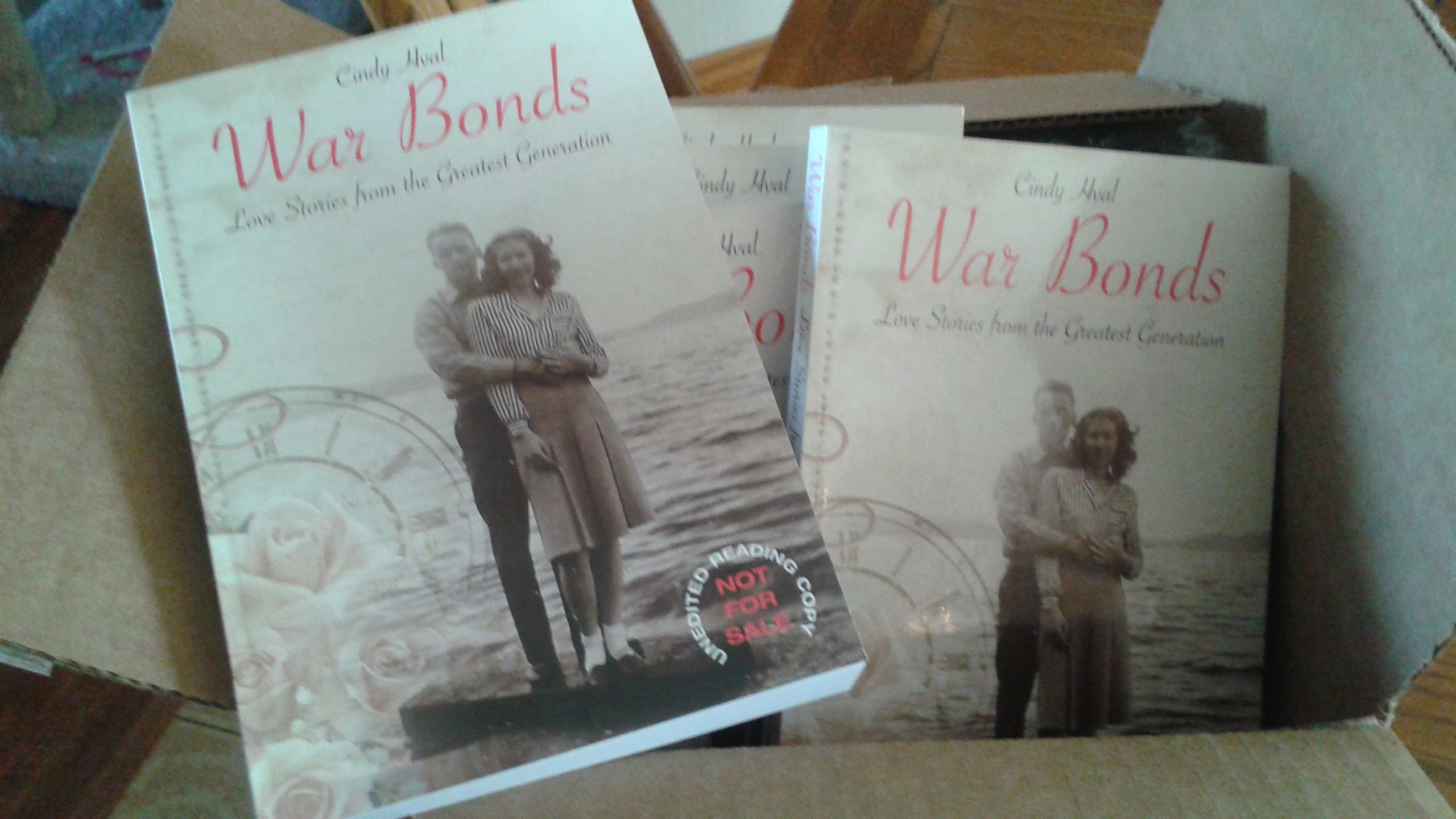
War Bonds

Never Forget

Wayne said, “We followed a lot of fighting as we went up the island. The Japanese were still strafing Kadena.”
But he did as he’d been taught and laid face down in a bunker when under fire. He didn’t lose any of his wire team. “We lucked out,” he said. “The other part of the company lost a couple guys.”

He grew quiet and glanced out his living room window. “Some parts you don’t remember– some parts will be in your mind forever.” ~ Wayne Best.

From chapter five of War Bonds. Thank you to our veterans. May we never forget.

War Bonds

Greatest Generation = Greatest Sense of Humor

Betty Driscoll Ratzman low resBetty Driscoll Ratzman

Caught up with this lovely War Bonds bride this afternoon while returning the photoss she’d loaned me for the book.
I told her the publisher is still hoping for a Valentine’s Day release of War Bonds.

She replied, “Well, they better hurry up with that. Dean just told me he never wanted a 90-year-old wife. I told him, ‘Well, I never wanted to be one!'”
They’ve been married 68 years!

War Bonds

Naval Aviator and WWII hero Robbie Robinson, dies

Chpt 35 Robbie Robinson - Copy

Just learned that Naval aviator Robbie Robinson passed away last week.
Robbie survived a horrific plane crash in the Pacific during WWII. Here’s an excerpt from his chapter “Wings of Gold.”

Robbie took off from his ship, the U.S.S Manila Bay with a full payload of bombs. The crew didn’t spot any enemy activity and at dusk they headed back to the ship.

The weight of the explosives made an already tricky landing more difficult. As they made their approach, Robbie knew they were in trouble. “Without warning the plane lurched and trembled. Like a goose hit in the wing by a volley of shot we plummeted into the Pacific with terrifying finality.”

The plane smashed into the water, shattering on impact. Cascades of water tossed him about like limp seaweed. Blown from the aircraft and barely conscious, he tripped the release on one side of his May West lifejacket, and it partially inflated, supporting his head.

He was plucked from the sea by the crew of a nearby destroyer. Later that night he learned that his radioman, George Driesback Jr., and his gunner, Harold Eckert, had been killed on impact. “They never had a chance,” he said. “They were in the belly of the plane.”

RIP Robbie Robinson. Thank you for your service and for sharing your story with me.


War Bonds

Long before e-mail, there was V-Mail

V-Mail from Ray, low resDuring WWII V-Mail (Victory Mail) was the primary way servicemen were able to communicate with their loved ones back home.
In this note, Ray Stone writes to his wife “I think about you always Betty. The feeling and the love I have for you has grown into something much deeper than small talk & sayings.”
He wrote this from Belgium during the Battle of the Bulge.

The horrors of war became most apparent to the young paratrooper when  he and his company liberated Camp Wobbelin in Germany. They found 1,000 dead– mostly Jews and another 3,000 dying prisoners in the compound.

Stone went on to become a lifelong educator, eventually serving as mayor of Coeur d’Alene, Idaho and received the Raoul Wallenburg Award, as well as the Eisenhower Liberation Medal.

Ray and Betty Stone’s story is featured in a chapter titled, “Fireworks.”


Columns

Foundational Support Proves Painful (or These Undies Are a Pain in the Ribs)

The pain in my rib cage jabbed with startling ferocity. I squirmed in my seat in the crowded auditorium, trying to get comfortable.

I was learning a painfully expensive lesson about the high cost of vanity.

You see, there comes a time in every woman’s life when she feels the need for more support – and by support I mean foundational garments. (Male readers feel free to stop here.)

This perceived need for figurative assistance spans the generations. My great grandmother wore a corset. My grandmother wore a girdle. My mother wore a panty girdle. Today’s generation has “shapewear” most commonly found in the brand name Spanx.

Somehow, I’d reached my late 40s without becoming familiar with the misleadingly silky garments that provide an iron-fisted hold on unsightly bumps and bulges.

But recently I bought a new dress – a fitted sheath that looked fabulous – as long as I’m holding my breath.

Have you ever tried to hold your breath for an entire evening whilst simultaneously engaging in lively conversation? At the first wearing of my new dress I was reduced to breathy Marilyn Monroe-ish whispers, and had a stunning headache at the end of the night due to lack of oxygen.

When I confessed my dilemma to a group of friends they expressed shock that I hadn’t yet acquainted myself with Spanx. “Even 20-year-olds should wear Spanx,” asserted one fashion savvy friend.

So, off to the store I went. Combing through the shapewear racks left me reeling with sticker shock. It costs a lot of money to instantly slim and tone. After much dithering I came home with three items guaranteed to give me the sleek silhouette I desired. I could tell these were the real deal, serious grown up undergarments, because my color choice was limited to black or beige. No flirty fuchsia or pretty pink. I purchased a camisole, a pair of panties and something called a high-waisted girl short. I believe in covering all my bases.

This weekend I decided to give my dress another outing. I laid my shapewear purchases on my bed, trying to decide which item would provide the support I needed while still making breathing possible.

In the end I decided to go all out – the high-waisted girl short topped by the camisole. It turns out deciding what to wear was the easy part. Getting dressed? Not so much.

I started with the girl short. The garment slid on with ease until it reached my knees. From there on up it was an epic struggle. For once I was thankful I no longer have time for manicures. If I’d had one it would have been ruined.

Feeling confident the worst was over, I reached for the camisole. I won’t elaborate on the battle. Let’s just say at one point, I had both arms pinned over my head and the danger of suffocation via spandex was very real.

When at last the camisole reached the top of my thighs, I collapsed on the bed. The fact that I’d gotten an aerobic workout and a strength training workout without leaving my house comforted me.

After I recovered, I finished dressing and surveyed the result in the mirror. Not bad. My fitted dress fell smoothly to my knees with no unsightly lumps, and no breath holding needed.

However, once I got into my car I realized I hadn’t tried sitting in Spanx. That edge of that high-waisted girl short began digging into my ribs. Its rubberized edging meant it wouldn’t roll or slide down through the evening, but it also meant I couldn’t adjust the parts that pinched.

I could stand and walk and talk with ease, but sitting proved miserable, and I was in for a night of sitting.

As the evening progressed, so did the pain in my ribs. I tried to adjust the girl short through my dress, but I couldn’t budge it. The snug camisole prevented me from getting a grip on the edge of the offending garment. My “more must mean better” philosophy proved painfully inaccurate when applied to shapewear.

Finally, the discomfort outstripped my vanity. I slid out of my seat and made my way to the restroom where I peeled off the girl short and tucked it into my purse.

I felt like a new woman when I returned to my seat. Shapewear may be all the rage, but I think I’ll stick with the shape the good Lord gave me. Lumps, bumps and all.

This column originally appeared in the Spokesman Review. Contact Cindy Hval at dchval@juno.com. Her previous columns are available online at spokesman.com/columnists. Follow her on Twitter at @CindyHval

War Bonds

Every Two Minutes a Memory Disappears

According to the National WWII Museum, approximately every two minutes a memory of World War II – its sights and sounds, its terrors and triumphs – disappears.

That’s because our WWII vets are dying at a rate of 555 a day. By 2036, it is estimated there will be no living veterans of World War II left to recount their experiences.
I am so grateful to have been able to meet and interview so many of these amazing veterans. Their stories are important and deserve to be shared.