War Bonds

Slinging Books and Shopping Small

DPbZt9KUEAAzyRJ[1]

Take a group of authors. Give them name badges. Turn them loose in a bookstore. That’s the recipe for Indies First held each year on Small Business Saturday.

The event brings together authors, readers, and publishers in support of independent bookstores. Authors and local celebrities volunteer at events across the country, and publishers offer special terms on books and exclusives.

I had a blast as usual at Auntie’s Bookstore. Chatting with readers, helping them find great gift ideas and catching up with these great authors is always fun.

DPgw34rUEAAG8Et[1]

Sam Ligon, Kate Lebo, Cindy Hval, Jack Nisbet

DPgimptVQAEfuSZ[1]

Stephanie Oakes, Cindy Hval, Sharma Shields

One Spokesman Review reader said she came in just to see Jack Nisbet and me, but she walked out with Shop Small shopping bag filled with books. That’s the danger and delight of hanging out in a bookstore!
Another reader stopped by to make sure I was alright. My Thanksgiving column about sometimes finding it hard to be grateful, prompted her concern.

At the end of my shift I rewarded myself with a copy of the delightful anthology Pie & Whiskey: Writers under the Influence of Butter & Booze. My husband and I are reading it aloud every night before bed. It’s a hoot. Honestly, Sam Ligon’s whiskey cocktail recipes are my favorite part. Some drink recipes call for things like a soul, a pistol, a Bible and a sword, but you can still make the drinks without them.

Indies First offers a great way to get customers into independent bookstores, but it’s even more important to support local businesses and Shop Small all year long.

After all, Santa does!

23843069_1602183639820257_6274803145774913316_n[1]


War Bonds

Every Time We Say Goodbye

72.

That’s how many individuals made the final cut of War Bonds: Love Stories from the Greatest Generation.

24.

That’s how many people died before the book went to print.

19.

That’s how many goodbyes I’ve had to say since War Bonds 2015 publication.

In the past month, Barbara Anderson and Dale Eastburg passed away.

Barbara’s loss hit me especially hard. The Anderson’s story is featured in chapter 28 “Keeping Time.” They  met in 1945 when Louis came into her father’s jewelry store to get his watch repaired. When War Bonds was published, he still wore the watch and it still kept time.

The Love Lesson Barbara shared at the end of the chapter resonates.

“You can’t take back bad words. We’ve never said one thing we’ve had to take back.”

.facebook_1510783440734

This photo was taken 11/16/16, the last time I saw Barbara. She wanted more signed copies of the book to send to a family that was grieving the loss of a wife/mom/grandma.

She always thought of others. When I left she insisted I on giving me a water glass from Air Force One. Her late grandson had served as pilot for President Obama.

She also always asked if I needed to use the restroom before I left!

Her spirit and generosity are simply irreplaceable and I worry how Louie will do without his bride.

Dale and Eva Eastburg had been married for 75 years when he died earlier this month. When last I spoke with them, they were still going to the gym regularly!

009

The title of their chapter seems especially poignant today. It’s titled “Hard to Say Goodbye.”

And it is. It really is.

Columns

Moving Mom

The For Sale sign swung wildly in the blustery October wind, and though I’d known it was coming, the sign startled me.

I pulled over in front of what used to be my house and let the memories wash over me.

Growing up in a military family, I moved a lot. Nine houses in 16 years, until we finally returned to Spokane to stay.

This house represented permanence to my parents, who’d grown weary of years of moving. It welcomed my best friends and high school sweethearts. My first day of college photo was taken on its front steps.

On my wedding day, I woke in my twin bed, in my blue bedroom with the switch plate that reads “Cindy’s Room.” The switch plate is still there, though it hasn’t been my room for 31 years.

A few years later, a photo taken in the entryway shows my dad proudly holding my firstborn son – his namesake, Ethan Thomas. It was Ethan’s first visit to what was now known as Grandma’s house.

Dad is wearing a sportcoat and tie, so he must be home for lunch. After he retired from the Air Force, he went to work for the Department of Social and Health Services, and his office was within walking distance – a huge selling point when they bought the house.

By the time our sons Alex and Zach were born, Dad had retired, and my husband and I had bought a home nearby. Dad delighted in dropping in to “check on the babies.” I always thought he meant my sons, but chances are he meant me, too.

When he died 22 years ago, my mom remained in their home – happy to know I was close. And when after several years of widowhood, our last son arrived, she was especially glad she’d stayed in the neighborhood.

Grandma’s house became a rite of passage. When boys anxious for independence wanted to venture from my nest, unsupervised – it was to her house they went. Sometime after the magic age of 10, I’d let them walk the six blocks to her house. This was long before every kid had a cellphone, so the kid had to first call Grandma to let her know he was on the way, then immediately call me when he arrived, and then call me again when he left.

Freedom had a laborious cost back in the day.

As Mom aged, the split-level design of the house proved daunting, and one spring she took a tumble down the stairs, breaking her ankle.

Still she wouldn’t move. Wouldn’t hear of it. This was her home – the place she and Dad ceased their wanderings, and besides, I lived just a few blocks away.

We worried that when the time finally came for her to move, she wouldn’t be able to help us choose her new home. And that’s just what happened.

This summer her mental and physical health failed at an alarming rate. Suddenly, my siblings and I had to make major decisions with no input from Mom.

Thankfully, my brother David and his wife, Becky, had retired to Spokane several years ago. They were able to find Mom a nice apartment in an assisted living facility, arrange for movers and an estate sale, and last week they sold the house.

Mom is 86, and doing better than she was this summer, but she’s still confused about what happened to her home, to her things.

Her new residence is just two blocks from her old one, so the landscape of her neighborhood is familiar. Her grandsons visit more frequently, now that she doesn’t have to come down any stairs to open the door. And when they visit they talk about the happiness and love they always found at Grandma’s house. The location may have changed, but the love hasn’t.

I pull away from the house, and I don’t think I’ll drive by again for a while.

It’s someone else’s turn to make memories on Standard Street. My own are locked safely in my heart, and there isn’t a house anywhere big enough to contain them.


Columns, War Bonds

Who Needs Prince Charming?

I didn’t really think he’d show up on a white horse. I’ve never been a great rider and city streets aren’t welcoming to skittish steeds.

Instead, my Prince Charming borrowed his father’s Ford Tempo for our first date. “I’m in the middle of restoring a ’67 Mustang,” he explained.

Thirty-one years later, he’s still in the middle of restoring that same ’67 Mustang. I no longer sing “Someday My Prince Will Come;” instead I mutter, “Someday my prince will be done – with something. Anything!”

After three decades of marriage I’ve had ample time to rethink my original dreams of Prince Charming.

My prince has never waltzed me around glittering ballrooms, and I’m not in the habit of losing any shoes. But sometimes he sneaks into the kitchen while I’m cooking, takes my hand, and spins me into a slow dance across the dining room floor.

“There they go again,” one of our sons will say, groaning with embarrassment.

As if dining room dancing wasn’t enough, several years ago, Derek decided to add guitar-playing to his romantic resume.

“I’m going to learn to play ‘Can’t Help Falling in Love With You’ for your birthday,” he announced.

My birthday came and went. As did Valentine’s Day, our anniversary and Christmas.

Finally, I schlepped the two guitars and the amp he’d purchased downstairs, and shoved them in a closet. His musical ardor may have dimmed, but his passion for me has yet to wane.

I know this, because several times a month he’ll text me: Date night?

He makes reservations at one of our favorite restaurants. And we don’t stare at our phones over dinner – we talk about anything and everything. We’ve yet to run out of words.

It turns out my prince didn’t have a castle to offer me, but that’s OK . I’ve heard the upkeep on palaces is brutal. And I’ve never been a damsel in distress in need of rescue.

In fact, the demur, soft-spoken girl in white satin he married, grew up into a confident woman with opinions that often differ from his, and a newspaper column in which to express them.

Instead of being threatened, Derek applauded and encouraged my evolution. Willingly, he picked up the slack at home when my work took me out of town – or more often inside my head.

Writers are rarely easy to live with, especially when a new project swallows every waking thought and even haunts our dreams. But he is uncomplaining, knowing that my glazed eyes will eventually light on him, recognition will dawn, and I will invariably smile.

He hasn’t ruled a kingdom. His birthright is more plastic spork than silver spoon, but for over 20 years he’s run a successful small business. His reputation for integrity remains sterling, even in tough economic times.

When our children grew, and rebellion brewed with teens eager to topple the home regime, he handled those painful transitions with grace, dignity and infinite patience. Watching him parent our sons made me fall in love with him all over again.

Time has changed us. My prince has lost some hair, gained some weight, lost that weight and gained some wrinkles. And I’ve done the same, except my hair has grayed instead of thinned.

His unfinished projects still drive me crazy. The Mustang rusts in our driveway; the guitars gather dust in the closet, and the long-promised home office remains elusive. I never know what he’ll start next, but I’m confident it probably won’t be completed.

And just when my frustration reaches its zenith, I catch his eye across a crowded room (all of our rooms are crowded, now) and my heart skips a beat.

He holds out his hand to me. I take it and he pulls me into an embrace that still takes my breath away.

We sway together, and he hums in my ear. “Wise men say, only fools rush in, but I can’t help falling in love with you.”

I don’t need Prince Charming. Or a ballroom. I don’t really even need the tiara he bought me.

I just need this man.

And I’m profoundly grateful that our marriage is still an unfinished project.

23131848_1580341082004513_2624145754997905891_n[2]

Contact Cindy Hval at dchval@juno.com. She is the author of “War Bonds: Love Stories From the Greatest Generation.” You can listen to her podcast “Life, Love and Raising Sons” at SpokaneTalksOnline.com. Her previous columns are available online at spokesman.com/ columnists. Follow her on Twitter at @CindyHval.

War Bonds

Shop Small With Me!

Mark  your calendars for Indies First, November 25 at Auntie’s Bookstore.

Check out the array of amazing authors who will serve as volunteer booksellers!  I’ll be on duty from 1 Pm- 3 PM and would love to help you find literary treasures to fill your Christmas wish lists.

Support a fabulous Indie bookstore, buy great books and chat with the people who write them.
What could be more fun?

DNkze9mVwAACyOD[1]

War Bonds

Death Diminishes War Bonds Roster

Sometimes I run out of words. A dire problem for a writer, but gut-wrenching loss will do that to you.

Within the span of a few weeks, two precious people featured  in War Bonds: Love Stories From the Greatest Generation have passed away.

First my beloved Marine, Myrt Powers, died. The story of her marriage to sailor, Walt Powers, is featured in chapter 30– and is unusual because both she and her husband served in World War ll. This couple were also featured on the television show Northwest Profiles and shared their story at a local veterans support group, following the book’s publication.

I last saw Myrt in March 2016 when my husband and I ran into her waiting in line for coffee in Hawaii! She and her husband wintered on Oahu for many years.

Feisty, upbeat and absolutely adorable, Myrt is everything I want to be when I grow up. My heart aches for Walt and for all of us who knew and loved her. Though she was tiny, her absence leaves a huge hole.

14090_890795544292407_8952799764996575077_n[1]Cindy Hval with Myrt and Walt Powers, 2015.

And then last week, Jack Rogers died. A lifelong, prolific artist, Rogers taught all four of my sons during his tenure as art teacher at Northwest Christian School.

The story of his courtship and enduring marriage to his wife, Fran, is featured in chapter 20 of War Bonds.

He was still painting up until the last week of his life as he decorated wooden tailgates for Personal Energy Transporters for the PET Project.

In November, I was privileged to cover one of his last art shows.

“I was given a gift and I want to share it,” he said.

And here’s where words fail.

How can I possibly convey the depth of my admiration and love for these people? How do I sum up the gratitude I feel for having been a small part of their lives and for being entrusted to share their stories with the world?

I can’t.

But I can say I will miss them and treasure the memories of the hours spent with Myrt Powers and Jack Rogers.

I hope that I’ve given readers of War Bonds a snapshot of how they made the post World War ll world, a place of hope.

Rest in peace, beloveds, for you have surely earned it.


20160720_142938
Jack and Fran Rogers, with Cindy Hval, 2016.


War Bonds

70 Years of Adventure

20708109_1498992003472755_632359020316113008_n[1]John and Amy Roberson

Amy and John Roberson grew up in the same small community of Woodland, Washington, on farms about 2 miles apart. They attended the same school grades K-12, yet it took a world war to bring the couple together.

That’s not to say Amy went unnoticed by John.

“I had my eye on her,” he said. “She was very attractive.”

In their Greenacres home, Amy shushed him.

“Now, now,” she said, smiling.

But neither of them can recall a single conversation between them until they met again in 1945 in Washington, D.C., where both were serving in the Navy.

John had been accepted to the V-12 Navy College Training Program in 1943. The program was designed to supplement the force of commissioned officers in the Navy during World War II.

He thought the Navy would be a great fit for him.

“I loved the water,” he said. “I built my own boat on the Columbia River.”

It came as quite a surprise when the first place the Navy sent him was to the University of Kansas.

He shrugged.

“I studied engineering at the University of Kansas.”

Amy had to wait until she was 20 to enlist.

“My uncle was in the Navy in World War I,” she said. “I wanted to join the Navy, too.”

After basic training, she was sent to the U.S. capital to study decoding. Meanwhile, John was stationed nearby, in Norfolk, Virginia.

A mail carrier in Woodland kept track of the local youths in the service. He discovered there were eight Woodland youths in the Washington, D.C., area where his daughter was stationed, and he connected them.

They all got together and had a great time talking about home, and that’s when Amy truly noticed John.

“John asked me for a date,” she recalled. “We were supposed to meet at the movie theater. It was pouring rain, and I showed up with drippy hair.”

Wet hair didn’t deter him from asking for another date.

Soon John left for what would be the only cruise of his Navy stint.

“My sea duty consisted of taking a ship from San Diego to Charleston (South Carolina),” he said.

They stayed in touch and both returned to Woodland when they were discharged in 1946.

“We both qualified for the GI Bill, and I told him I was going to WSU,” Amy recalled. “John said, ‘I think I will, too.’ ”

They got engaged in April 1947 and returned home in August for their wedding.

Amy made her wedding gown and bridesmaid dresses from parachute silk.

“I got a whole bolt for $10, so we all wore white,” she said.

On Aug. 17, 1947, they were married at the Presbyterian church in Woodland. They honeymooned in British Columbia and then returned to WSU where John received a Bachelor of Science in civil engineering in 1948.

Amy, too, would eventually earn a degree in home economics, but first busy years ensued.

Son, Roger, arrived in 1950, followed by twins David and Janice in 1951.

The young family moved numerous times as John pursued a master’s degree, followed by a doctorate.

“It was hectic,” Amy said.

She recalled many late nights and early mornings when John would place Janice across his knees and jiggle her to sleep while he studied.

He taught at WSU, and their children were active in Camp Fire and Boy Scouts.

In 1963, they moved to Thailand when John accepted a teaching position with the SEATO Graduate School of Engineering.

Two years later the family set out to visit the famous Bridge over the River Kwai and the POW Memorial. As they crossed the bridge used by pedestrians, carts and bicycles, a train approached.

Roger and David took refuge on a pedestrian platform on one side of the bridge while Amy, Janice and John perched on the other side. As the train drew near, John reached out to help a Thai man on bicycle with a large metal ice cream box balanced on the back. As the train passed it hit the metal box which knocked the bicycle into the three of them. Amy, Janice and John were thrown against the bridge railing which broke, sending them plunging into the dry riverbed beneath.

“We hit hard,” John recalled.

Their sons scrambled to help.

“The first aid training they received in Scouts really paid off,” Amy said.

The boys cautioned the locals not to move them, checked for bleeding and signs of concussion and summoned an ambulance.

“I do think they saved our lives or at least made our injuries less severe,” said Amy.

As it was their injuries were substantial. All three suffered numerous broken bones. Janice recovered first, but her parents were in for a long hospital stay.

“We shared a tiny hospital room for 90 days and 90 nights,” Amy recalled. Then she grinned. “And we came out as friends.”

The severity of John’s injuries curtailed their stay in Thailand and the family returned to Pullman, where more surgery awaited. He was bedridden for months as his battered body healed. Amy took care of him and their three teenagers while her own broken bones mended.

Eventually, he resumed his teaching career at WSU and authored two textbooks: “Engineering Fluid Mechanics,” with Clayton Crowe and “Hydraulic Engineering.” Both books are still in print and used in universities here and abroad.

“Without Amy’s typing, editing and encouraging, the books may never have been completed,” he said.

For several years Amy taught ESL classes in Pullman for wives of foreign students.

Their adventures continued when John retired in 1980. They enjoyed more than 50 Elderhostel trips and visited 45 countries and all 50 states.

As they celebrate their 70th anniversary Thursday, the Robersons, both 92, marvel at the way the years have flown.

“She’s been a tremendous partner – we’re good friends,” said John. “I could not have been luckier.”

Amy smiled at him.

“I learn new things about him every day.”


War Bonds

War Bonds as seen in the wild

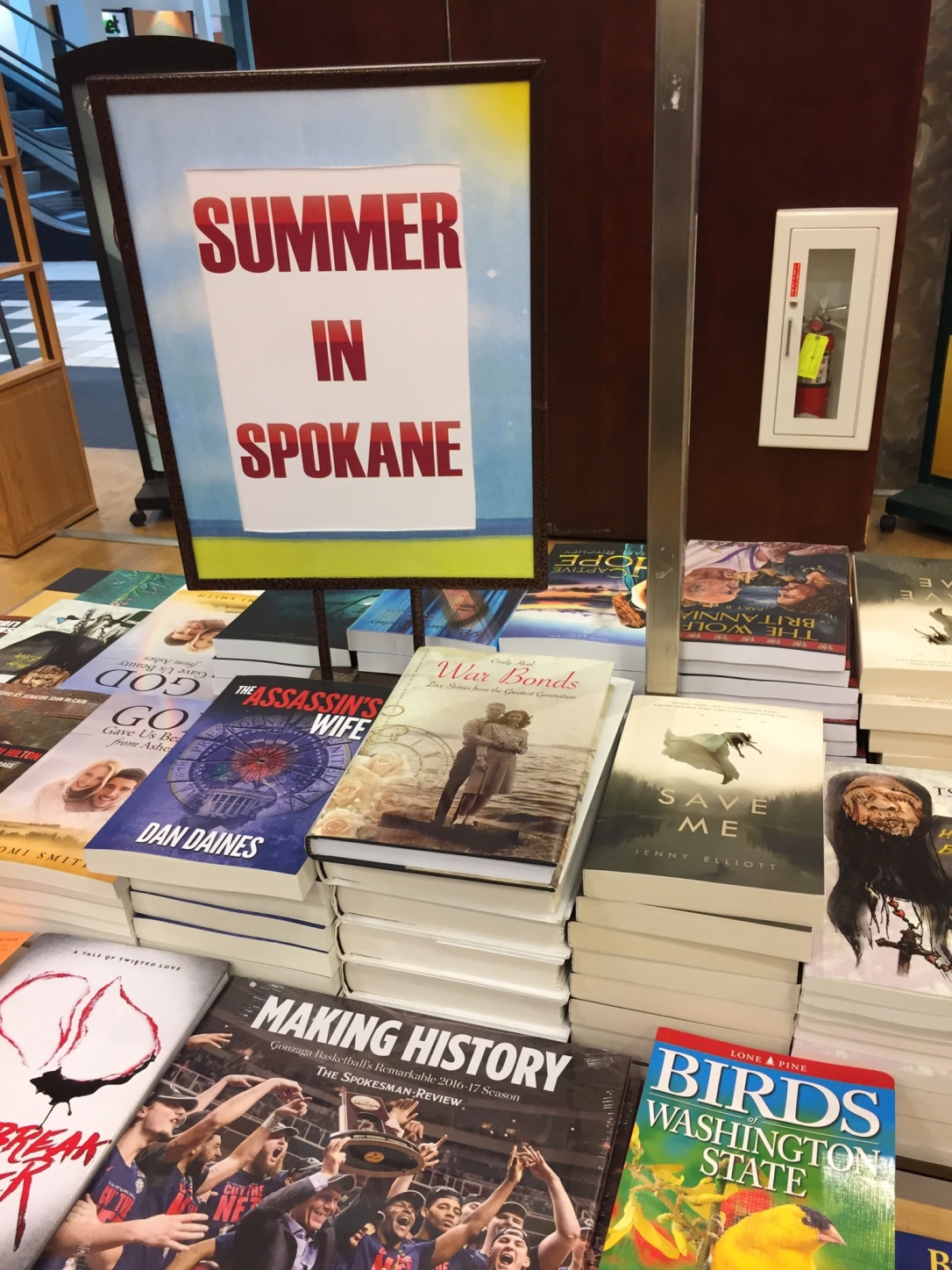
image

My oldest son sent this photo of War Bonds as part of a Summer Reading display at Barnes & Noble Northtown in Spokane.

Makes me happy to think someone may pick up a copy for a summer read!

I’d love to see more photos of War Bonds in the wild. Feel free to email me photos at dchval@juno.com

Meanwhile enjoy your summer reads!


Columns

The Great Zucchini

20228745_1479340748771214_8152867723725408811_n[1]

Unfortunately, the most valuable life lessons are often learned the hard way. This summer I’ve been schooled in the veracity of the adage “be careful what you wish for.”

Last year my husband experimented in the Glorious Garden. He tried growing zucchini, vertically, in pallets. The experiment failed, and I was disappointed.

“Next year, I want zucchini. LOTS of zucchini,” I told my hardworking spouse.

He heard me. Boy, did he hear me.

Two weeks into this summer’s zucchini season had me yelling for mercy – praying for drought, pestilence or plague. No such luck. Our bumper squash crops shows no sign of slowing down.

It’s come to this – last week, I went to a party. I took zucchini as a hostess gift.

I returned my sister-in-law’s baking dish – with a squash tucked inside. Our relatives are starting to avoid me.

Our teenager used to eagerly ask, “What’s for dinner?”

Now, he hesitates.

In the last few weeks I’ve made zucchini cornbread casserole, cheesy zucchini, zucchini and rice, zucchini fritters, zucchini chips, zucchini stuffing casserole – and that’s just for dinner.

I’ve also baked dozens of zucchini chocolate chip muffins and many loaves of chocolate zucchini bread.

I have bags of shredded frozen zucchini in the freezer, and Derek recently bought a spiralizer. He wants to try zucchini spaghetti, but I’m not sure I’m ready to make the vegetable-in-place-of-pasta leap. Ask me next week.

And yes, I should know better, because many years ago, I used to write for a now defunct section of this newspaper, called HOME, and one of my assignments was to cover ‘The Great Zucchini War’ between two Spokane Valley neighbors.

It was actually more of a story of the gift that kept on giving. In the 2006 article, I chronicled the tale of a super-sized squash that made its way from bench, to birdbath, to treetop, as two neighbors escalated the art of re-gifting.

The Pedens and the Fairhursts took the squash war to unheard of heights. The much maligned vegetable was camouflaged in orange, black and silver and set afloat in a koi pond. It was transformed into a replica of a Flying Tiger fighter plane. Sporting wings, tail fins and the snarling teeth of a tiger, it perched in the upper branches of a walnut tree where it remained until a ladder tall enough to reach it could be found.

When last seen, it was Halloween and the re-gifted gourd was growing soft in the middle. It had been painted white, covered in ghostly draperies and encased in concrete – on a neighbor’s porch.

That was 11 years ago, and one can only hope the extra-large zuch was given a decent burial somewhere, or at least turned into enough bread to feed the ’hood.

Which brings me back to my squash stash. I’ve been trying to make eye contact with my next-door neighbors, but surprisingly they always seem to be in a hurry to peel out of their driveways or slam shut the sliding doors on their decks.

I’ve pondered placing the surplus squash in a box in our front yard with a “free to good home,” sign, but I worry they will rot in the hot summer sun before they are adopted.

There’s always Craigslist, but I don’t relish getting caught in some kind of undercover sting operation. I can just picture a jaded cop in a deserted parking lot mocking me. “You thought you’d get cash – for squash!?”

Last week I interviewed a longtime greengrocer who told me, “If you have to buy zucchini at a store, you must not have any friends.”

Well, at the rate my freezer is filling, I won’t have any need for zucchini or friends until roughly, 2020.

Listen to me dear readers; be careful what you wish for – especially if it involves produce.

Contact Cindy Hval at dchval@juno.com. previous columns are available online at spokesman.com/ columnists. Follow her on Twitter at @CindyHval.


Columns

Tattoo Talk Turns Troublesome

A delicious family dinner on the Delightful Deck turned into a conversational minefield recently when my husband asked what my plans were for the following day.

“Oh, the usual,” I replied. “I have an interview for a magazine story in the morning, and I’m getting a tattoo in the afternoon.”

As the kids say, mic drop.

Sam, 17, recovered first.

“No,” he said. “No, you most certainly are not.”

Kids can be so bossy.

I just smiled.

Derek took a deep breath, shrugged and said, “OK, but only if you get it on your … .”

Let’s just say my husband wanted me to get a tattoo where he could see it, but I couldn’t.

Sam was still concerned, but Derek wasn’t. That’s because he vividly remembers our first childbirth class, some 27 years ago.

Everything went well until they took us on a tour of the birthing rooms. Mind you, we’d already seen the graphic movies of natural, medicated and cesarean births, and I was unfazed, but during the tour the nurse showed us the needle they use to administer epidurals.

I took one look and Derek said my face turned whiter than the stack of cloth diapers on the table near the bassinet.

Woozily, I backed out of the room and leaned against a wall. One of the soon-to-be dads had a similar reaction and slumped next to me.

“OK,” I said to Derek. “Natural childbirth it is. There is no way I’m letting that needle anywhere near me.”

“Me too,” said the guy next to me. “Natural childbirth all the way.”

I’m not sure his wife agreed with him.

All this to say, Derek wasn’t convinced my tattoo plan would come to pass because he was quite certain that I’d pass out at the sight of the needle.

He also knows how changeable I am. On any given day I change my mind about what to wear at least a half dozen times.

Permanent body art might be a stretch for a person whose accessories litter her dresser like flotsam the tide washed in, because she can’t decide between gold or silver earrings and then needs a bracelet to match.

The jumble of shoes on my closet floor is not a testament to a hoarding problem, but the result of my inability to stick with the shoes I’d carefully laid out the night before to go with the outfit that I no longer feel like wearing.

Ethan, our oldest son had a more pressing question – what would I get a tattoo of?

“I think tattoos should mark something meaningful,” he said. “A milestone, a memory – something important.”

I agree. The birth of each of my children was certainly meaningful, but those events have already documented on my skin in the form of stretch marks.

In fact, if I wanted important permanent reminders etched on my flesh, having my name and birthdate tattooed somewhere would be more useful. Or maybe the words “If found return to … .” As long as the info was inked where my husband has suggested.

At the end of the meal I admitted to my family that I was actually going to get a henna tattoo. I’ve always wanted one and my teenage niece, Lizzie, recently started doing them.

The next day I showed off the results; a beautiful mandala with a trailing leaf pattern, exquisitely etched on the inside of my arm.

My guys agreed Lizzie’s talents are exceptional, and they all thought the design was perfect. Best of all henna isn’t permanent, so I can get something different next time.

And there will be a next time, because when I posted a photo of my tattoo on Facebook, a friend commented, “A bold design choice. Known as two fighting cats – shows them swirling in anger and rage as their tails are poofed out and the spittle flies. Not everyone chooses this design so you are the brave.”

I’m pretty sure he was teasing, but his comment reminded me that the milestone additions of two cats to our family still hasn’t been marked in a meaningful way.

Yet.

19990538_1470332729672016_6011695266451606864_n[1]

Contact Cindy Hval at dchval@juno.com. She is the author of “War Bonds: Love Stories From the Greatest Generation.” You can listen to her podcast “Life, Love and Raising Sons” at SpokaneTalksOnline.com. Her previous columns are available online at spokesman.com/ columnists. Follow her on Twitter at @CindyHval