Columns, War Bonds

The Scrapbook

It’s been almost six months since my first book, War Bonds: Love Stories From the Greatest Generation was released. I’ve signed hundreds of copies, but at a recent reading I was asked to sign something that brought tears to my eyes.

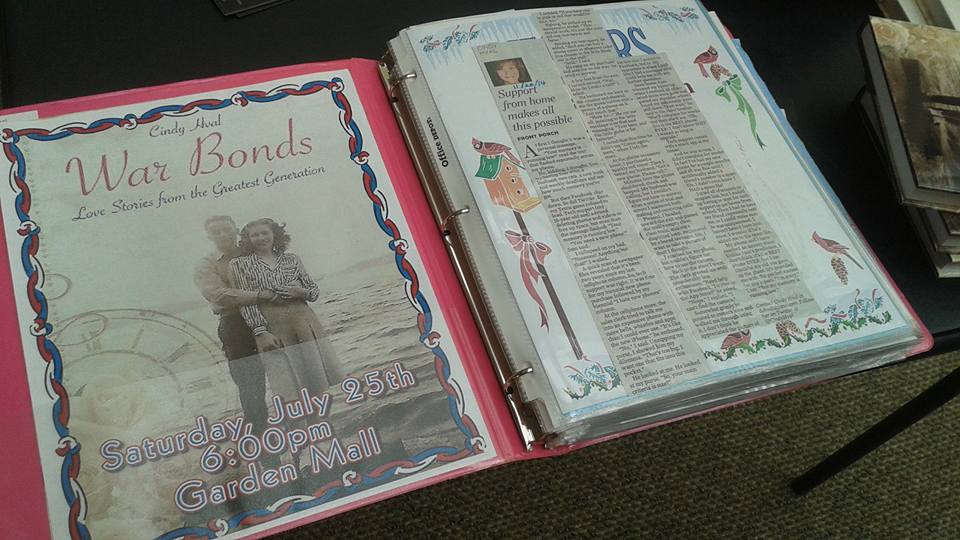
A sweet lady approached me before the event began and said, “I’m wondering if you will sign something for me?”  And she pulled out a bulging scrapbook from her basket.

War Bonds at Fairwood

It was filled with clippings from from my Spokesman Review newspaper column, The Front Porch.

“I’ve been saving them for years,” she said.

So, I blinked back tears and happily signed her scrapbook.

Writers are nothing without readers. To think my columns mattered enough for her to save delighted me. It also made me happy that my next book will be an anthology of those columns. Who knows? Maybe in a few years I’ll be doing another reading at that venue and this time I’ll have my own “scrapbook” of sorts, to sign.

Columns

Saying goodbye to Betty

Today’s Spokeman Review column.

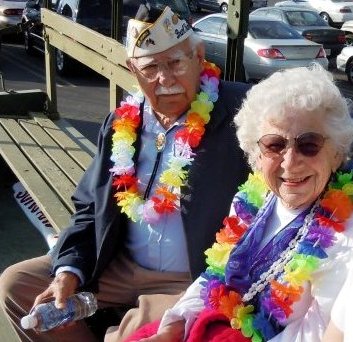
Betty Schott (seated) wears a lei at a ceremony in 2014 to commemorate the 73rd anniversary of the attack on Pearl Harbor.

I loved to listen to her talk.

Though soft-spoken, Betty Schott, 98, had a sharp mind and an even sharper sense of humor. She smiled easily, laughed often, and called me “honey.”

But when her husband of 76 years died in May 2014, her smile faded and the quips didn’t come as quickly.

Adjusting to life without her beloved wearied her.

On Sunday, Betty died, 80 years and one day from the anniversary of her first date with Warren Schott.

I met the Schotts in 2007 when I interviewed them for my Love Story series. It was the start of a friendship that spanned eight years and immeasurably enriched my life.

From the beginning, a no-nonsense Warren assured me their story was no romantic tale. In fact, all those years ago, when a friend offered to set him up on a blind date with Betty, Warren scoffed, “Don’t do me any favors.”

He was a young sailor, not in the least interested in finding true love. But on July 4, 1935, love found him in the form of a beautiful, petite North Central High School graduate named Betty Forest.

They were married April 2, 1938, at the Wee Kirk O’ the Heather chapel at Forest Lawn Cemetery in Los Angeles.

When I attended their 75th anniversary celebration, Betty quipped, “Well, we got married in a cemetery and honeymooned in Death Valley, so we got all that out of the way!”

But as Pearl Harbor survivors, the Schotts saw more than their share of death.

Warren had been sent to the Naval Air Station at Pearl Harbor shortly after their marriage. Betty was determined to join him and worked until she earned her passage. She arrived on Ford Island in 1939 and they settled into a tiny apartment near Battleship Row.

Their bedroom overlooked the island’s runway, so they were accustomed to noise, but the sounds that woke them on Dec. 7, 1941, were unlike any they’d heard before.

Betty pulled on her robe and looked out the bathroom window. “Warren!” she called, “there’s smoke and fire at the end of the runway.”

Warren went to another window and spotted a plane flying low overhead. “I saw the red balls on the wings of the plane,” he said. “I watched that plane torpedo the USS Utah. I said, ‘Betty, we’re at war!’ ”

While Betty filled fire extinguishers with other civilians in a supply warehouse, Warren had the grim job of pulling the dead and injured from the harbor. The men he pulled out of the water were covered in oil. Afterward, Betty discovered, “They got rid of every towel in my house trying to help clean them up. Finally they took down my kitchen curtains and used them.”

Over the years, they talked about everything, but on one topic Warren remained silent. “He never talked about the people he pulled out of the oily water that morning,” Betty said. “Never.”

It was often painful for them to share their memories. “Slamming a door for days after the attack would make you jump,” Betty said, recalling the terrible noise and confusion they experienced.

But the Schotts felt it was their duty to tell their story and to honor those who died that day.

Though they didn’t think their 76-year marriage was anything remarkable, they were tickled that their story was included in “War Bonds: Love Stories From the Greatest Generation.”

When I visited with Betty in December while working on a story about the 73rd anniversary of Pearl Harbor, I returned some photos she’d let me use for the book.

She reached up and patted my cheek with her soft, timeworn hand. “I’m so proud of you, honey,” she said. And it felt like I’d received a blessing from my grandmother.

What I remember most was my last visit to her home – the home Warren had built, the home they’d shared for 65 years.

The plaque I’d seen years earlier still hung in the kitchen. It read, “Happiness is being married to your best friend.”

Warren’s death had left her adrift. She missed him so much, and she swore sometimes she could still see him sitting in his chair. She’d blink or turn her head and he’d be gone, but his presence was so real to her, his voice so compelling. Her own voice quavered when she said, “Every night at 11 p.m., he’d say, ‘Honey, now it’s time to go to bed.’ ”

That’s why I would not be at all surprised if on Sunday morning, Betty heard him whisper, “Honey, now it’s time to come on home.”

And of course she went to him. How could she not? She said, “He’s been my best friend for 77 years.”

Contact Cindy Hval at dchval@juno.com. She is the author of “War Bonds: Love Stories From the Greatest Generation.” Her previous columns are available online at spokesman.com/ columnists. Follow her on Twitter at @CindyHval.

War Bonds

Saying goodbye is the hardest part

When you write a book about WWll veterans who are in their 80’s and 90’s you know your time with them is limited, but it doesn’t make saying goodbye any easier.

Betty Schott died on July 5. She and her husband, Warren, survived Pearl Harbor together and their marriage spanned 76 years.

Betty 2Warren and Betty Schott appearing in the Armed Forces Lilac Parade in Spokane, May 2010.

In this week’s Spokesman Review column I say goodbye to Betty, one of the sweetest, wisest, kindest women I’ve ever known.

Her last words to me were, “I’m so proud of you, honey.”

You can read the column here.  Or here.


Columns, War Bonds

Books and the stores that sell them are in good hands

In today’s Spokesman Review column I write about what I’ve observed in bookstores across the area.

It seems the dirge lamenting the demise of printed books and the stores that sell them was sung a bit too soon.

Last month, the Christian Science Monitor featured an article about the rise of independent bookstores.

“After a precipitous fall, indie bookstores are making a quiet, but sure, comeback,” the correspondent wrote. “In fact, the number of independent bookstores has increased 25 percent since 2009, according to the ABA (American Bookseller Association). What’s more, sales are up, too.”

And the Associated Press reports that e-books sales have leveled off, leaving print books as the most popular medium of choice.

As someone who’s spent a lot of time in bookstores lately, I’ve had an eyewitness view of this phenomenon.

Since the February release of “War Bonds,” I’ve spent many weekends signing copies or doing readings at stores across the region, and what I’ve seen is enough to warm even the most skeptical writer’s heart.

The most wonderful thing I’ve observed is that bookstores seem to be a destination for young families. On a recent Saturday at a Spokane Valley store, scores of kids still dressed in soccer uniforms browsed the shelves with parents in tow.

A miniature Spider-Man clutched a stack of books. He raised his Spidey mask just long enough to ask his mom for “just one more, please, please, please!”

At another venue, a little boy marched up to my table. “Are you a famous author?” he said.

“I don’t know about famous, but I’m an author,” I replied.

He slowly traced my name on the cover and then shouted, “Dad! Dad! I met a famous author and her name is Cindy!”

From my vantage point, I watch the expressions as people enter. Some are focused and frowning. They have a specific purchase in mind and want to dash in and out.

Then there are what I call “my people.” They enter with bemused expressions, with no certain destination in mind. One woman took a deep breath and said, “I love the smell of books!”

These folks wander from shelf to shelf, picking up a book here and there, stroking the covers, reading the flaps. Sometimes they leave with a stack of books, sometimes just one, but they always leave smiling.

As you’d imagine, I get a fair number of questions while parked at a table near the front of a store. The most common one being, “Did you write this?”

At least that’s a question I feel confident answering.

The second most frequently asked question is, “Where’s the bathroom?”

I’ve also been asked what woodworking books I’d recommend and if I have a favorite travel book. Thankfully, there’s usually a sales associate nearby.

Then there was a youngish man who stopped and asked about my book. When I mentioned I write for The Spokesman-Review, his eyes widened and he said, “I was written about in an opinion column, once.”

Intrigued, I asked why he was featured and he launched into his tale of woe.

“See, I was working at the KFC and this old, cranky-looking dude came in. He was like, totally, old and totally cranky and I didn’t want to make him crankier, so I offered him the senior discount. BOY! Did he get MAD! Then the next week, there I was in his column and he’s complaining about the KFC kid offering him a discount. I was like, dude, you’re already old and cranky, take the damn discount!”

I hope that gentleman doesn’t mind being featured in yet another newspaper column.

At one store, a couple stopped to have a book signed. She said the bookstore was part of their date night. “We have dinner and then come here,” she said.

Now, that’s romantic!

But not everyone who enters a bookstore is there for the printed word. Most stores sell gift items, music and movies, too. That explains the conversation I had with a man about my own age.

He stopped and asked about my book. I gave him my spiel. He nodded, smiled and said, “I don’t read.”

Taken aback, I said, “Not even magazines or newspapers?”

“Nah,” he said. “I just don’t like reading.”

But for every nonreader there are others like the little tyke in his Spider-Man costume, clutching a stack of books and begging for just one more.

From what I’ve observed, books and the businesses that sell them are in good hands.

Contact Cindy Hval at dchval@juno.com. She is the author of “War Bonds: Love Stories From the Greatest Generation.” Her previous columns are available online at spokesman.com/ columnists

War Bonds

“She’s the other half of me.”

I would have loved to have included the Tucker’s story in War Bonds but I just met them last week. Stories like theirs are so worth telling.

Colin Mulvany, Spokesman Review photo

During the 1940s and ’50s many lasting love stories began in a roller rink. That’s just what happened to Harold “Tom” Tucker and his bride, Shirley.

“I was a sailor stationed at Farragut,” Tom said. “I got liberty and came into Spokane to roller skate.”

It was spring 1944 and he and other sailors on leave often took a bus to Cook’s Roller Rink (now Pattison’s). Shirley, 17, was a senior at North Central High School. When she skated past, Tom noticed.

“I saw her and I though, WOW! I gotta meet that lady!” he said.

They skated together, but Shirley wasn’t swept off her feet. She shrugged. “He was alright.”

Tom laughed. “She just liked sailors,” he teased.

“Oh stop that!” his wife retorted.

A few weeks later he showed up at Cook’s again and quickly sought her out. This time he asked for her address and phone number. They skated every couples skate together and held hands. “Oh boy! That was fun!” Shirley said.

Her parents weren’t thrilled about her dating a sailor, but they figured the youthful romance would quickly blow over.

It didn’t.

After skating, Tom would walk her home from the bus stop. They’d often pause and sit on a wooden fence that surrounded a sand pit. “That’s where I kissed her for the first time,” said Tom. “The wind came up and blew my hat off. Down it went, into the sand pit. She’s a powerful kisser to blow my hat right off!”

In August, Tom asked her father for Shirley’s hand in marriage. “I was madly in love by then,” she said.

Her father’s response? “Absolutely not! You are both too young.”

Shirley was heartbroken, knowing Tom would soon be sent overseas.

“I cried and cried,” she said. But when Tom shipped out for the South Pacific, she still didn’t have a ring on her finger.

A flurry of letters ensued and when Tom got a 10-day leave he bought her a ring and mailed it to her.

“My folks didn’t say anything that time,” Shirley said. “They could see it was serious.”

Also serious was the trauma that Tom was about to endure. The 19-year-old hospital corpsman was stationed aboard the USS LaGrange and anchored at Buckner Bay near Okinawa.

One night, 13 Japanese twin-engine bombers attacked.

“They hit every ship around us, but didn’t hit us,” said Tom. “We were young. We stood on the fantail and cheered the anti-aircraft fire. We hollered every time they shot down a plane.”

Then on Aug. 13, 1945, two days before the war ended, the LaGrange was attacked by two kamikaze pilots. One plane struck the ship and damaged it before crashing into the water. The other, carrying a bomb, plunged through the ship and the bomb detonated.

“I was in the dental office trying to write a letter to Shirley,” Tom said. “I couldn’t think of anything to say, so I went to the mess hall to watch a movie. Five minutes later, the bomb went right through the dental office. The next morning I found my belongings floating in the water.”

In the following hours, Tom did his best to care for the wounded and dying.

“There was fire on the deck – so many men were badly burned. One guy asked for water. I gave him a sip and held his head while he drank. The back of his head came off in my hand. He died 30 minutes later,” said Tom.

“People really don’t know what these guys went through at 18 and 19,” Shirley said.

The LaGrange suffered the war’s last casualties about a U.S. ship.

The event so shook Tom that he wrote Shirley a letter saying, “Forget about the wedding. We’re not getting married.”

Stunned, Shirley wept bitterly. Her father cautioned her to wait before replying, and she did.

Not long after, another letter arrived apologizing for the earlier missive and asking her to make wedding plans.

On Nov. 11, 1945, while on a 30-day leave, Tom and Shirley were married at Pilgrim Lutheran in Spokane. When his leave was up, Tom returned to duty and the couple spent the first six months of married life apart.

After his discharge in spring 1946, they lived for a time in Spokane before Tom said, “I want to go home.”

Home was Illinois. Initially, Tom had a hard time adjusting to the Pacific Northwest. “I thought I was in prison,” he said. “I couldn’t see because of the big trees and mountains!”

But after a few months in Illinois, he turned to Shirley and said, “Honey, I want to go home.” This time home meant Spokane.

In 1950, Tom joined the Spokane Police Department and was assigned to the motorcycle unit. Shirley gave birth to three children; Douglas in 1947, Ronald in 1949 and Pattie in 1951. She worked for many years at a neighborhood pharmacy.

After 25 years on the force, Tom retired and then took a job as an investigator for the state Department of Revenue. He was also very active in the Masonic Lodge, and in his 60s became an ordained minister, serving for a time as interim pastor of the United Church of Christ in north Spokane.

For 69 years, Tuckers have supported and encouraged each other. “We talk about everything and make all our decisions together,” said Shirley. “He has always been there for me – always.”

Tom looked across the room at the girl he first saw at the roller rink so many years ago and said, “She’s the other half of me.”

Cindy Hval, Spokesman Review, December 11, 2014

Columns

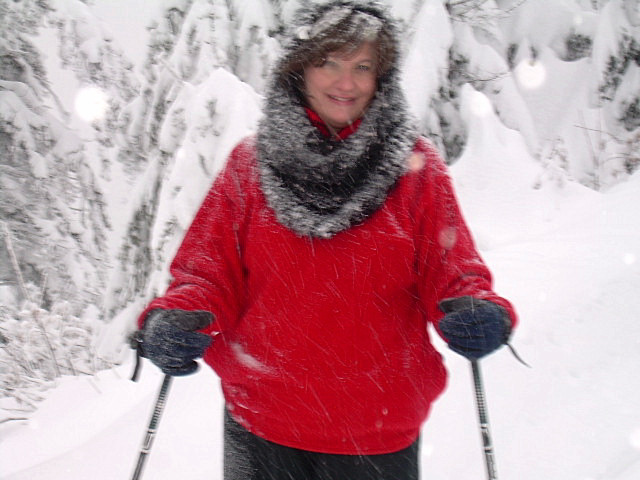
In Which I Attempt Nordic Skiing

When my husband Derek bought me a pair of long underwear, I knew it meant one of two things. Either the thrill was gone from our marriage, or he wanted me to do something I probably didn’t want to do.

The fact that the long johns were black and trimmed with lace offered a glimmer of a hope. Then Derek told me what he had in mind. Snow Queen

“You know honey, Mount Spokane is a very romantic place,” he began. “There’s a rustic lodge with a wood-burning fireplace that’s perfect for a picnic.”

Derek is an avid cross-country skier. No downhill racing with those sissy ski lifts for him. He skis the way his Nordic ancestors have for centuries, climbing steep slopes, then gliding downward on skinny, well-waxed skis.

Every weekend he hits the trails at Mount Spokane. Our sons or his sister and her Norwegian husband usually accompany him.

My spouse is an extroverted, gregarious sort of guy, and if he loves something, he wants everybody to love it – especially me. However, he knows I’m not an outdoors person. I prefer to view snow from the comfort of my sofa with a mug of cocoa in hand.

So he made me an offer I couldn’t refuse.

“I bought cheese,” he said, and wiggled his eyebrows seductively. “Smoked black-pepper white cheddar cheese,” he continued. “And I’ve got salami and gourmet crackers. I’ll make a big thermos of your special fireside coffee. Would you please try cross-country skiing – just once?”

It’s so unfair. I’m a sucker for any meal I don’t have to cook, and Derek is well acquainted with my passion for cheese.

“OK, I’ll try it.”

“Great!” he said. “You’ll love it. It’s just like walking.”

I rarely tackle any project without some kind of research. This is what I found on Wikipedia: “As a sport, cross-country skiing is one of the most difficult endurance sports, as its motions use every major muscle group.”

That didn’t sound like walking to me. Looking for reassurance I asked my sister-in-law for more information. “Well, it’s pretty hard at first,” she said, “but all you really need is rhythm and balance.”

Rhythm and balance? The one time I attempted downhill skiing, I tripped on a chunk of crusty snow in the parking lot at Mount Spokane. I spent the afternoon in the lodge with an ice pack on my ankle. Does this sound like someone who’s gifted with rhythm and balance?

But it was too late to back out. Derek had already procured boots and skis for me and packed the promised picnic. I grimly donned my long underwear.

The drive up the mountain was beautiful, and as the snow softly fell, I began to feel a bit more optimistic about the whole adventure. The lodge was warm, the fireplace inviting, and the indoor plumbing reassuring.

Derek knelt in front of me and slipped my feet into the ski boots. He’s right; I thought as he smiled up at me. This is romantic.

And then we went outside. My misgivings returned in earnest when my first lesson proved to be how to fall. “Always fall to the side,” Derek instructed. “Now, let’s try to glide, OK?”

That’s when the romance began to pale. Those slippery skis slid and skidded under my shaky feet. I struggled mightily to glide, but just when I got the stride right, the trail angled downhill. “Crouch forward, squat down, bend your knees,” my husband encouraged. All to no avail as my skis slid out from under me and I, remembering my instructions, toppled to the side.

I then discovered falling down is very easy. Getting up again is not. I lay in the snow while a pair of toddlers on tiny skis scooted past me. “OK, honey, get your skis parallel to your body,” Derek urged. I thrashed about while a couple of octogenarians sailed by.

Finally, upright again, I eyed the trail ahead with suspicion. “Are there any more little hills you want me to know about?” I asked.

Ideally, cross-country skiing is great aerobic exercise. However, the best I could manage was a slow shuffle, like Tim Conway’s old-man character on the “Carol Burnett Show.” The only time my heart rate surged was when I found myself swooping downhill, tottering precariously on those skinny skis.

Soon the drifting flakes began to fall faster, shrouding us in a feathery white blanket. Snow-laden trees surrounded us, enveloping us in a winter hush. And later, at the lodge, the cheese was delicious.

Looking into Derek’s twinkling blue eyes as he unlaced my boots, I made a discovery. The greatest thrill can come from pushing the edges of your comfort zone aside, and seeing the delight it brings to someone you love.

Thrills like that can keep you warm, even when wet snow seeps into your long johns.

This column first appeared in the Spokesman Review.


War Bonds

Fundraiser for WWII vet who died destitute

This story from the Huckleberries Online newspaper blog broke my heart. That one of our heroes should die alone and destitute seems unthinkable. Bless the generous donor who paid for his fune

A brave combat veteran of the storied 10th Mountain Division who recently died destitute will be honored with a “Beer and Brats” fundraiser on November 2, 2014 at St. John the Baptist Orthodox Church in Post Falls. Jim Ayers, who served in the 10th Mountain Division during World War II as the United States Army fought its way across Italy, recently died destitute and without any surviving family members and his funeral costs were paid by a generous anonymous donor. St. John the Baptist Orthodox Church is holding a memorial “Beer and Brats” fundraiser to reimburse this donor for those costs/Jennifer Dancy, of St. John the Baptist Orthodox Church, Post Falls. More here.

This fundraiser will be held on Sunday Nov. 2nd from 1-3 PM at St John the Baptist Orthodox Church in Post Falls located at 4718 E. Horsehaven Avenue. Visit http://www.stjohnorthodox.org/directions.html for directions.