War Bonds

Long before e-mail, there was V-Mail

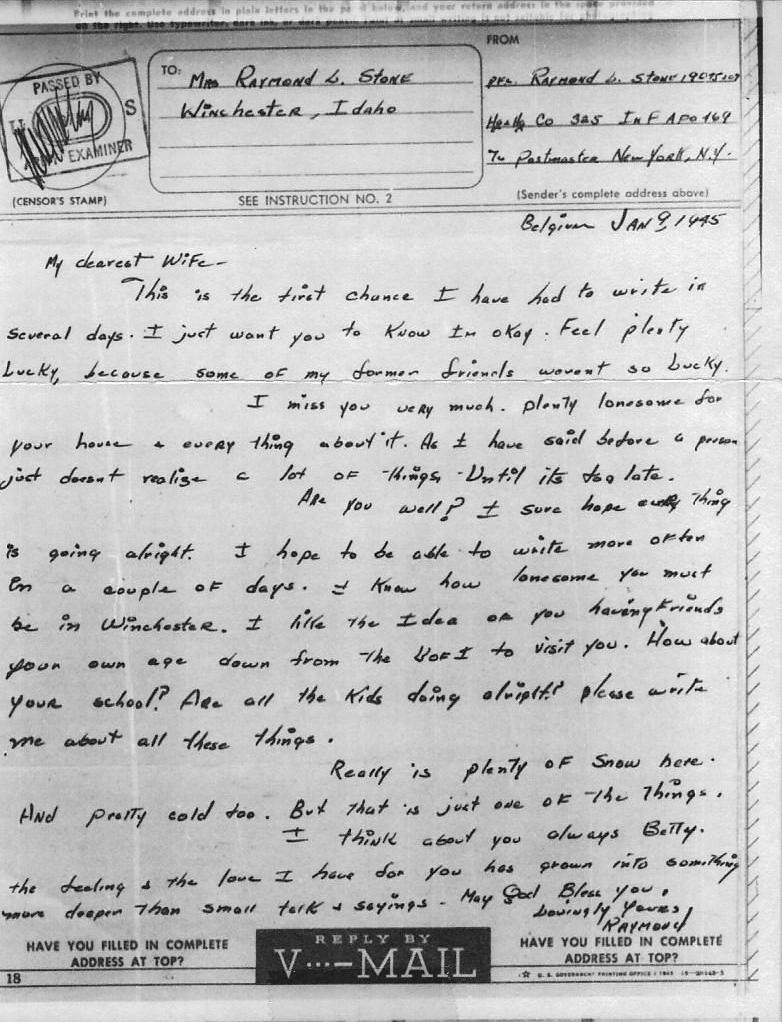
V-Mail from Ray, low resDuring WWII V-Mail (Victory Mail) was the primary way servicemen were able to communicate with their loved ones back home.
In this note, Ray Stone writes to his wife “I think about you always Betty. The feeling and the love I have for you has grown into something much deeper than small talk & sayings.”
He wrote this from Belgium during the Battle of the Bulge.

The horrors of war became most apparent to the young paratrooper when  he and his company liberated Camp Wobbelin in Germany. They found 1,000 dead– mostly Jews and another 3,000 dying prisoners in the compound.

Stone went on to become a lifelong educator, eventually serving as mayor of Coeur d’Alene, Idaho and received the Raoul Wallenburg Award, as well as the Eisenhower Liberation Medal.

Ray and Betty Stone’s story is featured in a chapter titled, “Fireworks.”


War Bonds

Every Two Minutes a Memory Disappears

According to the National WWII Museum, approximately every two minutes a memory of World War II – its sights and sounds, its terrors and triumphs – disappears.

That’s because our WWII vets are dying at a rate of 555 a day. By 2036, it is estimated there will be no living veterans of World War II left to recount their experiences.
I am so grateful to have been able to meet and interview so many of these amazing veterans. Their stories are important and deserve to be shared.

War Bonds

Fundraiser for WWII vet who died destitute

This story from the Huckleberries Online newspaper blog broke my heart. That one of our heroes should die alone and destitute seems unthinkable. Bless the generous donor who paid for his fune

A brave combat veteran of the storied 10th Mountain Division who recently died destitute will be honored with a “Beer and Brats” fundraiser on November 2, 2014 at St. John the Baptist Orthodox Church in Post Falls. Jim Ayers, who served in the 10th Mountain Division during World War II as the United States Army fought its way across Italy, recently died destitute and without any surviving family members and his funeral costs were paid by a generous anonymous donor. St. John the Baptist Orthodox Church is holding a memorial “Beer and Brats” fundraiser to reimburse this donor for those costs/Jennifer Dancy, of St. John the Baptist Orthodox Church, Post Falls. More here.

This fundraiser will be held on Sunday Nov. 2nd from 1-3 PM at St John the Baptist Orthodox Church in Post Falls located at 4718 E. Horsehaven Avenue. Visit http://www.stjohnorthodox.org/directions.html for directions.


War Bonds

Rest in peace Harvey Shaw

Harvey Shaw at the wheel, low res

Harvey Shaw at the wheel of the USS Kwajalein, 1944

Just received word that this handsome sailor died October 7. Harvey Shaw was a kind and gentle man who dropped out of high school during WWII and enlisted in the US Navey because he liked to swim!

He was proud to have served his country, but even prouder of his 64-year marriage to his wife, Bonnie and of their six children.

Rest in peace, Harvey. Thank you for your service and for sharing your story with me.

War Bonds

War Bonds veteran is in Washington DC today

Rusty, low res, Bougainville, 1944This handsome solidier is In Washington DC today visiting the World War ll Memorial, courtesy of Inland Northwest Honor Flight. Rusty Clemons was stationed on Bougainville Island during the war.The story of he and his bride, Marie, is featured in War Bonds in a chapter titled “Dishpan Hands.”

War Bonds

Patriotism on Parade

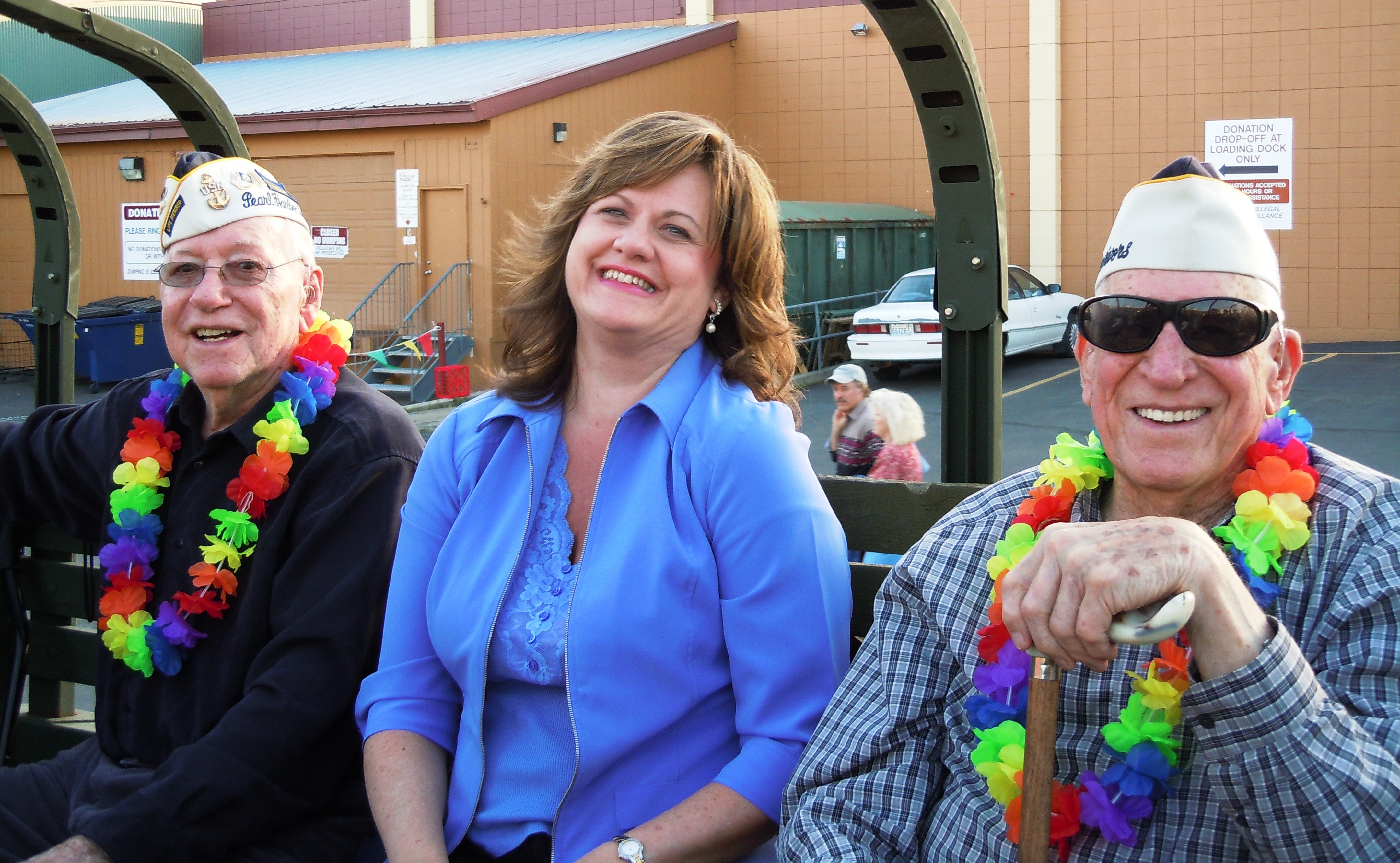
In 2010, I accompanied a group of Pearl Harbor Survivors during an annual Armed Forces parade in my hometown. The reaction of the crowd to this small group of heros showed me just how much Americans value the men and women who served our country during WWII and solidified my desire to write War Bonds.

Here’s the column I wrote about that event. Ray, Cindy and DenisRay Daves, Cindy Hval and Denis Mikkelsen

When I received an invitation to appear in this year’s Armed Forces Torchlight Parade, I had mixed feelings. My only previous parade experience hadn’t gone well.

In seventh grade I rode on our church youth group’s float in Moses Lake. The theme? Daniel in the Lion’s Den. I had a major crush on the guy chosen to be Daniel, so I agreed to ride on the float. I pictured myself as one of the angels sent by God to shut the lions’ mouths. Instead, they made me a lion, complete with furry suit and painted-on whiskers. My mane was made of cardboard, and I kept poking my fellow feline’s eyes with every turn of my head.

Did you know Moses Lake gets very warm in the spring? I sizzled and sweated through the parade and my black whiskers ran like polluted rain down my cheeks. Then I started sneezing. The “den” was made out of hay bales, those being plentiful in Moses Lake. That’s how I found out I’m allergic to hay. By the end of the parade my eyes were swollen shut, and “Daniel” hadn’t even noticed me growling at his feet.

However, the Torchlight parade would be different. The theme was “Freedom is not Free,” and instead of a float made of hay bales I’d been ask to accompany the Pearl Harbor survivors on a military truck. I’ve written several stories about these incredible folks over the years, and they’ve kind of adopted me. I was so honored by the invitation, I would have said yes even if they wanted me to wear a lion costume.

So on parade day, I boarded the truck with five Pearl Harbor survivors ranging in age from 86 to 93. Among them: Warren and Betty Schott, who were both on Ford Island when the bombs began to fall.

Denis Mikkelsen who was sleeping aboard the USS West Virginia and woke to the sound of chaos. When the order came to abandon ship he dived into the harbor.

Sid Kennedy at the Naval Air Station Kaneohe, watched the planes swoop in. “Look at the show the Army’s putting on,” he’d said. Then he saw the red circles on the aircrafts’ wings.

And Ray Daves was on his way to breakfast when he looked up to see the first bomb hit Ford Island. He prayed, “God, don’t let it get my friend, Jim.”

The memories of Dec. 7, 1941, are seared into the minds of this small band of survivors. Each year their number dwindles, yet those who are able agree to appear in the parade, not for cheers or accolades, but to honor the thousands of Americans who did not survive the attack on Pearl Harbor.

Joining us on the truck were the survivor’s family escorts and Jean Flechel, widow of a Pearl Harbor survivor. The sun warmed us as we waited for the start of the parade and at last we began our slow trek through city streets.

Much has been said and written about the decline of patriotism in America and how younger generations don’t seem to honor the flag and our country the way our forebears did.

This may be true, but it certainly wasn’t what I observed that night. Almost without exception men, women and children leapt to their feet as our truck went by. Teenage boys took off their ball caps, men saluted or put their hands over their hearts and the applause was deafening. Amid the clapping I heard shouts of, “God bless you!” and “We love you,” but mostly what I heard were these words shouted over and over again: “Thank you! Thank you for your service.”

I heard teenage girls scream as if Justin Bieber was in town. I watched grown men weep and small children wave and clap while others stood somberly at attention as the truck passed.

Some may believe our country has lost its way and its citizens no longer value the tenets upon which our nation was built. But what I experienced in the company of American heroes that night, filled me with hope.

Maybe we haven’t forgotten what is most important, after all.

Columns, War Bonds

Column: Grateful to have told WWII veteran’s story

The fading late afternoon sun, blurred by the haze of wildfires, fell softly across the foot of his bed. A smoke-tinged breeze wafted through the open French doors.

His once-commanding frame seemed frail against the stark whiteness of crisp sheets and rumpled pillows. I stood quietly beside him, a writer at a loss for words.

Nick Gaynos was dying.

The World War II veteran and Pearl Harbor survivor had endured many things, but the loss of his beloved wife, Tex, was proving too much for his heart to bear. After more than 70 years with her, he doesn’t want to be here without her.

I met Nick and Tex in 2010 when I shared their Love Story with newspaper readers. His regal military bearing and her gorgeous red hair and sense of style made them one of the most elegant couples I’ve interviewed.

They laughed and bantered throughout the afternoon, recalling how they met in the Bamboo Room of the Hotel Californian in Fresno. Nick spotted Tex through some bamboo fronds and was immediately smitten. He told his friend, “See that redhead? I’m going to marry her!” His buddy replied, “No way!” Gaynos said, “I’ll bet ya $10.”

Six weeks later he collected that $10 as he walked down the aisle to marry Tex.

His smile faded when he recalled the horror of the attack on Pearl Harbor. The young private was in charge of air/ground communications at Hickam Air Field on Dec. 7, 1941.

He was asleep in his bunk when the earsplitting scream of airplane engines and the rat-a-tat sound of bullets strafing the barracks woke him. Grabbing his pants, he scrambled out the door.

As he ran down the beach back toward his duty station, a Japanese Zero strafed the sand around him. He hit the ground and covered his head. Gaynos said he felt a hot breeze and heard a whistling sound inches from his ears. He looked up and saw the face of the pilot as he flew alongside him. The pilot grinned.

When Gaynos got up he discovered a large piece of shrapnel next to him. “I grabbed it,” he said. “It was still hot from the explosion.”

After Pearl Harbor he was sent to Officer Candidate School and quickly moved up through the ranks. He married Tex in 1943 and enjoyed a long military career followed by a successful second career in real estate.

On a recent day, I came to tell him that their story will be included in a book I’m working on and to collect photos for the project. His daughter warned me that his health was fading and he wasn’t expected to live much longer.

His caregiver greeted me at the door and Gaynos opened his eyes briefly when I entered the room, then he sighed and turned away.

I sorted through the photos, selecting the ones I needed, and when his caregiver went to photocopy them, I approached his bed.

“Nick,” I said.

His eyes fluttered and he slowly raised his hand. I took it and he wrapped his fingers around mine. His eyes fell shut, but his grip on my hand was firm.

I told how I admired Tex, and how much I appreciated that after talking about the awfulness of war, we were able to laugh together at the silly jokes and stories they shared.

“I’ve never forgotten that you told me that a sense of humor is vital to a marriage,” I said. “Thank you, Nick. Thank you for serving your country, for loving your wife, for sharing your memories with me.”

He sighed and released my fingers.

I heard his caregiver returning to the room, so I bent down and kissed his brow – taking a liberty I’m sure Tex wouldn’t mind.

According to recent statistics, World War II veterans are dying at a rate of 555 a day. Time is running out to tell their stories. But in this case, not only did I get to share this hero’s story, I also got to say goodbye.

As I drove away, my eyes blurred and the tears that had threatened all afternoon fell.

The tears weren’t of grief, but of gratitude.

This column originally appeared July 31, 2014 in the Spokesman-Review.